The Meat Case, Front to Back: A Home Cook’s Map of Every Type
The main types of meat, from red meat and poultry to game, pork, and deli cuts, with what separates them and how to pick the right one for dinner.
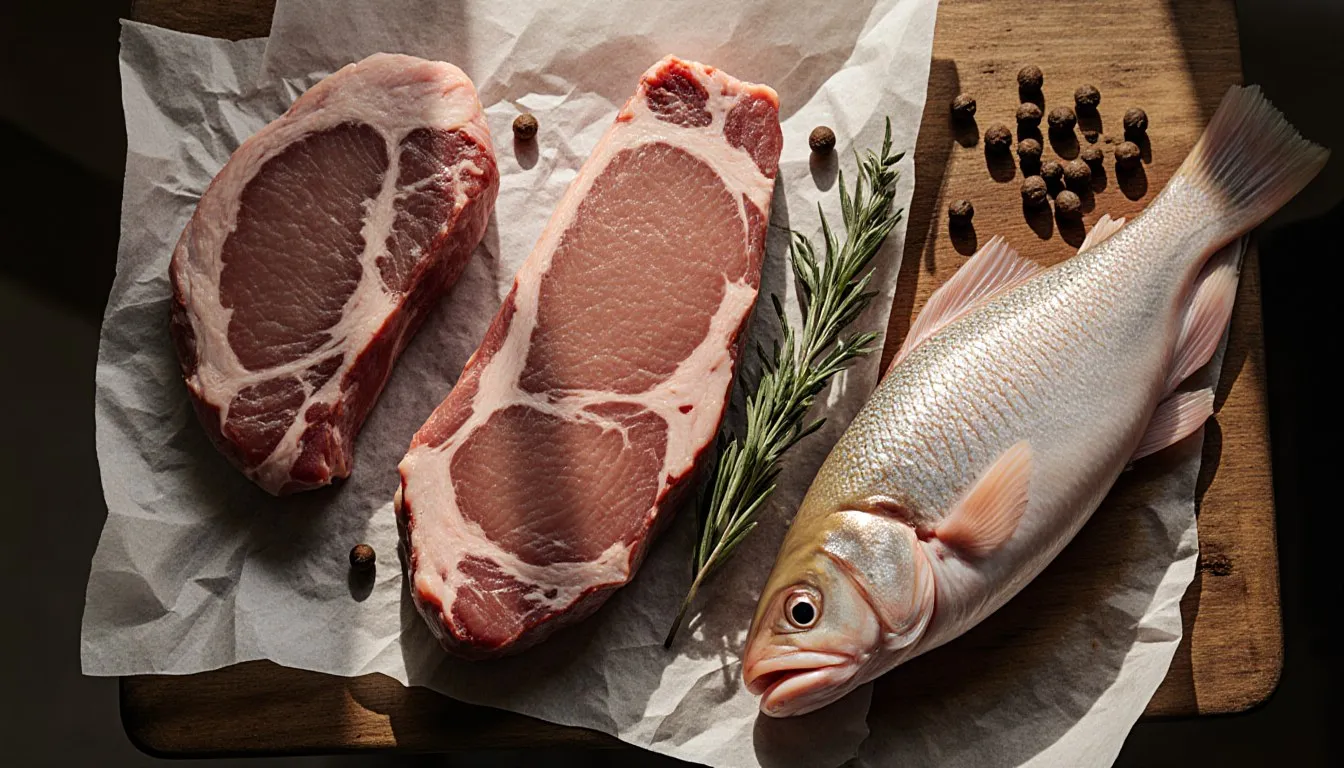
Nearly every type of meat you will ever buy falls into five groups: red meat, poultry, pork, game and specialty meats, and cured or processed meats. That’s the whole map. The butcher case looks like a hundred separate decisions because it’s arranged by what sells fastest and what needs the coldest shelf, not by any logic that helps you cook, and once you can see the five groups underneath the arrangement, the whole case reads like a menu you already know how to order from.
What follows is that walk, front to back, the way I’d do it with you standing next to me. Think of it as a map of the case. By the end you’ll know what separates red meat from white, where the bison and the rabbit fit, why the deli counter is playing an entirely different game from the fresh case, and how to pick a type of meat for a Tuesday without standing there second-guessing yourself while the ice cream melts in your cart.
What Are You Looking At in the Meat Case?
Start at the left end of the case, where the beef usually is, and walk right. In most American markets you’ll pass through roughly the same sequence: beef in deep red trays, then pork in paler pink, then chicken and turkey in the coldest stretch near the back, then a small cooler or a freezer bay with the specialty items, then the deli counter with its glass front and its stacks of pink and burgundy slabs. That sequence is built around turnover and temperature, the fastest sellers up front and the coldest shelf toward the back, and it happens to walk you through the five main categories in order.
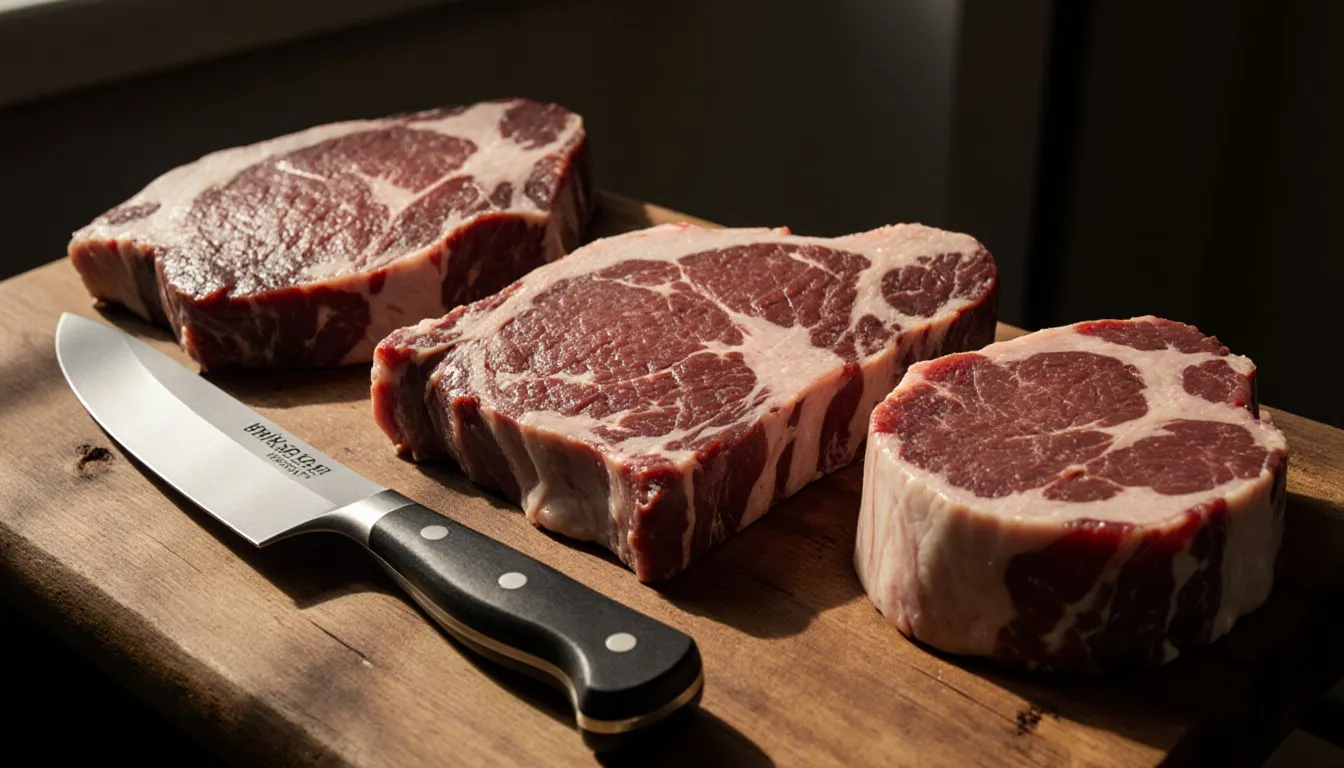
Red meat is beef, lamb, veal, and goat: the muscle of mammals raised for the table, dark in the raw state and beefy or grassy in flavor. This is where you find steaks, roasts, ribs, ground beef, lamb chops, and the tough braising cuts that repay a long afternoon.
Poultry is domesticated birds: chicken, turkey, duck, goose, guinea hen, and the occasional quail or squab in a fancier market. Mild, quick-cooking, and the most forgiving entry point in the whole case if you’re just learning to cook.
Pork gets its own group, and I’ll defend that in a minute. It’s mammal meat, so by the technical definition it belongs with the red meats, but it cooks, tastes, and gets sold like something in between.
Game and specialty meats covers venison, bison, elk, rabbit, duck if it’s wild rather than farmed, and the further reaches: goat in a market with a good halal or Caribbean trade, alligator in the Gulf South, ostrich if somebody’s farming it near you. Leaner, more assertive in flavor, usually sold frozen.
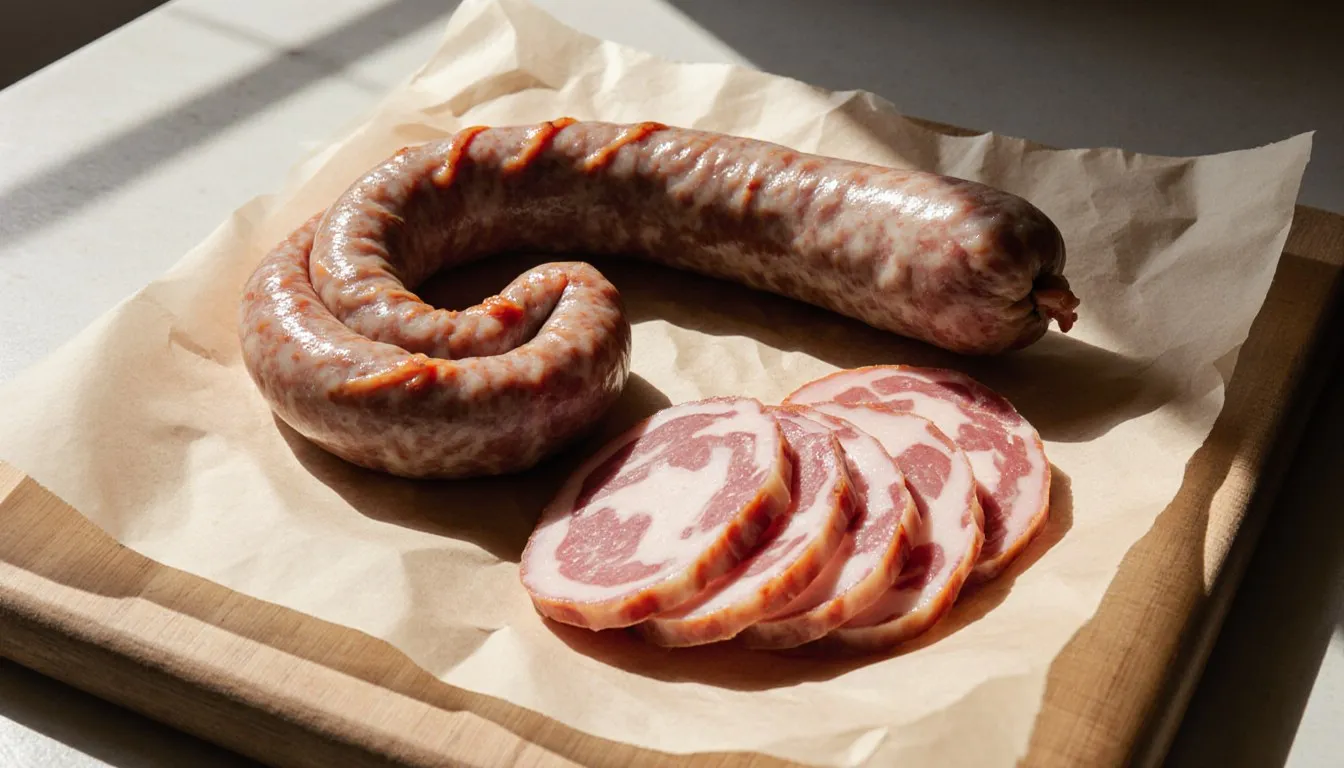
Cured, smoked, and processed meats are the deli counter and the packaged aisle: bacon, ham, salami, prosciutto, hot dogs, fresh and dried sausages, corned beef, pastrami. Fresh meat that’s been transformed by salt, smoke, time, or grinding into something with its own rules.
Fish and shellfish are their own world, sold at their own counter, and I’m leaving them there. Most kitchens treat seafood as a separate category and most cooks do too, which is honest, because almost nothing you learn about a chuck roast transfers to a fillet of sole.
One more thing you’ll see on labels as you walk: conventional, organic, grass-fed, pasture-raised, natural. Those describe how the animal was raised and fed, not what type of meat it is. Grass-fed beef is still beef. It’s leaner and it tastes a little more mineral and grassy than grain-finished beef, and it wants slightly gentler heat because there’s less fat buffering it, but it lives in the red meat group with everything else. “Natural,” for what it’s worth, is close to meaningless on a meat package. It only promises minimal processing and no artificial ingredients, and it says nothing at all about how the animal was raised or fed.
What Really Separates Red Meat From White Meat?
Myoglobin. That’s the answer, and it’s the only one that holds up. Myoglobin is the protein that ferries oxygen into muscle cells, it’s reddish, and the more of it a muscle has, the redder the meat looks raw and the deeper it tastes cooked.
Which muscles have a lot of it? The ones that work all day. A cow walks, stands, and carries considerable weight around on the same four legs for years, so its muscle is dense with myoglobin from end to end. That’s why beef is red everywhere, from the tenderloin to the shank. Lamb, goat, and veal follow the same logic, though veal is paler because a calf simply hasn’t put in the miles yet.
Birds are where it gets visible on the plate. A chicken spends its life standing and walking but not flying, so the leg and thigh are worked muscles, darker and richer, while the breast is a sprint muscle it uses for a startled three-second flap and nothing else. Pale, lean, and quick to dry out. Cut open a duck and you get the opposite picture, because a duck actually flies: the breast is dark, dense, and closer to a steak than to a chicken cutlet in both looks and handling. Same category, completely different bird.
So the honest version of the rule is that “red” and “white” describe myoglobin content, which tracks how hard the muscle worked, which is why the line runs through individual birds and not just between species.
Why pork sits in the gray zone
Pork is mammal meat. Nutritionally and in the standard scientific classification it counts as red meat, and I say that plainly because it’s true. But walk up to a pork loin in the case and it’s pink, almost blond in places, and it cooks up pale and mild in a way that has nothing in common with a ribeye.
Two things drive that. Modern pigs are bred and raised to be considerably leaner than the hogs of a century ago, and pork muscle carries less myoglobin than beef to begin with. Add to that the pork shoulder, which is a hardworking muscle and genuinely darker and richer than the loin, and you get one animal spanning most of the color range by itself.
The “other white meat” line came from a pork industry marketing campaign in the 1980s, and it worked so well that people still repeat it as a fact about biology. It was a positioning claim aimed at shoppers who were buying more chicken, and it left behind a permanent muddle in a category that was already ambiguous. My own rule in the kitchen: file pork with the red meats when you’re talking about what it is, and cook it like white meat when you’re standing at the stove. Lean pork dries out on you exactly the way a chicken breast does, so the loin and the tenderloin want a thermometer and a short rest, while the shoulder wants hours.
How Is Each Type of Meat Broken Down Into Cuts?
Every carcass gets divided first into a handful of big sections called primal cuts, and everything in the case comes out of one of them. On beef those are the chuck, rib, loin, round, brisket, plate, flank, and shank. Pork has its own set: shoulder, loin, belly, ham, and the picnic. Lamb divides into shoulder, rack, loin, and leg. Poultry doesn’t get primals at all; a bird is small enough that it just gets broken into parts, breast, thigh, drumstick, wing, back.
Those sections matter because of what the muscle inside them did for a living. The animal’s midsection along the spine barely works, so the rib and the loin give you the tender, expensive, fast-cooking cuts: ribeye, strip, tenderloin, pork chops, rack of lamb. The shoulder and the leg are the working end, so they arrive threaded with connective tissue and they turn to leather over high heat. Give the same shoulder three hours of low moist heat and that connective tissue melts into gelatin, and you get pot roast, pulled pork, birria, ragù. Collagen is the whole variable, and the method has to be the one that melts it.
Here’s what I want you to carry out of the store, because it’s the single most useful thing in this whole section: tender cuts want fast, dry heat, and tough cuts want slow, wet heat. Sear, grill, roast hot, broil for the first group. Braise, stew, smoke, slow-cook for the second. Easy peasy, and it’s most of what separates a good dinner from a chewy one. Nearly every meat disaster I’ve watched happen in a home kitchen was somebody applying the first method to the second kind of cut, usually a beautiful chuck steak grilled to the texture of a work glove.
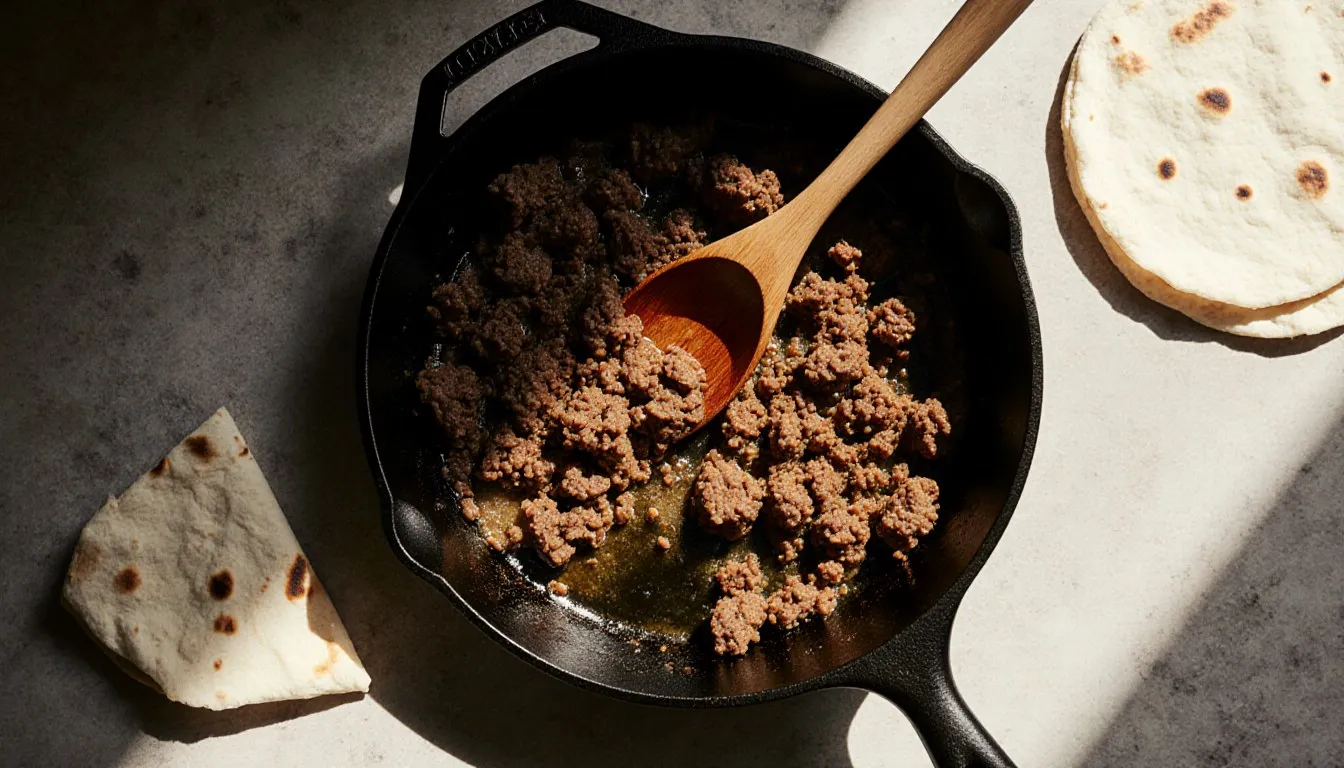
Grinding cuts across all of it. Ground beef, ground pork, ground turkey, ground lamb, ground venison, these come from trim and from the tougher primals, mechanically broken down so you don’t have to wait three hours for the connective tissue to give up. That’s why ground meat cooks fast regardless of which part of the animal it started as.
If you want the full picture of which beef cut comes from where, and what each one is good for, the guide to beef cuts lays out the whole animal so you can shop with real confidence.
Where Do Game and Specialty Meats Fit In?
Game meat means the animal was hunted rather than raised, and “specialty” is the practical catch-all for everything a mainstream case doesn’t stock: farmed venison, bison, elk, rabbit, goat, alligator, ostrich, wild boar. The line between the two blurred years ago. Almost all the venison and bison you can legally buy in a store is farm-raised, because in the United States wild-taken game generally can’t be sold commercially, only shared. If a friend hands you a package of venison, it came from a hunt. If you bought it, an animal was raised for it.
What unites the category is leanness. A wild or semi-wild animal moves constantly and doesn’t get finished on grain, so it carries far less intramuscular fat than a feedlot steer. Venison and elk are noticeably lean. Rabbit is leaner still, closer to a very firm chicken. Bison sits closest to beef of the bunch, which is why it’s the easy on-ramp: it grinds into burgers, roasts, and steaks that behave a lot like beef, just faster.
Leanness is the whole cooking problem in one word. There’s no fat cushion, so the window between right and ruined is narrower than you’re used to. Two habits fix most of it: pull it earlier than instinct says, and give it moisture from outside, a bard of bacon over a venison roast, a brine, a braise, a sauce with some body to it. The old hunters’ trick of larding a lean roast with strips of pork fat has been standard practice for generations for exactly this reason.
And the “gamy” thing gets overblown. Most of what people call gamy traces back to how the animal was handled after the kill, how fast it was cooled and cleaned, rather than the species. Well-handled venison tastes like clean, dark, faintly nutty beef. I’ve served it to people who spent the whole meal deciding they didn’t like game and then asked for the recipe.
Goat deserves a specific mention because Americans treat it as exotic and much of the world does not. It’s one of the most widely eaten meats on the planet, lean, a little sweet, and outstanding in a curry or a long braise. If you have a halal butcher, a Caribbean grocer, or a Mexican carnicería nearby, it’s likely already in the case and cheaper than you’d expect.
These meats each have their own quirks, and a closer look at game and specialty meats covers the individual animals in more depth than a survey like this can.
What Counts as a Processed or Deli Meat?
Anything that’s been salted, cured, smoked, fermented, dried, or ground and reformed into something shelf-stable or ready to eat. The deli counter holds the same animals after salt, smoke, and time have had their way with them, and that transformation changes everything about how you buy, store, and use them.
Curing is the foundation. Salt pulls water out of the muscle and makes it inhospitable to spoilage bacteria, which is how humans kept meat through winters for thousands of years before refrigeration. Most commercial cures also include nitrite, usually as pink curing salt or as celery powder in “uncured” products, which fixes that stable pink color, contributes the distinctive tangy cured flavor, and guards against the bacterium that causes botulism. Worth knowing: a package labeled “uncured” is almost always still cured, just with a naturally sourced nitrite instead of a synthesized one. The label is a regulatory technicality about the nitrite’s source.
The useful sorting inside this group is by what still needs cooking:
- Fresh sausages: ground meat plus salt and seasoning, no cure, no smoke. Italian sausage, breakfast links, fresh chorizo, bratwurst. Raw meat in a different shape, handle it and cook it like raw meat.
- Cooked or smoked, ready to eat: hot dogs, bologna, most ham, kielbasa, mortadella. Already fully cooked; you’re only heating them for flavor and texture.
- Dry-cured, never cooked: prosciutto, salami, soppressata, coppa, bresaola. Preserved by salt and months of controlled drying rather than heat. This is why you can eat prosciutto straight off the slicer with a fig and not think twice.
- Cured but requiring cooking: bacon, pancetta in most uses, raw country ham. Cured, sometimes smoked, still needs to hit the pan.
Two food-safety notes that belong here rather than buried further down. Deli meat sliced fresh at the counter has a short life; use it within about three to five days once it’s home in the fridge. And ready-to-eat deli meats carry a listeria risk that the CDC takes seriously enough to recommend that pregnant people, older adults, and anyone immunocompromised heat lunch meat until steaming hot, meaning 165°F (74°C), before eating it. That one’s non-negotiable in my kitchen when I’m cooking for somebody in those groups.
My honest stance on this whole category: it’s food, it’s delicious, and I keep bacon in my fridge without a shred of guilt. What I’ll say as a cook is that a small amount of cured meat is one of the most useful ingredients you can own, because it carries salt, fat, and smoke into a dish all at once. Two ounces of pancetta turns a pot of beans into dinner. Curious what actually separates a Genoa salami from a hot dog? The sausages and deli meats guide gets into the individual ones.
Does the Type of Meat Change How You Should Cook It?
It changes almost everything, and the fastest way to see why is to line up three pieces of meat and ask what each one is afraid of.
Poultry is afraid of drying out. Lean white breast meat goes from juicy to chalky in the space of a few degrees, while dark thigh and leg meat has more fat and connective tissue and stays forgiving well past the safe temperature. That’s why cooking a whole bird is a balancing act and why the smartest home cooks stopped fighting it: cook thighs and breasts separately, or shield the breast, or spatchcock the bird so it all finishes together. Thighs also happen to be the cheapest, most flavorful, hardest-to-ruin thing in the poultry section, which is a rare combination.
Pork is afraid of the reputation it used to have. Two generations of American cooks were taught to cook pork until it was gray and squeaky, because of a trichinosis risk that modern pork production has all but eliminated. The USDA lowered its recommendation for whole cuts of pork years ago, and a pork chop cooked to the current standard and rested is faintly pink at the center, juicy, and completely safe. If you remember pork chops as dry, you’re remembering them cooked to the old 160°F target; take them to 145°F (63°C), rest them three minutes, and they come off the pan a different piece of meat. Ground pork and bulk pork sausage are the exception and still need the higher ground-meat temperature of 160°F (71°C). A fresh, uncooked ham is a whole cut and goes to 145°F (63°C) with a three-minute rest, same as a chop.
Beef is afraid of the wrong method. A whole muscle cut of beef is safe at a range of doneness levels, which is why steak is a matter of preference in a way chicken never is. The risk on an intact steak sits on the surface, and searing handles it. Ground beef is a different animal in the food-safety sense, because grinding takes anything on the outside and distributes it throughout, which is exactly why burgers get a higher required temperature than steak.
Lamb and goat behave like beef for these purposes: whole cuts are a preference call, ground is not. Game follows the same rules with a narrower margin because of the leanness.
The other thing your type of meat decides is which tool you reach for. Fast dry heat for tender cuts and lean birds, meaning a hot skillet, a grill, a broiler, a hot oven. Slow moist heat for the tough, collagen-rich cuts: a Dutch oven, a slow cooker, a smoker running low for hours. Smoking is really slow-cooking with flavor attached, which is why the cuts that famously get smoked, brisket, pork shoulder, ribs, are exactly the ones that need the long haul anyway.
Each of these has more to it than one section can carry. The guides to how to cook chicken, how to cook pork, and how to cook steak go deep on their respective animals, and grilling and smoking meat is where the low-and-slow methods get their proper treatment.
What Temperature Keeps Each Type of Meat Safe to Eat?
Here are the numbers, stated at the conservative USDA standard, and these are the one place in this entire article where I won’t give you wiggle room. Buy an instant-read thermometer. Poke the thickest part, away from bone. Everything else in cooking is judgment; this part is arithmetic.
- Poultry, all of it: 165°F (74°C). Chicken, turkey, duck, goose, whole birds and parts, ground poultry, and anything stuffed. No resting time required.
- Ground meats (beef, pork, veal, lamb): 160°F (71°C). This covers burgers, meatloaf, meatballs, and bulk sausage. Ground poultry goes to 165°F (74°C) with the rest of the poultry.
- Whole cuts of beef, pork, veal, and lamb: 145°F (63°C), followed by a three-minute rest before carving or eating. Steaks, chops, roasts. The rest is part of the standard, not a serving suggestion; the temperature keeps climbing during it.
- Ham, fresh or uncooked: 145°F (63°C) with a three-minute rest. Fully cooked ham being reheated: 165°F (74°C), or 140°F (60°C) if it was packaged in a USDA-inspected plant.
- Leftovers and casseroles: 165°F (74°C), reheated through.
A few practical notes on top of the numbers. The USDA standard for whole cuts of beef and lamb is 145°F (63°C) with a three-minute rest, and that’s the number I’ll give you. Cooks and restaurants have long served intact steaks rarer than that, and if you go that route you’re stepping outside the published guidance, which is your call to make knowingly rather than by accident. Ground meat gets no such allowance, ever. And a whole bird is done when the thickest part of the thigh reads 165°F, not when the pop-up timer decides; those things run late and I’ve never trusted one.
Two more that live outside the thermometer. Meat should not sit out for more than two hours at room temperature, and only one hour if it’s above 90°F, so a package that rode home in a hot car deserves a hard look. And thaw in the refrigerator, in cold water changed every thirty minutes, or in the microwave if you’re cooking it immediately, and those three are the only methods on the approved list. Not on the counter. My mother thawed chicken on the counter all through my childhood and we all lived, and I still don’t do it, because the outside of that bird spends hours in the temperature range where bacteria are having the time of their lives while the middle is still a brick.
How Do You Choose the Right Type of Meat for a Given Meal?
Work backwards from three things: how much attention you have tonight, how many people you’re feeding, and what the meal is supposed to feel like. Type of meat falls out of those answers almost automatically.
Start with your attention budget. Twenty minutes of active cooking and no more? You want something tender and fast: chicken thighs, a pork chop, ground beef, a quick steak, shrimp if you’re at the seafood counter. Two hours where you’re home anyway, doing laundry, half-watching something? Now the tough cuts are your friends, chuck, shoulder, shank, brisket, and they’re the cheaper ones too. Braises are the ultimate low-attention cooking. Twenty minutes of work up front, then the oven does the rest and the house smells like you tried.
Then check the headcount. Feeding two, buy exactly what you’ll eat and pick the tender fast cuts without much thought. Feeding six or more, a single large roast, a whole bird, a pork shoulder, or a big pot of something braised is less work and less money than six individual portions. This is where whole cuts earn their keep. One pork shoulder feeds a crowd on Saturday and becomes tacos, sandwiches, and a pot of beans through Wednesday.
Then think about the mood. Meat is emotionally coded whether we admit it or not. A whole roasted bird says holiday and family, even in March. Steak says occasion. A stew says weather and comfort. Sausage and peppers says nobody has to behave at this table. Matching the type to the feeling matters more than most people give it credit for, and it makes the cooking easier because you’re not fighting the dish’s natural personality.
Budget, without me pretending to know your grocery store. Prices swing by region, season, and week, so instead of numbers, here’s what reliably moves them. Tender cuts from the loin and rib cost more per pound than the shoulder and leg, always, because there’s less of them per animal. Bone-in costs less per pound than boneless but you’re paying for weight you won’t eat, so it evens out closer than the sticker suggests, and the bone adds flavor and helps things stay juicy. Whole birds cost less per pound than parts. Chicken thighs cost less than breasts and taste better. Ground beef gets cheaper as the fat percentage goes up, and for burgers, higher fat is what you want anyway. Game and specialty meats run higher because the production scale is smaller. And the tough, slow-cooking cuts, the ones that need the most time, are almost always the cheapest thing in the case, which is one of cooking’s great fair trades: pay with money or pay with hours.
A few honest cross-substitutions. Ground turkey stands in for ground beef in a chili, a meatloaf, or a bolognese, but it’s leaner, so add fat somewhere, olive oil, a little bacon, extra dairy, or it’ll be dry and flat. Boneless chicken thighs swap for breasts one for one by weight, and they stay juicier because the extra fat and connective tissue carry them past 165°F (74°C) without going chalky; they also cook a few minutes longer, and they will not give you a thin even cutlet, so leave the schnitzel and the tidy sliced-for-salad jobs to the breast. Bison grinds into burgers in place of beef at the same weight, leaner and a little sweeter, and because there’s less fat it cooks faster, so start checking early; ground bison still goes to 160°F (71°C) like any ground meat, and the pull-it-early advice belongs to whole-muscle bison steaks and roasts only. Pork shoulder and beef chuck are interchangeable pound for pound in almost any braise, with pork coming out sweeter and softer-textured and beef darker and more mineral, so adjust the seasoning toward the animal you used; neither one works if you cut the cooking time, because both need hours before the connective tissue gives up. But don’t swap a tender cut into a braise expecting it to work, tenderloin in a slow cooker turns into stringy sadness. There’s no collagen in it to melt, and collagen is the whole point of a braise.
What to Buy on Your Next Trip
Next time you’re at the counter, pick one thing you’ve never bought. A duck leg, a piece of goat, lamb shoulder, a whole rabbit. Buy one, cook it once, cook it badly if that’s how it goes. One dinner with an unfamiliar animal teaches you more about it than any guide can, this one included.
Tessa Calloway
Staff Writer
Tessa Calloway has spent twenty years cooking dinner on a weeknight clock and testing the shortcuts that survive contact with a real kitchen. She believes the best recipe is the one you can make with what's already in the house, and she has strong opinions about what actually needs to be homemade (less than you think) and what always does (dressing).