How the Deli Case Is Organized, and How Long Any of It Keeps
Sausages and deli meats, sorted: fresh vs cured, natural vs collagen casings, what “uncured” really means, and how long each one keeps in the fridge.
Three to five days. That is the clock on an opened package of lunch meat or a half pound sliced fresh at the counter, and no amount of good intentions stretches it. Fresh raw sausage runs shorter still, a day or two, and that is the number people blow past most often.
The case gets much easier to shop once you know how a given piece was built, what it’s wrapped in, and how fast its own clock runs. Sausage and deli meat overlap heavily, since the counter will happily slice you salami and mortadella alongside roast beef, turkey breast, and a bologna the size of a fire hydrant. Below: the three sausage types and what each one obligates you to do, how to read a casing and a label, the storage windows worth trusting, and how to buy well at the counter.
What’s the real difference between a sausage and a deli meat?
Sausage is a construction technique. You grind meat, season it, force it into a casing, and then leave it raw, cook it, smoke it, or hang it in a cool room for months. Deli meat is a shelf at the store: sliceable, sold ready to eat, reached by several different roads. Sausage is one of those roads. A slow-roasted beef round is another.
So a stick of salami is both. It’s a sausage by construction and a deli meat by the time it hits your sandwich. A whole roasted turkey breast is a deli meat and not a sausage at all, because nobody ground it. Fresh bratwurst is a sausage and not a deli meat, because you still have to cook it.
“Cold cuts” is the older term for the same shelf. It came from the idea of meat cooked, chilled, and served cold, and for most purposes it and “deli meat” are interchangeable now. If there’s any daylight between them, it’s that “deli meat” has quietly widened to cover things you might warm up, like sliced pastrami piled on rye. Nobody at the counter will correct you either way.
Four techniques account for nearly everything behind that glass: grinding, salt-curing, smoking, and air-drying. Polish kielbasa, Cajun andouille, and Spanish chorizo are the same handful of moves in different proportions, with different peppers and different amounts of time. Learn the moves and you can predict what any unfamiliar link is going to ask of you.
What are the main types of sausages?
Nearly every sausage in an American grocery case falls into one of three buckets, and the bucket tells you exactly what you’re obligated to do with it.
- Fresh: raw ground meat in a casing, never cooked, never cured. Italian sausage, bratwurst, breakfast links, Mexican chorizo, boudin blanc. These are groceries, not snacks. Cook pork or beef sausage to 160°F (71°C) and poultry sausage to 165°F (74°C), and if you want the technique for the most common one in this bucket, how to cook italian sausage covers it properly.
- Cooked or smoked: fully cooked at the plant, sold ready to eat, usually better warmed through anyway. Hot dogs, most supermarket kielbasa, andouille, knockwurst, bologna. Andouille is the smoky, coarse, heavily peppered one that carries a pot of gumbo, and the tradition holds that it reached Louisiana by way of French charcuterie before Cajun cooks reworked the seasoning into something else entirely.
- Dry and semi-dry cured: fermented and air-dried until they’re shelf-stable, eaten as-is. Genoa salami, soppressata, pepperoni, Spanish chorizo, summer sausage. The drying is what preserves them, which is why a whole one can hang at room temperature while a fresh bratwurst can’t sit out for an hour.
The trap is the chorizo aisle, where two completely different products share a name. Mexican chorizo is fresh and raw and slumps out of its casing into the pan like loose sausage. Spanish chorizo is dry-cured, firm, and sliceable straight from the stick. Grab the wrong one for a recipe and you’ll be standing at the stove wondering why nothing is browning.
Smoking a sausage at home is its own project with its own rules, and grilling and smoking meat is where that lives. Here I’ll only say this: fresh sausage over high direct heat splits, weeps its fat into the coals, and comes out dry inside. Medium heat, a little patience.
What counts as a deli meat, beyond the sausage case?
Two families, and the difference is visible on the cut face if you look.
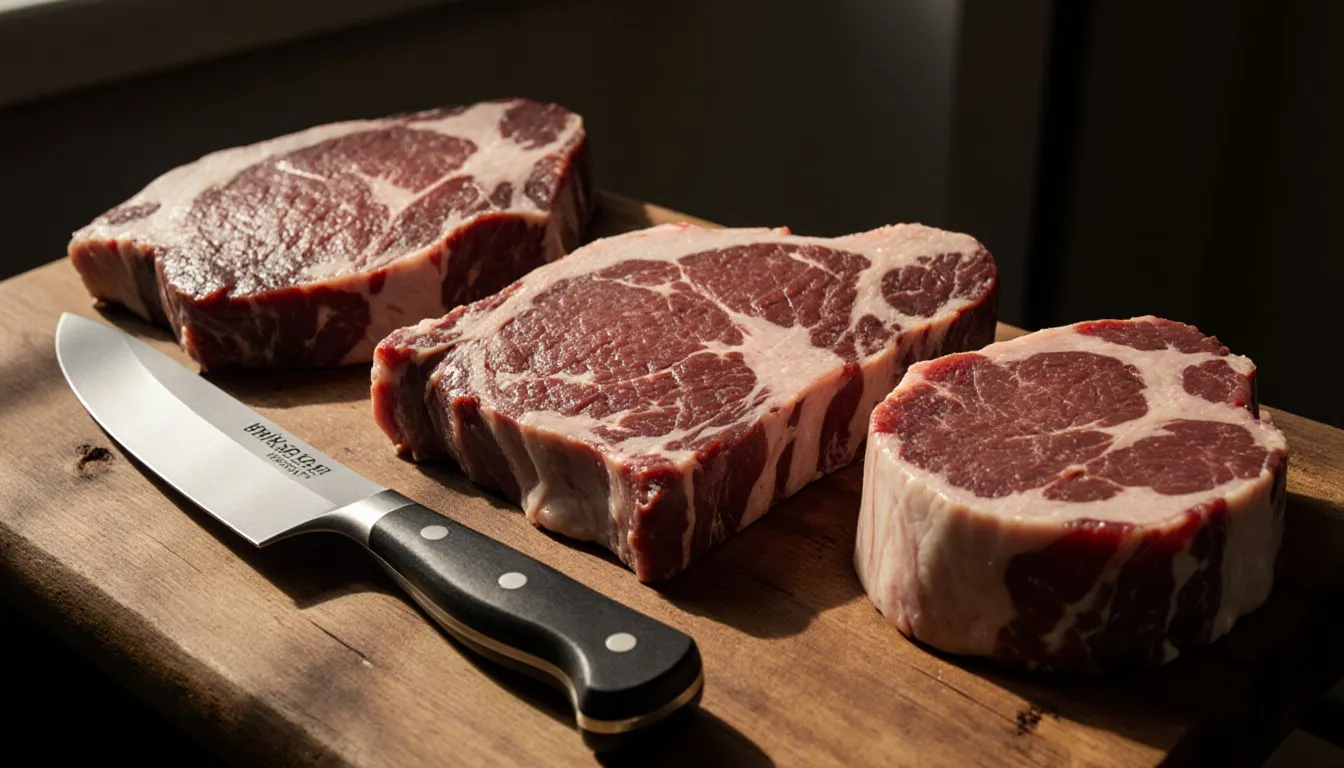
Whole-muscle cold cuts are exactly what they sound like: a roast, cooked and chilled and put on the slicer. Roast beef, oven-roasted turkey breast, ham, capicola, prosciutto, and the smoked-and-spiced beef in the pastrami vs corned beef conversation. Look at the end of the piece and you can see muscle grain, seams of fat, the shape of a real cut of meat. Ask for a thicker slice on roast beef and you get something with chew and beefiness. Shave it to tissue paper and it turns into a wet ribbon.
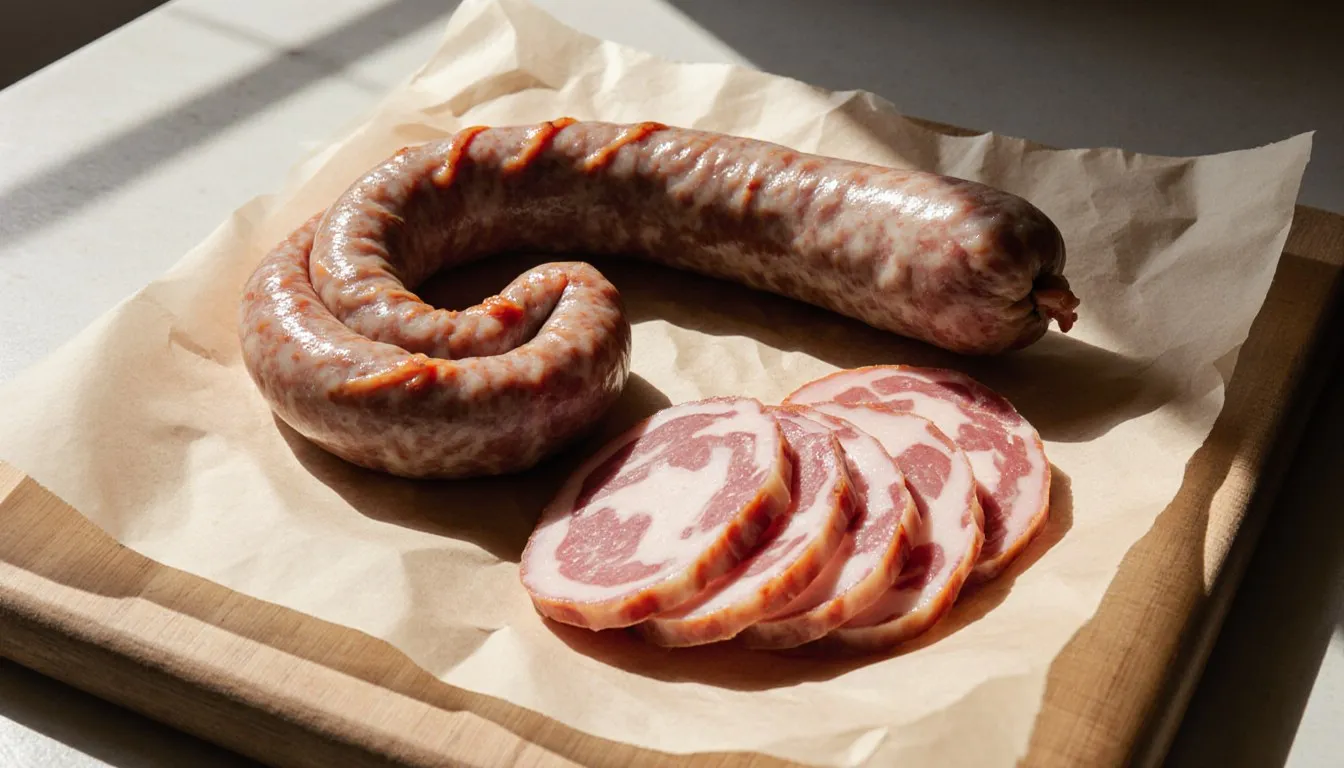
Loaves and emulsified meats are ground so fine that meat, fat, and water blend into a smooth paste, then cooked in a mold or a large casing. Bologna, olive loaf, liverwurst, and the whole family behind hot dog ingredients live here. So does mortadella, which charcutiers in Bologna will tell you is the original that American bologna descends from, distantly: pale pink, studded with white cubes of fatback and often pistachios, and gently spiced with black pepper and myrtle berry. Sliced whisper-thin, warm from a good counter, it’s one of the great sandwich meats on earth, and it costs a fraction of what a comparable cured ham does.
Turkey is where the labels earn a squint. “Turkey breast” means a breast. Wording like “sectioned and formed” or “chopped and formed” means smaller pieces bound back together into a uniform log. Neither one is a crime, and the formed stuff slices beautifully for kids’ lunches. Just know you’re paying whole-muscle prices for something else if you don’t read.
Natural casing or synthetic: does the wrapper change the bite?
It changes the snap, and snap is most of what people love about a good hot dog or a bratwurst. There are three casings you’ll meet.
Natural casings are cleaned animal intestines, most often hog, sheep, or beef. Sheep casings are the narrowest and go around breakfast links and slim frankfurters. Hog casings are the workhorse for bratwurst and Italian sausage. Beef casings, the wide ones, hold bologna, mortadella, and summer sausage. Natural casings are edible, they let smoke through, and they shrink onto the meat as it cooks, which is what produces that thin resistance and then the pop.
Collagen casings are made from processed cattle or pork hide collagen, extruded to a perfectly consistent diameter. They’re edible, they’re cheaper, and they’re the reason every link in a package is identical. They give a softer, more uniform bite with less snap, and on a thin snack stick you’d never know the difference.
Cellulose and fibrous casings come from plant fiber, and you don’t eat them. Skinless hot dogs are made in cellulose, cooked, then peeled at the plant, which is why they have that smooth, slightly slippery surface. Fibrous casings hold the big deli loaves and summer sausages, and yes, that’s the layer you’re supposed to strip off before slicing. Everyone has served a plate of salami with the casing still attached at least once.
None of this makes one sausage better than another. A collagen-cased breakfast link at a reasonable price is a fine breakfast. But when a butcher tells you something is in natural casing and charges a little more, they’re charging for texture, and it’s a real difference you can feel.
How do you read a sausage or deli meat label?
Start with cured versus fresh, because that determines whether the package is food or an ingredient. Curing means salt plus sodium nitrite, or sodium nitrate for things that hang for months. The nitrite is doing three jobs: it fixes that pink color that survives cooking, it builds the tangy flavor everyone recognizes as “cured,” and it suppresses the bacteria responsible for botulism in an anaerobic environment like a stuffed casing. That last job is why curing salts exist in the first place and why home curing recipes are not the place to improvise.
The word that trips everyone up is “uncured,” and it actually means close to the opposite of what it says. Those products are cured, just with celery juice powder or sea salt standing in as the nitrate source, converted to nitrite by a bacterial culture during processing. USDA labeling rules require the qualifier that goes with it, some version of “no nitrates or nitrites added except those naturally occurring in celery powder.” Read to the end of that line and you’ve read the whole story.
“Natural” on a USDA-regulated meat label means minimally processed with no artificial ingredients or added color. It says nothing about how the animal was raised, what it ate, or whether it saw daylight. Different claim, different word, different verification.
On ham, the label tells you how much water came along for the ride. Plain “ham” is the most concentrated. “Ham with natural juices,” then “ham, water added,” then “ham and water product” step down from there, and the last one has to declare the percentage of added ingredients right on the front. Cheaper per pound, wetter per slice. For a sandwich you’re dressing anyway, sometimes that’s a fair trade.
How long do sausages and deli meats keep in the fridge?
Conservative windows, at a refrigerator running 40°F (4°C) or below, in line with USDA cold storage guidance:
- Deli meat sliced at the counter, or any lunch meat package once opened: 3 to 5 days.
- Unopened, vacuum-sealed lunch meat: about 2 weeks, or the use-by date, whichever comes first.
- Hot dogs: 1 week once opened, about 2 weeks unopened.
- Fresh raw sausage: 1 to 2 days. This is the shortest clock in the case, and people routinely blow past it.
- Fully cooked smoked sausage like kielbasa: about a week once opened, 2 weeks sealed.
- Hard dry salami and pepperoni, whole and unopened: weeks in a cool pantry, far longer refrigerated. Once you’ve cut into it, plan on about 3 weeks in the fridge.
- Freezer, for quality rather than safety: 1 to 2 months for both deli meat and sausage.
One thing to know without turning it into a scare story. Listeria monocytogenes is unusual in that it grows at refrigerator temperatures, slowly, on ready-to-eat foods, which is exactly what deli meat and hot dogs are. For most healthy adults this is a low-odds situation. For people who are pregnant, adults 65 and older, and anyone with a weakened immune system, the standing federal advice is to heat deli meats and hot dogs to 165°F (74°C), steaming hot, before eating them, or skip them. Not “warm.” Steaming.
My mother’s rule covers the rest: if you have to lean in and sniff it twice, you already know. Sour smell, tacky or slimy surface, gray dullness on what should be pink. Out it goes, and no, a rinse doesn’t fix it.
What’s the best way to store deli meat and sausage at home?
Get it out of the deli paper. That waxed sheet is designed to carry meat across a counter, not to store it, and it breathes just enough that by day three your turkey has curled edges like a bad haircut. Move slices into a zip bag with the air pressed out, or an airtight container, the moment you’re home.
Vacuum-sealed packages are different. Leave those sealed until you’re ready, then rewrap the remainder tightly and start the three-to-five-day count from the day you opened it. Write the date on the bag with a marker. You will not remember. Nobody remembers.
Store it in the back of a lower shelf, where the temperature is coldest and steadiest. The door swings warm every time somebody wants milk, which makes it the worst spot in the fridge for the most perishable thing you own.
Buy smaller and more often. A half pound twice a week beats a pound once, because the second half of that pound is going to hit day six while you’re deciding what to do with it. If you’re shopping for someone in a higher-risk group, ask for it cut fresh off a whole piece rather than taking pre-sliced stacks that have been sitting in the case, and buy only what gets eaten in a couple of days.
Freezing works better than most people expect for fresh sausage and dry salami, and less well for wet, high-moisture deli meats. Frozen turkey and ham slices thaw watery and a little spongy, fine chopped into a scramble or a chef salad, disappointing on a cold sandwich. Freeze in portions you’ll use in one go, slide a square of parchment between slices so they peel apart, press the air out, and date the bag. Easy peasy, and it saves the half pound you were about to lose.
How do you pick good sausages and deli meats at the counter?
Ask for a taste. A good counter will hand you a slice without blinking, and how they answer that request tells you as much as the meat does.
On whole-muscle cold cuts, look at the cut face before they start slicing. You want visible grain and a natural, uneven edge. A perfectly round cross-section with no muscle structure at all is a formed product, which is fine if that’s what you meant to buy. Watch for liquid pooling in the tray, too, which usually means the piece has been open a while.
On fresh sausage, you want to see the grind. Distinct flecks of fat against meat, not a smooth uniform paste, and a short ingredient list you can read out loud. On dry salami in a natural casing, a powdery white bloom on the outside is the mold culture that’s supposed to be there. Fuzzy green or black patches are not, and that stick goes back.
Then talk about thickness, because it changes the eating more than price does. Roast beef wants a slice with some body. Prosciutto and salami want to be nearly translucent so the fat melts on contact. Mortadella and bologna are best shaved thin and piled high. Say the number if you know it, or just say “thin enough to see through,” and they’ll get you there.
Price is a weak signal on its own. Some of the best kielbasa in America comes from a small shop charging supermarket money, and plenty of imported product coasts on the flag on the label. What’s consistent is turnover: a counter that sells a lot cuts fresh often, and fresh-cut is most of what “good” tastes like here.
Next trip, buy one thing in a whole piece instead of sliced. A half-stick of dry salami, a chunk of mortadella, a small piece of kielbasa. It keeps considerably longer than slices do (see the windows above), it costs less per pound in most cases, and you get to decide the thickness at home, which is when you find out how much of that decision was never the deli’s to make.
Tessa Calloway
Staff Writer
Tessa Calloway has spent twenty years cooking dinner on a weeknight clock and testing the shortcuts that survive contact with a real kitchen. She believes the best recipe is the one you can make with what's already in the house, and she has strong opinions about what actually needs to be homemade (less than you think) and what always does (dressing).