How to Cook Steak in a Skillet Without Guessing
How to cook steak on the stove with a hot pan, a dry surface, and a thermometer. Doneness temps, resting times, and the mistakes to stop making.
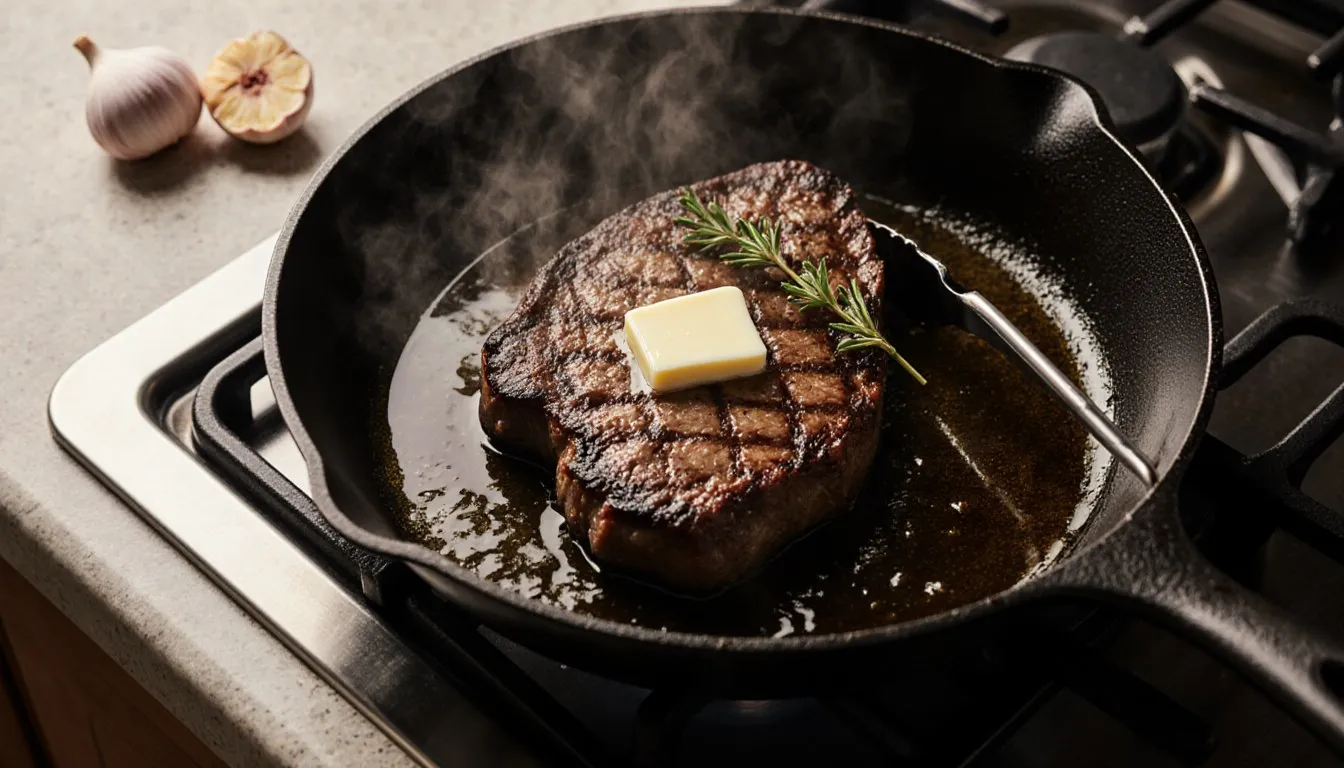
The single biggest thing standing between you and a good steak is a pan that is not hot enough and meat that is not dry enough. Fix those two and everything else is bookkeeping. Pat the steak bone dry, salt it, get a heavy skillet ripping hot until the oil shimmers and just barely wisps smoke, lay the steak down, and then leave it alone long enough to build a crust. Pull it off the heat by internal temperature, not by the clock, and let it rest before you cut. That is the whole method, and the rest of this walks through why each part matters and where it goes sideways.
What’s the one thing that ruins most home steaks?
Moving it. People lay a steak in the pan and then poke it, nudge it, lift a corner to peek at thirty seconds. Every time you move it, you break contact between meat and metal, and that contact is the only thing making a crust.
Right behind that: a wet steak in a lukewarm pan. Surface moisture has to boil off before browning can start, so a wet steak in a moderate pan spends its first two minutes steaming itself gray. By the time the surface finally dries out and starts to color, the inside has climbed well past where you wanted it. That is the gray band you see on a sad steak, a quarter inch of overcooked meat wrapped around a middle that never got a proper crust to go with it.
Browning is the Maillard reaction, sugars and amino acids rearranging into hundreds of new flavor compounds, and it needs a dry, hot surface to get going. Water sitting on the meat caps the surface temperature right around the boiling point, which is nowhere near hot enough. So: dry meat, hot pan, hands off. A steak you keep checking on never browns, for the simple reason that you keep breaking the contact that browns it.
How do you get a steak ready to cook?
Take the steak out of the fridge, blot both sides and the edges with paper towels until they stop coming away damp, and season it. That is the short version, and for a weeknight steak it is genuinely enough.
Drying it out
Paper towels get you most of the way there. If you have the time and the fridge space, an uncovered steak on a rack over a plate in the refrigerator for a few hours (overnight is better) dries the surface further and browns noticeably faster. This is the same principle behind air-drying a bird before roasting, and it costs you nothing but planning.
How to season steak
Kosher salt, generously, on every surface including the edges. More than feels polite. A lot of it ends up in the pan rather than on the meat, so timid salting reads as bland steak.
Timing has two workable windows and one bad one. Salt right before it hits the pan, within a minute or two, and you get seasoning without any moisture drawn to the surface. Or salt at least forty minutes ahead, ideally several hours, and the salt has time to draw moisture out, dissolve, and get pulled back into the meat, which seasons it deeper and leaves the surface dry again. The window in between is the one to avoid: fifteen minutes out, the salt has beaded moisture onto the surface but has not reabsorbed it, and you are back to searing a wet steak.
Pepper goes on before cooking if you like a bit of char on it, after cooking if you do not. Cracked coarse, either way. Garlic powder, granulated onion, a spice blend you like, all fine, though anything with sugar in it will scorch at searing heat, so save the sweet rubs for lower-and-slower cooking.
Should you bring it to room temperature?
Twenty to thirty minutes on the counter takes the deep chill off, which helps the middle come up to temperature without the outside pulling too far ahead. The old advice to let a steak sit out for an hour or more overstates how much a thick piece of beef actually warms in that time, and it drifts into territory food-safety guidance would rather you avoid: perishable food is not meant to sit at room temperature for more than two hours. Half an hour is the practical sweet spot. If you forget entirely and cook it straight from the fridge, it still works, you just need the oven finish described below.
What’s the best way to cook steak on the stove?
Heavy pan, high heat, high-smoke-point oil, one flip or several, and pull it early. Here is the whole sequence.
- Pick the pan: cast iron first, heavy stainless second. Both hold heat, which is what matters, because a cold steak dropped into a thin pan drops the pan’s temperature and you never recover it. Skip nonstick. It is not rated for the heat you need here, and it will not build the fond you want anyway.
- Preheat properly: medium-high for three to five minutes on most home burners, longer on a weak one. Cast iron heats unevenly at first, so give it the extra minute. A drop of water flicked in should skitter and vanish, not sit and simmer.
- Add the oil: a thin film of avocado, canola, grapeseed, or refined safflower. These take real heat without burning. Butter and unrefined olive oil scorch and turn acrid at searing temperature, so they go in during the last minute, once the crust is already built.
- Wait for the signal: the oil should shimmer and move like water, with the first faint wisps coming off it. Heavy billowing smoke means you have gone past it, so pull the pan off the heat for thirty seconds and let it settle.
- Lay it down away from you: so any splatter goes toward the back of the stove. It should hiss loudly and immediately. A quiet pan is a pan that was not ready.
- Leave it: two to four minutes for a steak around an inch thick, but go by the edges. When the bottom quarter inch turns from red to opaque brown and the steak releases from the pan without dragging, the crust has formed. A steak that is stuck still has crust left to build, so give it another thirty seconds and try again.
- Flip and repeat: tongs, not a fork, no need to make holes in it. Give the second side the same treatment.
- Sear the edges: stand the steak up on its fat cap with the tongs for thirty seconds or so. That strip of fat is delicious when it renders and rubbery when it does not.
- Butter at the end: in the last minute, drop in a tablespoon or two of butter, a smashed garlic clove, and a sprig of thyme or rosemary. Tilt the pan, spoon the foaming butter over the top repeatedly. The butter browns, the aromatics bloom in it, and the whole thing tastes like you did something clever.
A note on flipping, because the internet has strong feelings. Flipping every thirty to sixty seconds browns just fine and evens out the interior, because neither side has long to overheat before it goes back up off the metal. Use whichever suits you. I flip often on thick steaks and once on thin ones, mostly out of habit.
One more thing that people get wrong: give each steak room. Two steaks in a ten-inch skillet crowd each other, the pan temperature crashes, and released moisture has nowhere to go, so both of them steam. Cook in batches or use a bigger pan. Kitchen too smoky? Crack a window and turn the fan on before you start, while you are still ahead of the smoke.
Do you need to finish steak in the oven?
It depends entirely on thickness, and the dividing line falls right around an inch and a half. Anything at or under that will usually reach the temperature you want in the pan alone. Anything thicker needs help, because the crust will be past its best long before the center catches up.
Measure the steak, do not eyeball it. A thumb’s width is roughly an inch, if you need a quick gauge at the counter.
The pan-to-oven finish
Preheat the oven to 400°F (205°C) while the pan heats. Sear both sides on the stovetop until they are properly browned, then slide the whole skillet into the oven. Start checking the internal temperature after about four minutes. Thick, cold-from-the-fridge steaks can want ten or more, so let the thermometer make the call. Cast-iron handles come out screaming hot, so leave a folded towel over the handle as a reminder before somebody grabs it barehanded.
The reverse sear, for anything genuinely thick
For steaks pushing two inches or more, flip the order. Cook the seasoned steak on a rack in a low oven, somewhere in the 250°F (120°C) neighborhood, until the interior sits about 10 to 15 degrees below your target. That is a slow climb, often forty minutes to an hour depending on thickness and starting temperature. Then dry the surface off, get a skillet blazing hot, and sear ninety seconds a side purely for the crust.
The payoff is an interior that is one even color from edge to edge with almost no gray band, plus a surface so dry after the oven time that it browns nearly on contact. It takes longer and it is worth it on a nice thick cut. On a thin steak it is pointless, the meat hits temperature before it has done anything useful. And if you would rather do a thick cut over live fire, that is its own craft, covered properly in grilling and smoking meat.
What internal temperature is steak done at?
Here are the numbers, and a thermometer is the only way to hit them. Instant-read, digital, poked into the thickest part from the side so the probe sits in the center of the meat rather than touching bone or riding through a pocket of fat.
- Rare: 120 to 125°F (49 to 52°C), pulled off the heat. Cool red center.
- Medium rare: 130 to 135°F (54 to 57°C). Warm red center, and where most steak lovers land.
- Medium: 135 to 145°F (57 to 63°C). Warm pink throughout.
- Medium well: 145 to 155°F (63 to 68°C). Faint pink at the center.
- Well done: 155°F (68°C) and up. No pink. Cook it how you like it, nobody here is judging.
Now the safety part, stated plainly. USDA guidance for whole-muscle beef steaks is a minimum internal temperature of 145°F (63°C) followed by a three-minute rest. Anything below that, and rare and medium rare both are, carries some risk, which is a call that belongs to you and your household. Anyone cooking for young children, older adults, pregnant people, or anyone with a compromised immune system should stick to the 145°F standard. Ground beef is a different animal entirely: because grinding distributes surface bacteria throughout, it needs 160°F (71°C) all the way through, no exceptions. That distinction is why the medium-rare hamburger is a bad idea even when the medium-rare steak is not.
Two more things about those numbers. First, carryover cooking is real. A steak keeps rising roughly 3 to 5 degrees after it leaves the heat, more on a thick one, so pull it a few degrees short of your target and let the rest happen on the cutting board. Second, thermometer placement is where most bad readings come from. Go in through the side, horizontally, and push slowly until the number stops moving. A probe jabbed in from the top of a one-inch steak is barely in the meat at all.
How do you check steak doneness without a thermometer?
You press it and compare it to your hand, and you accept that you are guessing. The touch test is a real technique cooks have used for generations, and it will get you within a doneness level or so on a cut you know well.
Open your hand relaxed and press the fleshy pad at the base of your thumb. That soft give is roughly rare. Touch your thumb to your index finger and press the same spot, that is around medium rare. Middle finger, medium. Ring finger, medium well. Pinky, and the pad goes firm, that is well done. Compare it to the steak by pressing the center with a fingertip or the flat of the tongs.
Where this falls apart: a fatty ribeye and a lean sirloin at the same temperature do not feel the same, a bone changes the feel near it, and hands vary. Experienced cooks read it well because they have made the same cut hundreds of times and calibrated on it. You get the same accuracy on a cut you cook constantly, and much worse accuracy on one you do not. Other backup signals, the color of the juices, a small nick with a paring knife at the thickest point, all cost you juice and still leave you interpreting.
A decent instant-read thermometer is one of the cheapest upgrades in a kitchen and it pays for itself the first time it saves a good piece of beef. If you cook steak more than a few times a year, buy one and skip the finger business entirely.
Why does steak need to rest before cutting?
Cutting hot meat immediately lets a puddle of juice run onto the board instead of staying in the steak. Resting lets the muscle fibers relax and the juices redistribute, so what was concentrated in the cooler center spreads back through the meat and stays there when the knife goes in.
Five minutes for a thin steak, closer to ten for a thick one, roughly half the total cooking time as a rule of thumb. Rest it on a warm plate or a cutting board, loosely tented with foil if your kitchen is cold. Loosely is the operative word: foil pressed down tight traps steam against the crust and softens the surface you just worked for.
Do not rest it so long it goes cold. Ten minutes is fine, twenty-five is a lukewarm steak. If you are cooking for a table, rest the steaks while you finish the sides, then slice at the last moment. And whatever pooled on the board, spoon it back over the slices. It seasons every bite and keeps the meat glossy on the plate.
Slice against the grain, meaning across the direction the muscle fibers run rather than parallel to them, which shortens the fibers and makes each bite noticeably more tender. On a well-marbled cut you might not notice much difference. On leaner, chewier cuts it is the difference between tender and workout, and the specifics of which cuts have which grain get their proper treatment in beef cuts.
What are the most common steak-cooking mistakes?
A hot pan and a dry surface solve most of it. These are the ones that catch cooks who have already sorted those out.
- Buying it too thin: at half an inch there is no sequence that gives you a crust and a pink middle at the same time. The center is at 130°F while the surface is still pale gray. Have the butcher cut you one steak an inch and a half thick and split it between two people.
- Trimming the fat cap off: that band of fat along the edge renders down and bastes the meat the entire time it cooks. Take off the ragged tags and any thick silverskin, which stays leathery no matter what you do to it, and leave about a quarter inch of fat.
- Rinsing the steak first: running water over raw beef sprays bacteria around the sink, the faucet handle, and whatever is drying on the counter. USDA guidance is to skip washing raw meat entirely. Paper towels do the job the rinse was supposed to do, and they leave the surface drier besides.
- Sweet rubs at sear heat: brown sugar, honey powder, and most bottled barbecue blends go black and bitter well before the crust has set. Save them for a low oven or the cool side of a grill, and keep the skillet seasoning to salt, pepper, and dry aromatics.
- Slicing with the grain: look at the cooked surface, find the direction the fibers run, and cut across them. This matters most on the cuts people rush: a flank or a skirt sliced the long way chews like rope no matter how well you cooked it.
- Serving on a cold plate: you rest the steak carefully for ten minutes and then set it on a plate straight from the cupboard, which pulls the heat right back out. Run the plates under hot tap water and dry them, or park them on the warm stovetop while the steak rests.
- Wasting the fond: those browned bits stuck to the pan are pure flavor. Splash in wine, stock, or even water, scrape while it bubbles, swirl in a knob of cold butter off the heat, and you have a pan sauce in ninety seconds.
- Using the wrong oil: olive oil and butter go in at the end. High-smoke-point oil does the searing.
Keep leftovers in the fridge and eat them within three to four days. Reheating is where good steak goes to die, so go low: a 250°F (120°C) oven until the center reads 165°F (74°C) on an instant-read, or, better, slice it cold and put it on a sandwich or a salad and skip reheating altogether. If you want the wider view of how steak sits alongside everything else in the meat case, types of meat lays out the landscape.
The next time you cook one, try the compound butter trick: mash softened butter with minced garlic, chopped parsley, a little lemon zest, and a pinch of salt, roll it in parchment, and keep the log in the freezer. A coin of it melting over a rested steak takes about four seconds of effort and makes the whole plate taste finished.
Tessa Calloway
Staff Writer
Tessa Calloway has spent twenty years cooking dinner on a weeknight clock and testing the shortcuts that survive contact with a real kitchen. She believes the best recipe is the one you can make with what's already in the house, and she has strong opinions about what actually needs to be homemade (less than you think) and what always does (dressing).