Hot Oven, Small Cubes: Cooking the Odd Roots in Your CSA Box
Unusual and root vegetables aren’t fussy: peel, cube, roast hot at 425°F. Plus the special-case fixes for salsify, sunchokes, and taro that change everything.
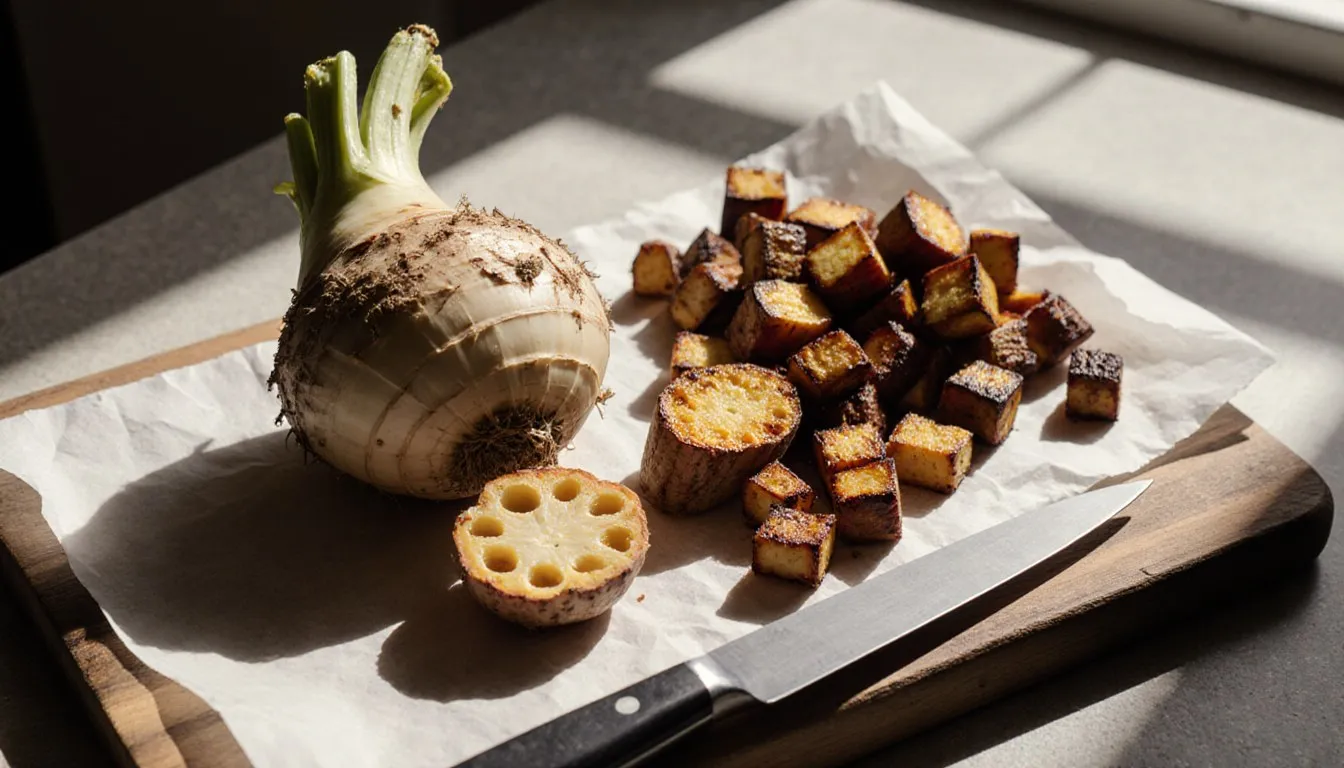
That knobby brown softball with the hairy roots is celeriac, and it wants what almost every other odd root in your bin wants: a hard peel, a one-inch dice, a 425°F oven, and more salt than feels polite. One technique carries you through most of the strange category, which is why a bin of unfamiliar roots is far less intimidating than it looks sitting on the counter at six o’clock.
The skill worth learning is the exceptions. Salsify goes gray the second you cut it. Sunchokes turn to sad puddles if you roast them like a carrot. Taro cannot be eaten raw at all, full stop. Below is the master method, then the handful of roots that need a special-case fix, and what each one is genuinely good at once you get it cooked.
What counts as an unusual or root vegetable?
A true root vegetable grows underground and stores the plant’s energy there, which is why almost all of them taste faintly sweet and turn creamy or silky when heat gets to that starch. Celeriac, salsify, daikon, jicama, and taro are the storage organ itself. Sunchokes and lotus root are tubers and rhizomes, technically stems, but they cook like roots and belong in the same conversation.
Then there’s the merely unfamiliar, which is a different problem. Plenty of what shows up in a CSA box is unusual only to you. Rutabaga and kohlrabi land in that bucket for most American cooks, and both reward a little specific instruction: rutabaga wants long roasting or a mash with butter, while kohlrabi is at its best sliced thin and raw. If either one is staring you down this week, how to cook rutabaga and how to cook kohlrabi will get you to dinner.
What follows sticks to the roots people bring home and then quietly compost two weeks later because nobody told them where to start.
How do you peel and prep an odd-shaped root?
Cut a flat side first, always. A round, lumpy, dirt-caked root rolling under your knife is the single most dangerous thing on a home cutting board, and the fix takes four seconds: lop off the top and bottom, stand it on the flatter cut end, and now you have a stable object instead of a bowling ball.
From there:
- Scrub before you peel, not after. Root crevices hold grit that a peeler will happily drag across the clean flesh. Cold water and a stiff brush, and be thorough in the folds where the rootlets attach.
- Use a knife, not a peeler, on anything knobby or fibrous. Celeriac, taro, and jicama all have skin too thick or too irregular for a swivel peeler. Ride the blade down the curve in strips, the way you’d peel a pineapple.
- Peel thin-skinned roots only if you want to. Sunchokes, young daikon, and small salsify are fine scrubbed. Skin means texture and a little more flavor.
- Cut for evenness above all. Same-size pieces cook at the same rate. A pan with half-inch chips and two-inch chunks gives you burnt bits and raw bits at the same moment.
If your knife skills are the wobbly part of this, vegetable prep basics covers the grip and the claw hand that make the rest of it easy. A dull knife is how you end up in the emergency room in your good sweater, which is the kind of specific that sticks with you.
What’s the one technique that works on almost any root vegetable?
High-heat roasting. Peel, cut into one-inch pieces, toss with about one tablespoon of oil and one-half teaspoon of kosher salt per pound, spread in a single layer with space between the pieces, and roast at 425°F (220°C). Flip once when the undersides have gone deep brown. There is no more to it than that.
Two details do most of the work. Space, because crowded pieces steam in their own moisture and never brown. And a preheated sheet pan, which gives you a hard sear the instant the vegetables land instead of a slow sad warm-up. Dark metal beats shiny for this.
Rough starting ranges at 425°F with one-inch cuts, checked with a paring knife tip rather than a timer:
- Celeriac: start checking at 30 minutes, usually 30 to 40.
- Sunchokes, halved or quartered: start checking at 20 minutes, rarely past 30.
- Salsify batons: 20 to 25 minutes.
- Taro, cut smaller at about three-quarters of an inch: 35 to 45 minutes, and it must go completely tender through the middle.
- Daikon wedges: 30 to 35 minutes, longer if you want real caramelization.
- Lotus root, sliced a quarter inch thick: 25 to 30 minutes.
- Jicama: 25 to 30 minutes will brown the edges, but it stays crunchy no matter what you do.
Reach for a braise instead when the root is huge, woody, or you want it silky rather than crisp-edged. Barely cover with stock, add a knob of butter and a bay leaf, cover, and hold at a lazy simmer until a knife slides in with no resistance. Braising also rescues a root that has gone slightly soft in storage, where roasting only makes leathery pieces more leathery. The broader question of matching method to vegetable is worked through in how to cook vegetables, if you want the full picture.
How do you cook celeriac (celery root)?
Cut the top and bottom flat, then carve the skin off in downward strips with a chef’s knife, taking a good quarter inch with it. You will lose more than feels reasonable. Do it anyway, because the outer layer is fibrous and the tangle of rootlets at the base holds dirt no amount of scrubbing reaches. What’s underneath is ivory white and smells like celery that grew up and got serious.
Raw, it’s crisp and grassy, and this is where celeriac earns its keep. Cut it into matchsticks, dress it with mustardy mayonnaise and lemon, and you have rémoulade, a fancy-schmancy French bistro plate that takes ten minutes and a box grater. Toss the cut pieces with lemon juice right away; celeriac browns like an apple.
Cooked, it goes two ways. Roasted at 425°F it turns sweet and nutty at the edges, and it is a very good sidekick to roast chicken. Mashed, it makes a lighter, more aromatic purée than potato, though a fifty-fifty mash of celeriac and potato is the version most people go back to, because straight celeriac purée can be watery. If it is, cook the drained cubes uncovered in the pot for a minute to steam off moisture before you mash.
What do you do with sunchokes (Jerusalem artichokes)?
Scrub them and leave the skin on. Sunchokes look like knuckly ginger, and trying to peel each lobe with a swivel peeler will cost you half the vegetable. A brush under running water is enough. Trim any spot that’s gone soft or shriveled.
Roasted whole if small, halved if larger, they get a crackly skin and an interior like a cross between an artichoke heart and a potato, sweet and slightly nutty. Here is the trap: more oven time makes most roots better, and sunchokes actually get worse. Their inulin breaks down and they collapse from creamy into watery, deflated pucks. Pull them the moment a knife tip meets no resistance, which is often ten minutes before you’d expect.
They are also excellent raw, sliced paper thin into a salad with lemon and good olive oil, where they snap like a water chestnut.
Sunchokes contain a lot of inulin, a fiber many people don’t digest well, and the resulting gas is legendary enough that the nickname “fartichokes” got around. If you have never eaten them, serve yourself a small portion the first time. Cooks have long claimed that a long, slow cook or a stint in a vinegar pickle takes the edge off, and pickled sunchokes are worth making regardless of whether that holds for you.
How do you keep salsify from turning gray?
Have a bowl of acidulated water ready before you pick up the knife: one quart of cold water with about a tablespoon of lemon juice or white vinegar. Peel each root, cut it into batons, and drop them straight in. Salsify oxidizes on contact with air faster than anything else in this article, and the gray sets in while you’re still peeling the next one.
The roots look like long dirty brown sticks, sometimes sold as scorzonera when the skin is nearly black. They ooze a sticky white sap when cut that will glue itself to your fingers and your peeler, so rinse the blade partway through. Some cooks oil their hands first.
The payoff is a delicate, faintly sweet flesh with a whisper of something briny, which is why it picked up the name oyster plant generations ago. I have never tasted an oyster in it, but I have also never met anyone who wasn’t charmed by it. Simmer the batons in salted water or milk until just tender, then finish in butter with parsley, or drain them well, pat them dry, and roast. Wet salsify will steam instead of brown, so dry is not optional here.
Why can’t you eat taro raw, and how do you cook it?
Raw taro is not safe to eat. The root contains needle-shaped calcium oxalate crystals that irritate the mouth, throat, and gut, and thorough cooking is what breaks them down. Cook taro completely, all the way through, every time. No raw slices, no tasting a corner to check, no undercooked center hiding in a big chunk.
The same compound is in the raw sap, which can leave your hands itching for hours. Wear kitchen gloves to peel it, or oil your hands and rinse well afterward. Peel it under running water with a knife, taking the shaggy brown skin and the layer just beneath.
Once it’s cooked, taro is a joy: dense, mildly sweet, faintly nutty, somewhere between a chestnut and a very starchy potato. Boil or steam cubes until a knife passes through with zero resistance, roughly 20 to 30 minutes depending on size, then use them in coconut milk curries and stews, where they thicken the sauce as they go. Fried is the other great use. Cut thin slices, fry until crisp and golden, and salt them hot. Taro also shows up mashed and sweetened across Chinese and Southeast Asian desserts, and steamed and pounded into poi in Hawaii, both traditions built on the same rule of cooking it fully first.
What’s the difference between daikon and jicama?
Daikon cooks down soft and sweet; jicama stays crunchy no matter what you do to it. They look vaguely similar in the bin, both pale and hefty, and they are not remotely interchangeable.
Daikon is a large white radish, sharp and peppery raw, mellow and almost turnip-sweet once heat hits it. Simmer thick rounds in dashi or chicken broth for 30 to 40 minutes until they turn translucent and take on the broth, which is the heart of Japanese oden. Braise wedges with soy, mirin, and ginger. Or skip cooking altogether and grate it raw into a fluffy pile as a condiment alongside anything fried, where its bite cuts grease better than lemon. Raw daikon also pickles fast; thin slices in rice vinegar, sugar, and salt are ready in an hour.
Jicama is the opposite proposition. Under its papery brown skin (peel it with a knife, in strips, the skin is fibrous) is a white, juicy, apple-crisp flesh that tastes faintly sweet and mostly of clean water. It is a raw vegetable and it barely browns once cut, which makes it a gift for crudité platters and packed lunches. The classic Mexican street treatment is batons with lime juice, chili powder, and salt, and it is very hard to improve on. Cook it if you want, in a stir-fry standing in for water chestnut, but understand you are getting warm crunch, not tenderness.
Where lotus root fits in
Lotus root belongs with the crisp crowd. Slice it crosswise so you get that lacework of holes, and drop the slices into acidulated water immediately, because it discolors nearly as fast as salsify. It stays crunchy through a stir-fry, holds its shape in a long braise, and fries into chips that curl and shatter. Peel it, and always cook it rather than eating it raw.
How do you store unusual root vegetables so they last?
Cut the greens off the moment you get home. Daikon tops and any leafy crown left attached keep pulling moisture out of the root, and a bunch of daikon with the greens on will go limp in days while a trimmed one holds for weeks. (Daikon greens are good sautéed, so don’t toss them.)
After that, two camps:
- Cool and humid, meaning the crisper drawer: celeriac, daikon, salsify, lotus root, and sunchokes. Unwashed, in a perforated or loosely open plastic bag. Celeriac and daikon are the marathoners here and hold for several weeks. Salsify and lotus root want a week or two. Sunchokes are the sprinters, shriveling within a week or so, so buy them for a specific meal rather than for the drawer.
- Cool and dry, no refrigeration: taro and whole jicama. Both dislike the fridge, where cold damp turns taro moldy and jicama slimy. A paper bag in a dark cupboard or pantry keeps them for a couple of weeks. Once either one is cut, wrap it and refrigerate, and use it within a few days.
Never wash roots before storing. Dirt is a preservative and moisture is not. Cut surfaces are where spoilage starts, so if you’ve hacked half a celeriac, wrap the exposed face tight against the plastic.
For anything you’ve already cooked, refrigerate within two hours and eat it within three to four days. Roasted roots reheat beautifully on a hot sheet pan and terribly in a microwave, which turns them soft and sulky.
Which unusual vegetable should you try first?
Start with celeriac. It’s widely available, it keeps for weeks while you work up the nerve, it has no safety caveats, and the payoff is immediate: half of it roasted into a side dish tonight, the other half grated raw into rémoulade tomorrow. Two completely different dishes from one ugly softball is a good introduction to the whole category.
Then make your oven do double duty. Peel and cube whatever roots you have on Sunday, roast a full sheet pan at 425°F, and refrigerate what you don’t eat. Cold roasted roots go into grain bowls, get blitzed with stock into a fast soup, or hit a hot skillet with an egg on Wednesday morning when there is nothing else in the house.
Tessa Calloway
Staff Writer
Tessa Calloway has spent twenty years cooking dinner on a weeknight clock and testing the shortcuts that survive contact with a real kitchen. She believes the best recipe is the one you can make with what's already in the house, and she has strong opinions about what actually needs to be homemade (less than you think) and what always does (dressing).