Asparagus, From the Store Shelf to the Plate
How to cook asparagus without guessing: what to look for at the store, where the woody end really breaks, and which method fits tonight’s dinner.
The fastest way to cook asparagus is in a hot skillet with a slick of oil, about five minutes, tossed once or twice, and dinner is on the table. That is the answer if you are standing at the stove right now with a bunch in your hand. But the method you reach for should depend on what else is happening in your kitchen, because asparagus is agreeable that way. If the oven is already at 425°F (220°C) for a chicken, roast it. If it is going cold into a salad tomorrow, blanch it. If you have five minutes and one burner, sauté.
Three things wreck asparagus: tired stalks, a bad trim, and a pan you walked away from. Sort those three out and every method works, from a screaming-hot grill to a lidded steamer basket.
What should you look for when buying asparagus?
Look at the tips first. They should be tight, compact, and dry, with the little scales pressed close to the stalk like a closed fist. When those tips start to open up, fan out, and go dark and damp, the bunch is on its way out. That is the first thing to fail on asparagus and the easiest thing to see through a grocery store’s plastic band.
Then pick the bunch up. A good stalk is firm and snaps rather than bends, and the cut end should look moist and pale, not dried out, split, or woody halfway up. Give it a light squeeze near the base. If it feels rubbery or the whole bunch flops over your hand like celery left in the crisper too long, put it back.
Color should be deep green, often with a purple blush at the tips, and that blush is a good sign rather than a bruise. White asparagus is a different animal entirely: it is grown covered so it never develops chlorophyll, it is milder and a little more bitter, and it almost always needs peeling. If you find it fresh, treat it gently and expect to spend more time prepping it than you would on green.
Now, thickness. Fat stalks are not better stalks, and skinny ones are not more tender by nature. Thickness comes down to the age and variety of the plant, and what it really tells you is how the asparagus will behave in the pan. Thin stalks cook in a flash and are fantastic sautéed or roasted hot and fast, but they overcook in the time it takes to answer a text. Thick stalks hold their bite, take a char beautifully on the grill, and are the ones worth peeling. If you are roasting alongside something else and want the spears to survive a longer stint in the oven, buy them thick on purpose.
Spring is the season, roughly April through June in most of the U.S., and that is when local asparagus is cheapest and best. The rest of the year it comes in from elsewhere and it is fine, it is just older by the time it reaches you, which makes the tip test matter even more.
Where do you cut or snap the woody end?
Hold one stalk near the bottom with one hand and about a third of the way up with the other, then bend. It breaks where the tough fiber gives way to tender stalk, usually somewhere in the bottom third. That is the snap test. Cooks have gone by it for generations on the reasoning that the stalk breaks along its own fiber line and picks the spot for you, landing higher on a thick spear than on a thin one. Plenty of test kitchens push back and say the break point tracks leverage, meaning where your hands are and how hard you bend, more than any fiber line. Worth knowing before you trust it stalk by stalk on an expensive bunch.
Here is the practical part nobody mentions: you do not need to snap all of them. Snap one, see where it lands, then line the rest of the bunch up on the board and cut them all at that point with a knife. You get the accuracy of the snap and the tidy even ends of the knife, and you are done in fifteen seconds instead of two minutes of one-handed wrestling.
People argue that snapping wastes asparagus, and sometimes it does break higher than it strictly needed to. But guessing with a knife and cutting an inch off the bottom on principle is how you end up chewing on the fibrous part and blaming the vegetable. If your bunch is fat and pricey and you hate to waste it, snap one, cut the rest to match, then take the discarded ends and simmer them in water for a light broth. Those woody bottoms have real flavor in them. My mother never threw a single end away, and the stockpot proved her point.
Rinse after trimming, not before, and pay attention to the tips. Sand collects down in those tight scales, and nothing sours a nice dinner like grit. A quick swish in a bowl of cold water, tips down, then a shake and a pat dry. Dry matters more than people think. Wet asparagus steams in a hot pan instead of browning.
Do you need to peel asparagus before cooking it?
Only if the stalks are thick, and mostly only the bottom half. On a spear thicker than your index finger, the skin down near the base gets fibrous and stringy in a way that no amount of cooking fixes. Lay the stalk flat on a cutting board, run a vegetable peeler from the middle down toward the cut end, rotating a quarter turn each pass, and stop before you reach the tender upper stalk and tips. Two or three passes per side is plenty.
Thin and medium stalks skip this step. There is nothing on a pencil-thin spear worth peeling off, and you will lose half the asparagus trying.
White asparagus is the exception that goes the other way: peel it, the whole length below the tips, and be a bit generous about it. The skin is genuinely tough. Support the stalk on the board while you peel or it will snap in your hand, and yes, that is why you always seem to break one. Everyone breaks one.
What’s the best way to cook asparagus?
There isn’t one, and the cooks who insist otherwise are usually cooking one kind of dinner. The right method is the one that fits the rest of your meal, so here is how I actually decide.
- Sautéing: when you have five minutes and the oven is cold. Medium-high heat, a tablespoon of oil or butter, spears in a single layer, tossed occasionally until they are bright green and blistered in spots. Best for thin and medium stalks. This is the weeknight default in my house, and if you want it pan by pan, the details are in the full guide to cooking asparagus on the stove.
- Roasting: when the oven is already on for something else. A hot oven, somewhere in the 400°F to 425°F (205°C to 220°C) range, oil, salt, single layer on a sheet pan with room between the spears so they roast instead of steam. Roasting pulls more sweetness out of a spear than steaming or blanching ever will, and it is nearly hands-off, which matters when you are juggling three other things. Slide the pan in, set a timer, and go back to the stove. Full timing and temperature specifics are in the guide to roasting asparagus in the oven.
- Steaming: when you want clean asparagus flavor and a tender bite with no browning at all. Good under hollandaise, good alongside fish, good when you are feeding someone who finds char bitter. An inch of water under a steamer basket, lid on, and check early.
- Grilling: when the grill is already lit and the stalks are thick. Thin spears fall through the grates and turn to ash, so this is a fat-stalk method. Oil them well and lay them perpendicular to the bars, or thread a few crosswise onto a pair of skewers so you can flip them as a raft.
- Blanching: when the asparagus is going into something else, a salad, a pasta, a platter you are assembling later, or into the freezer. Salted boiling water, then straight into ice water to stop the cooking and lock in that green. It is the one method built for making asparagus ahead of time. The technique carries over to nearly everything green, and the full method for blanching vegetables lays out the timing type by type.
Boiling asparagus in a lot of water, uncovered, until it goes olive-drab is how a whole generation learned to hate it. If you are going to put it in water, blanch it and pull it out early.
One thing worth knowing across all of these: asparagus does not cook evenly, because the tips are delicate and the stalk ends are dense. Roasting and sautéing handle this fine because the heat is dry and fast. If you are steaming or blanching thick stalks and want it perfect, stand them upright in a couple of inches of water with the tips above the waterline so the bottoms boil while the tips steam. That is the old restaurant trick and it still works. For most weeknights, honestly, just buy stalks of similar thickness and don’t overthink it.
When is asparagus done, exactly?
Watch the color. Raw asparagus is a flat, matte green, and about a minute into real heat it flips to a vivid, almost neon green. That flash of color is your first cue that things are happening. Perfectly cooked asparagus is still that bright green. Once it slides toward olive or army green, you have gone past it.
Then check the bend. Pick up a spear with tongs and hold it horizontally. Undercooked, it stays stiff as a pencil. Done, it droops gently at the far end but still holds its shape. Limp enough to fold in half is overcooked, and there is no coming back from that, so pull it a touch early if you are unsure. Asparagus keeps cooking on a hot sheet pan for a minute after it leaves the oven.
If you want certainty, use a knife. Slide the tip of a paring knife into the thickest part of a stalk near the base. It should go in with slight resistance, the way it goes into a ripe pear rather than a raw potato. No resistance at all means dinner is going to be mushy.
Times are a starting range, not a rule, because a thin spear and a thumb-thick one are not the same vegetable. Start checking a sautéed thin bunch at around three minutes and thick roasted spears well before you think you need to. Method-by-method numbers are laid out in how long to cook asparagus if you want them in one place, but the color-and-bend check beats a timer every single time. Ovens lie. Burners run hot. Your eyes don’t.
Can you cook asparagus from frozen?
Yes, and you should cook it straight from frozen rather than thawing it first. Frozen asparagus has already been blanched before freezing, so it is partly cooked going in, and thawing it on the counter just gives you a limp, watery pile before it ever meets heat.
Be honest with yourself about the texture, though. Freezing ruptures the cell walls, and frozen asparagus will never have the crisp snap of fresh. It comes out softer, no matter how careful you are. Where frozen works is anywhere the asparagus is a component instead of the star: stirred into a pasta, folded into a frittata, blitzed into soup, tossed through a grain bowl. Where it does not work is a platter of spears with lemon and shaved parmesan, because there the texture is the whole point.
For the best result, roast or sauté it hot and dry. Spread it out on a sheet pan in a single layer, no crowding, and let the oven drive off the surface moisture before it starts browning. Skip the crowded skillet, which will just pool water and steam the spears into sadness. And don’t salt frozen asparagus until the end, since salt pulls out even more moisture from an already-wet vegetable.
Frozen is the smarter buy in January, when fresh asparagus has traveled a long way and costs a lot for what you get. It is also the right call when you want asparagus in something rather than beside it. In May, buy fresh.
What tastes good with asparagus?
Lemon, butter, parmesan, and salt. The list really is that short, and everything else is a variation on it. Asparagus has a grassy, slightly mineral, faintly sweet flavor that gets flattened by anything loud, so the classics stick around because they support it instead of shouting over it.
The order matters more than the ingredients. Salt while it cooks, cheese while it is still hot enough to melt, and acid at the very end off the heat. Lemon juice added early goes dull and, worse, the acid turns green vegetables a drab olive. A squeeze right before it hits the table keeps everything bright, and grated lemon zest gives you the perfume without the extra liquid.
A few finishes I come back to:
- Butter and a hard-cooked egg pushed through a sieve over the top, which is the old French treatment and looks like far more work than the ninety seconds it takes.
- Parmesan grated over hot spears straight from the oven, so it melts into the browned bits.
- Toasted almonds or breadcrumbs for crunch, since asparagus is soft and welcomes something with texture.
- Prosciutto, bacon, or anything cured and salty. Fat and salt against green and grassy is a pairing that has been working forever.
- A soft-poached egg on top, which turns a side dish into lunch.
What I would skip: heavy tomato sauces, sweet glazes, and anything with a long ingredient list. Asparagus has a short season and a delicate flavor, and burying it under a balsamic reduction is a waste of both. Matching fat, acid, and salt to a vegetable’s character is most of what how to cook vegetables comes down to, and asparagus is where it is easiest to see, because you can taste the difference between good asparagus and buried asparagus in one bite.
How do you store asparagus, raw or cooked?
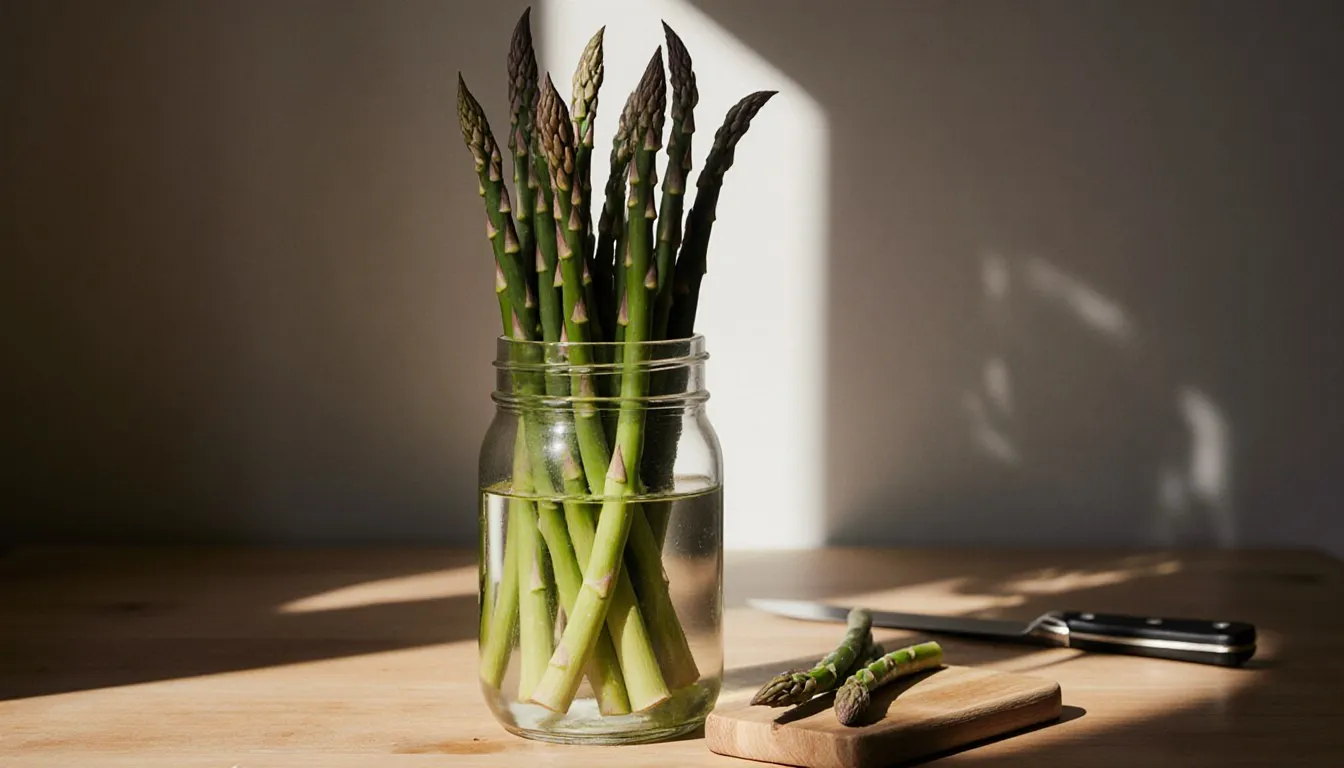
Treat a raw bunch like cut flowers. Trim a half inch off the bottoms, stand the stalks upright in a jar or glass with an inch or two of cold water, drape a loose plastic bag over the tops, and put the whole thing in the fridge. Stored that way it stays firm and green for several days, and the difference against a bunch lying flat in the crisper drawer is not subtle. The stalks keep drinking, and the tips stay tight instead of fanning open.
Change the water if it clouds up. If you have no room for a jar on the shelf, the runner-up is to wrap the cut ends in a damp paper towel, slip the bunch into a bag, and keep it in the crisper. Not as good, but it beats bare asparagus in an open fridge, which will go rubbery in a day.
Either way, cook it soon. Asparagus is a vegetable that starts losing sugars and turning fibrous as soon as it is cut, so buying it two days before you plan to use it is a plan, and buying it a week ahead is optimism. Do not wash it until you are ready to cook, because surface moisture is what starts the slime.
Cooked asparagus keeps in an airtight container in the refrigerator for three to four days, the standard window for cooked vegetables. It will not be crisp on day two, so plan for the leftovers rather than mourning them: chop them cold into a salad, fold them into eggs, or blend them into a soup where softness is an asset. This is exactly the case for blanching a big batch on purpose, since blanched-and-chilled spears hold their texture in the fridge far better than roasted ones do.
For longer storage, blanch and freeze rather than freezing raw. Two to three minutes in salted boiling water, straight into an ice bath, dried thoroughly, then frozen flat on a sheet pan before going into a bag. Raw asparagus frozen straight from the fridge turns to mush, because the enzymes keep working right through the freeze.
Next time you have a bunch, buy the thick stalks even if the thin ones look prettier, peel the bottom halves, and roast them hot. The sweetness you get out of a fat, properly peeled spear is a different vegetable from the thin ones most of us default to, and it is the version that converts people who think they don’t like asparagus.
Tessa Calloway
Staff Writer
Tessa Calloway has spent twenty years cooking dinner on a weeknight clock and testing the shortcuts that survive contact with a real kitchen. She believes the best recipe is the one you can make with what's already in the house, and she has strong opinions about what actually needs to be homemade (less than you think) and what always does (dressing).