Vegetable Substitutes: Match the Texture First, the Flavor Second
Vegetable substitutes work when texture and cook time match. Here are the swaps that hold up, with ratios, what changes, and when to skip the swap entirely.
Match the texture and the cooking time first, then worry about flavor. That order of operations rescues almost every vegetable substitution you will ever make on a weeknight, and getting it backwards is why so many swaps come out sad. Reach for butternut squash because the recipe wanted zucchini and you have “squash” in the house, and you will stand over a pan of raw orange cubes while everything else on the plate goes cold. One is mostly water and collapses in five minutes; the other is dense and starchy and wants half an hour in a hot oven. Below is the framework I use to size up any swap in about ten seconds, plus the pairs that hold up in real recipes with ratios and honest trade-offs.
What actually makes a vegetable substitute work?
A substitute works when it finishes cooking at the same moment as the original and lands in the same textural neighborhood. Flavor is the easy part. You can adjust flavor at the end with salt, acid, fat, or a handful of something green. You cannot adjust a vegetable that needed twenty more minutes than the recipe gave it.
Sort your candidate on three questions before you commit:
- Sturdy or tender: does it hold its shape through heat (carrot, parsnip, cauliflower, green bean) or does it slump (spinach, zucchini, tomato, mushroom)? Sturdy for sturdy, tender for tender.
- Wet or dry: a watery vegetable releases liquid into the pan, which either steams your food or thins your sauce. Zucchini, cabbage, mushrooms, and tomatoes all give up water. Potato, winter squash, and carrot absorb it.
- Raw-ready or needs heat: some vegetables are pleasant raw and merely nice cooked. Others are unpleasant raw and become good only after real heat. Those two groups are not interchangeable, no matter how similar they look sliced.
Same-family logic fails all the time, because a seed catalog sorts vegetables by flower and seed while your pan responds to water content and fiber. Fennel and celery happen to be cousins on paper, but that is not what makes the swap work; fennel stands in for celery in a braise beautifully because both are fibrous, both soften on the same schedule, and both melt into the background. Meanwhile kale and spinach are both leafy greens and both cook down, but spinach is done in ninety seconds and kale wants five to eight minutes plus a splash of liquid. Swap them one for one with no adjustment and you get either mush or chew.
The failure that shows up most in my kitchen is the aromatic base. A mirepoix of onion, carrot, and celery cooked slowly in fat leans on all three doing separate jobs, and doubling the carrot to cover a missing onion just makes the pot sweeter and flatter. Fresh onion pulls its own weight there, and if that’s the gap you are staring at, work through the onion substitutes on their own terms, because the ratios there have nothing to do with the ones on this page.
Swapping within the same vegetable family
Within a texture family, most swaps are one for one by weight or by cup, and the only thing that shifts is timing by a few minutes. These three groups are the safest zones in the whole produce section.
Cruciferous vegetables
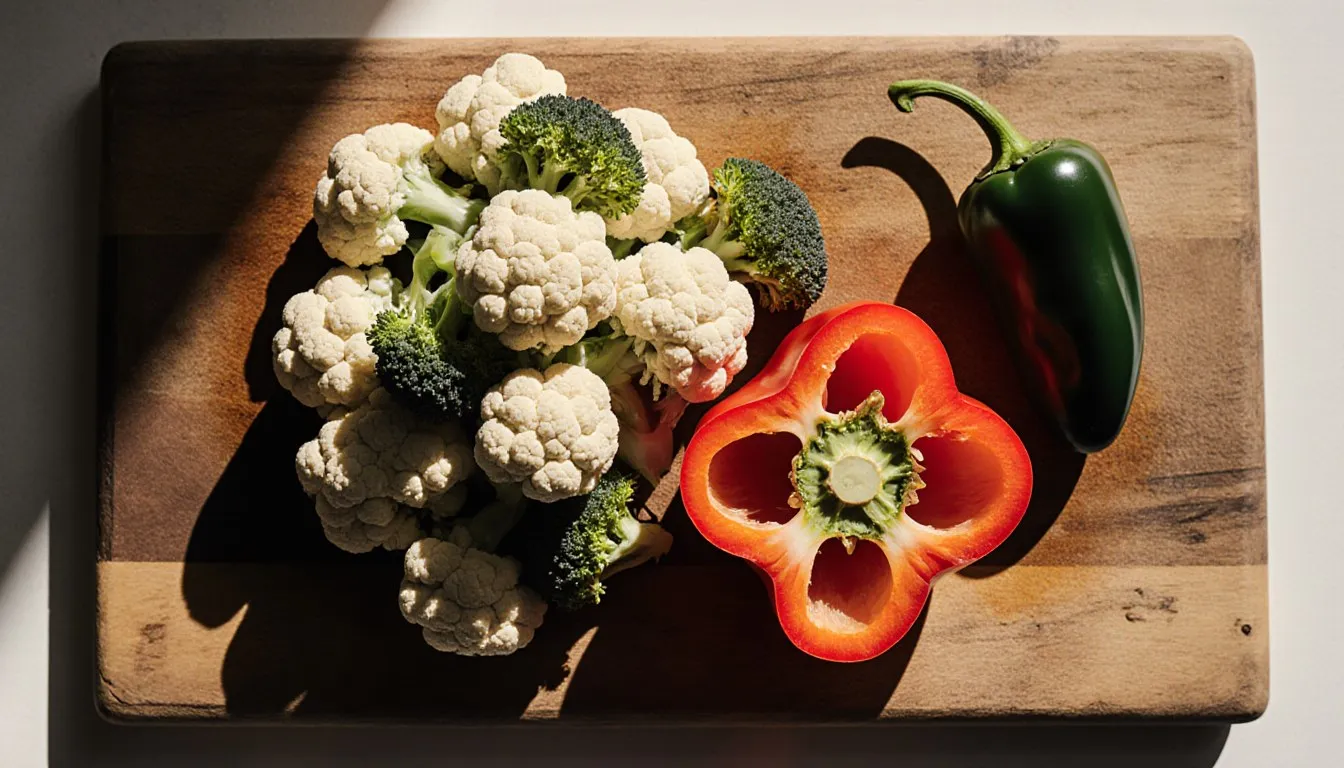
Broccoli, cauliflower, and romanesco trade evenly, one cup of florets for one cup of florets, in roasts, stir-fries, gratins, and soups. Broccoli cooks fastest because the florets are looser and catch heat on more surfaces. Cauliflower and romanesco run a touch slower and denser, so give them an extra three to five minutes and expect deeper browning at the edges. If you are roasting at 425°F (220°C), start checking cauliflower when the tips look burnished and a paring knife slides into a thick stem with no resistance.
Cabbage belongs to the same family and none of the same texture rules. It is layered, wet, and sweeter, and it wilts rather than holding a shape. Cabbage does a fine job standing in for broccoli in a stir-fry, where you want something that softens and takes on sauce. It does a poor job standing in for cauliflower in a roasted side, where you wanted craggy florets and instead get lace.
Summer squash
Zucchini and yellow squash are interchangeable with no adjustment at all, one for one, in every application I know of. Same water content, same softening speed, same mild flavor. Yellow squash sometimes has slightly softer seeds, so if you are cutting thick coins for the grill, halve and scoop the seedy center from an overgrown one.
Winter squash is a different animal entirely, whatever the shared name suggests. Butternut, acorn, kabocha, and delicata are starchy and dense and want a real roast. They swap freely among themselves, though delicata cooks fastest thanks to its thin edible skin and kabocha runs the driest and sweetest. Never sub winter for summer or the reverse in a quick-cooking dish.
Root vegetables
Carrots, parsnips, turnips, rutabaga, celery root, and sweet potato all roast, braise, and mash on roughly the same clock when you cut them to the same size, and my mother’s whole rule for this drawer was that like goes with like: cut it the same, cook it the same. Substitute one for another by equal weight and adjust for two variables. Sugar goes up with carrot, parsnip, and sweet potato, which means faster browning and a sweeter finished dish, so pull back on any honey or maple in the recipe. Bitterness and pepper go up with turnip and rutabaga, which is welcome alongside rich meat and jarring in a delicate soup. Parsnips in particular behave less like a carrot than people expect, so if that is the gap in your drawer, start with the closest substitutes for parsnips and cut them a size smaller than the recipe says.
Beets are the exception in the drawer. They stain everything, they cook slower than they look, and they are sweet enough to redirect a dish. Use them because you want beets.
Can you substitute a raw vegetable for a cooked one?
No, not without changing how the dish is built. A vegetable chosen for raw crunch and a vegetable chosen for long, slow surrender are doing opposite jobs, and putting one in the other’s slot breaks the dish in a way seasoning cannot fix.
Here is the mechanical reason. Raw-friendly vegetables (cucumber, radish, bell pepper, celery, tender lettuces, snap peas) are high in water and low in the tough fiber that heat is meant to break down. Give them thirty minutes in a braise and the water leaves, the structure goes, and what remains is a limp strand with faint flavor. A cucumber in a pot roast is a genuinely dispiriting thing.
Braise-friendly vegetables (kale stems, collards, fennel bulb, celery root, winter squash, whole garlic cloves, thick cabbage wedges) contain fiber and starch that need heat and time to convert into something soft and sweet. Serve them raw and they are woody, aggressively sharp, or both. Raw cauliflower has its defenders, and I am not one of them past the crudité platter.
What you can do is meet in the middle. If you must use a tender, raw-ready vegetable where the recipe called for a sturdy one, add it in the last three to five minutes instead of at the start, and accept that it contributes freshness rather than body. Going the other direction, take the sturdy vegetable and shave it paper thin on a mandoline or the wide side of a box grater, then dress it with salt and acid and let it sit fifteen minutes. Thin-shaved fennel, cabbage, kohlrabi, and even raw broccoli stems turn genuinely good this way. Thickness is a substitute for time.
The vegetable swaps that hold up in real recipes
Organized by how they behave in the pan, because that is how you need them mid-recipe.
Tender greens (fast, wet, collapse to nothing):
- Spinach for chard: even by volume raw, chard runs slightly earthier and its stems need a two-minute head start. Chop the stems and start them first, add the leaves after.
- Kale for spinach: use the same weight, but add four to six extra minutes and a splash of water or stock to the pan. Kale will not silk out the way spinach does, so skip it in a creamed spinach or a delicate filling where texture is the point.
- Escarole for spinach: works in soups and beans, where a little bitterness is an asset and the long simmer takes the edge off. In a quiche it fights the eggs, and you want one of the milder substitutes for escarole in that slot instead.
Watery vegetables (release liquid, cook fast):
- Zucchini for yellow squash: one for one, no changes.
- Mushroom variety for mushroom variety: cremini for white button is one for one and a straight upgrade in flavor. Shiitake for cremini is one for one by weight with the tough stems discarded, and gives you a meatier, smokier result. Portobello for cremini works by weight but releases more liquid and darkens sauces, so scrape the gills out with a spoon first if the color of the dish matters. I go through the rest of the bin in the substitutes for cremini mushrooms.
- Cabbage for bok choy: good in a stir-fry, one for one, though you lose the juicy stem-and-leaf contrast that made the original interesting. Napa gets you closer than green cabbage does, and there are better bok choy substitutes than either if your store carries them.
Peppers (structure plus a heat variable):
- Poblano for bell pepper: one for one, with real changes attached. Poblano is thinner-walled, so it softens faster and chars better, tastes greener and more savory, and carries mild heat where a bell has none. Excellent in enchiladas, chili, and anything roasted. Wrong for a crudité tray or a raw salad, where the heat has nowhere to go.
- Bell pepper for poblano: the reverse works structurally but the dish goes flat and sweet. Add a pinch of ground ancho or a few flecks of a hotter chile to put the savor back.
Sturdy and dense (slow, absorb liquid):
- Cauliflower for broccoli: one for one, plus three to five minutes, with a nuttier and less grassy result. Florets crumble under a lot of tossing, so leave it out of a stir-fry that gets worked hard in the pan, and out of anything you wanted green, like a broccoli soup or a bright pasta.
- Parsnip for carrot: equal weight, sweeter and more perfumed, slightly softer when done. Skip it in a dish that already carries honey, maple, or brown sugar, where the extra sweetness tips over, and in a two-hour braise, where parsnip goes woolly and stringy at the core while carrot is still holding its shape.
- Celery root for potato in a mash or gratin: replace up to half the potato by weight. It brings a clear celery-and-parsley flavor with it, so the mash will not taste plain, which is the point. Go past half and the mash loses the starch that holds it together and turns loose.
- Green beans for asparagus: equal weight in a sauté or roast, cooked two to three minutes longer. Asparagus for green beans is the riskier direction because asparagus goes from crisp to army-green in about a minute.
Fresh herbs sit outside this whole framework since a handful of them seasons a dish without filling it out. Work out herb substitutes by their own ratios, which are far less forgiving than anything on this page, because a tablespoon of tarragon dropped in where a tablespoon of parsley belonged rewrites the entire dish.
Frozen vegetables in place of fresh (and the reverse)
Frozen works seamlessly when the vegetable was going to be cooked soft anyway and the dish has liquid in it: soups, stews, curries, pot pies, casseroles, fried rice. Peas, corn, lima beans, chopped spinach, and green beans are all excellent frozen and I keep every one of them in the door of my freezer without an ounce of guilt.
Frozen fails where you wanted browning or crunch. Most frozen vegetables are blanched before freezing, so they arrive already partly cooked and full of ice, and ice in a hot pan means steam. Steam is the enemy of a good sear. If you want roasted frozen broccoli to actually roast, spread it on a preheated sheet pan in a single layer with plenty of space, do not thaw it first, and give it a hot oven. It will still not match fresh, but it will not puddle.
The adjustments, in both directions:
- Frozen for fresh: use the same weight and add it later than the recipe says, usually in the final five to ten minutes for a stew. Do not thaw for soups and stews. Do thaw and squeeze hard for anything baked or bound, thawing in the fridge or the microwave rather than on the counter: frozen chopped spinach holds a shocking amount of water, and a ten-ounce box wrung out in a clean towel cooks down to roughly a cup and a half. That water is what makes a spinach dip weep and a lasagna slide apart.
- Fresh for frozen: use the same weight and give it a head start, since fresh has not been blanched. Fresh green beans need six to eight minutes of real cooking where the frozen ones needed three. Fresh corn cut from the cob goes in earlier than frozen kernels, which basically just need warming.
One thing worth knowing: frozen vegetables were frozen within hours of harvest, which is why frozen peas in February taste better than the fresh ones flown in from somewhere. Buy the fresh ones when they are in season nearby, and stop apologizing for the bag the rest of the year.
When a vegetable substitute is a bad idea
Sometimes the honest answer is to cook something else for dinner. A swap is a bad idea when the vegetable is doing structural or defining work that nothing in your kitchen replicates.
- The vegetable is the vessel. Stuffed peppers, stuffed cabbage rolls, hollowed zucchini boats, twice-baked potatoes. The vegetable is holding the food, and a substitute has to be the same shape and the same sturdiness. There is no swap for a bell pepper’s cup.
- The vegetable is the whole flavor. A tomato tart, corn chowder, an asparagus risotto, French onion soup. Pull the corn out of the chowder and you have thin potato soup with a bay leaf in it; pull the tomato out of the tart and you have pastry with cheese on it. There is nothing left for the dish to taste like.
- The dish depends on a single vegetable’s water and sugar behavior. A potato gratin sets because potato starch thickens the cream. Sliced zucchini in the same dish releases water and gives you soup with cheese on top. If you want a squash gratin, salt and drain the squash first and cut back the liquid, which is a different recipe.
- The vegetable is the acid. Tomatillos in a salsa verde or a green chili are the sour backbone of the sauce, and green tomatoes are only an approximation, so read up on substitutes for tomatillos before you commit a whole batch of sauce to one.
- The dish is finished raw and the substitute needs heat. Grated raw beet in a slaw, fine. Grated raw rutabaga, unpleasant.
Nobody at the table is grading you on ambition. Swapping a side dish is a Tuesday. Swapping the centerpiece of a recipe you have not made before is how you end up ordering pizza.
What if the recipe calls for a vegetable I’ve never cooked with?
Size it up with your hands and your nose in the store, and you will know what to do with it before you get home. Four fast reads tell you everything:
- Press it. If it gives under your thumb, it is high in water and will be soft in under ten minutes. If it feels like wood, it needs long heat, liquid, or thin slicing.
- Judge it by weight for its size. Heavy and dense means starch and slow cooking. Light and airy means it will collapse. Pick up a kohlrabi and then a head of napa cabbage and the difference is immediate.
- Taste a sliver raw, but only once you know the vegetable is safe eaten raw. Cassava (yuca), taro, ackee, raw potato, and raw shell beans all need real cooking before they are edible, so if you cannot identify what you are holding, ask at the counter or look it up before anything goes in your mouth. Assume an unfamiliar tuber needs cooking until you learn otherwise. Once you have cleared it, sweet means it will brown fast and can burn. Bitter or sharp means heat and fat will mellow it, so plan to cook it longer and finish with something rich. Aggressively pungent raw usually means it wants a real braise.
- Look at the skin and the fiber. Thin skin, eat it. Delicata, young zucchini, and new potatoes all hold their shape better roasted with the skin left on. Thick or waxy, peel it, and peel deeper than feels right on anything with a tough layer just under the surface, like a big kohlrabi or an old broccoli stem. Visible stringy fibers running the length, cut across them, never with them.
Then cook it the plain way the first time: tossed with oil and salt and roasted at 425°F (220°C) until the edges brown and a knife goes in easily, or sliced and sautéed in butter. One naked test tells you more than any chart, and after that you will be substituting by instinct instead of looking anything up. That same read-the-ingredient habit is what makes the rest of cooking substitutes click, whether the gap in your pantry is a vegetable or something else entirely.
One habit worth starting this week: cut the sturdy stuff on Sunday. Carrots, parsnips, turnips, celery root, and peeled winter squash all hold three to four days cut, in a sealed container in the fridge, and broccoli and cauliflower florets keep about the same. Cover cut celery root and parsnip with cold water so they stay pale, then drain and pat them dry before they hit a hot pan, since wet vegetables steam instead of brown. With a container of cut vegetables already sitting on the shelf, most of these swap decisions make themselves at six o’clock, because you reach for what is ready and it turns out to be the right texture and the right clock.
Tessa Calloway
Staff Writer
Tessa Calloway has spent twenty years cooking dinner on a weeknight clock and testing the shortcuts that survive contact with a real kitchen. She believes the best recipe is the one you can make with what's already in the house, and she has strong opinions about what actually needs to be homemade (less than you think) and what always does (dressing).