Cooking Substitutes: The Framework That Works on Any Ingredient
Most cooking substitutes come down to one question: what job is that ingredient doing? The framework for swapping on instinct, and when not to.
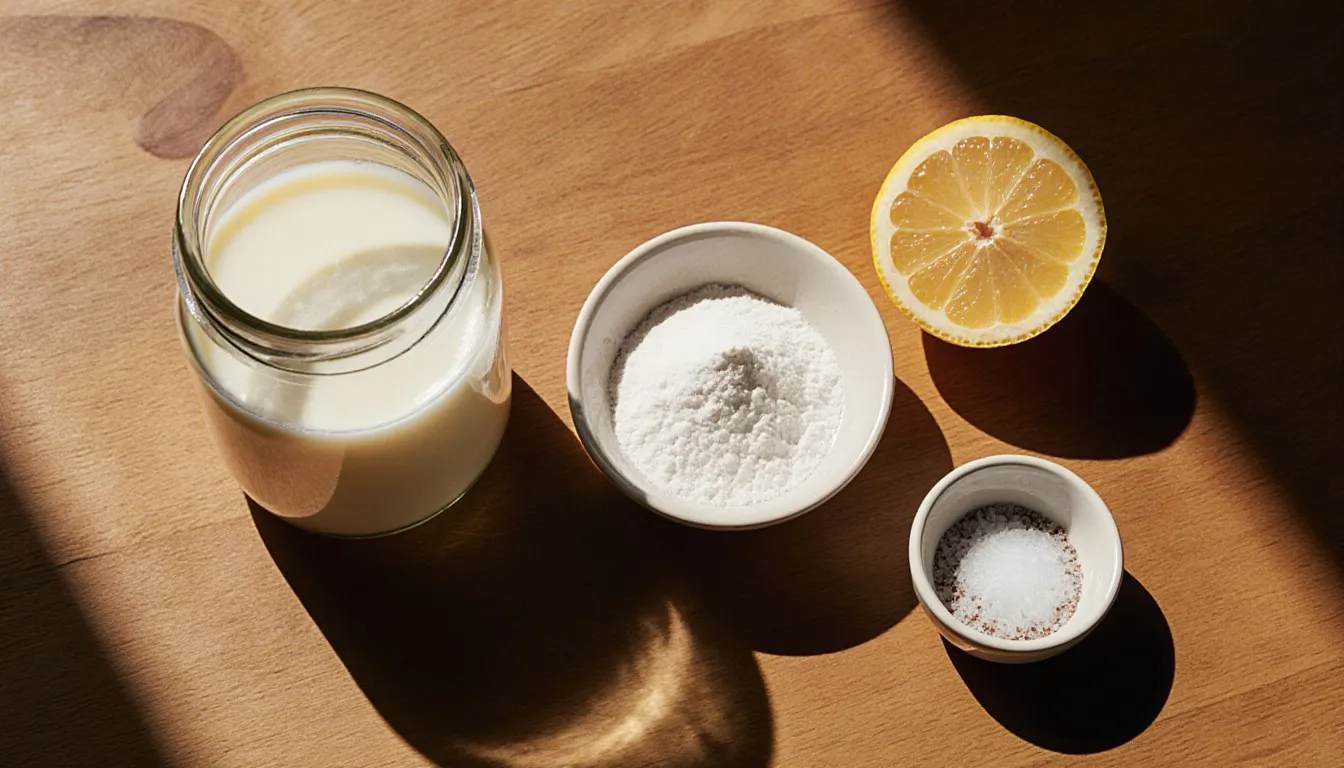
Out of buttermilk for biscuits? Stir a tablespoon of lemon juice into a cup of milk, let it sit ten minutes until it looks faintly curdled at the edges, and carry on. That works because in a biscuit the buttermilk has two jobs: bring acid to wake up the baking soda, and bring liquid with a little fat in it. In a buttermilk marinade the job changes to tenderizing over several hours, and lemon-spiked milk will leave your chicken exactly as tough as it started. Ask what the ingredient is doing in this particular dish and the swap picks itself.
That is the whole framework, and it is the thing I wish somebody had handed me twenty years ago instead of a laminated chart. The chart is useful. I keep one. But a chart only knows the swaps somebody thought to print, and your dinner will find the gap in it. Understanding the job an ingredient is doing lets you improvise past the gap, and, more importantly, tells you the handful of times you should stop and look it up instead of winging it.
What does “substitute” actually mean in a recipe?
A substitution is a functional trade: you are replacing a job, and the job is usually structural. The most common mistake I see is people picking a swap because it tastes similar, when the original ingredient was in there to hold something up and the taste was almost beside the point.
Take cream of tartar in a snickerdoodle. Nobody eats a snickerdoodle for the cream of tartar. It is there as an acid, doing two things: reacting with baking soda for lift, and keeping the sugar from crystallizing so the cookie stays chewy. Swap in another mild acid at about twice the volume, 2 teaspoons of lemon juice or white vinegar for every 1 teaspoon of cream of tartar, and you land close, though the extra liquid makes the dough slacker and the cookie spreads a little wider. Swap in nothing, or in baking powder measured one-for-one, and you get a different cookie. Once you know the job, you know which direction the error will run.
Here is the honest version of what a substitution costs you. Every swap changes something. The good ones change something you do not care about in this particular dish. Olive oil for butter in a chocolate chip cookie changes the flavor (grassier, more savory) and the spread (more, because there is no water to steam off and no milk solids to brown). If you wanted a crisp, thin, olive-oil cookie, congratulations, you meant to do that. If you wanted a bakery-style chewy cookie with browned edges, you did not.
You can substitute almost anything for almost anything, somewhere. What you want to know standing at the counter is which specific thing will change (flavor, spread, rise, color, set) and whether that change matters in the dish you are making tonight. That is what this whole guide teaches you to answer without looking anything up.
The three-part test for any swap
Before you pour anything into the bowl, run through this. It takes about four seconds once it is habit.
- What job is it doing? Fat, acid, leavener, binder, thickener, flavor, or two of those at once. Most ingredients do more than one, and that is where swaps go sideways.
- Is this dish forgiving? A braise will absorb almost any reasonable adjustment. A layer cake will not. More on that below.
- Can I taste and adjust? If yes, be bold. If the dish goes in the oven and you find out in forty minutes, measure carefully and pick a conservative swap.
My mother had a shorter version of this, which she said every time I asked her whether I could use something else: “you can, but you won’t like it.” She was right maybe seventy percent of the time, which is a suspiciously good hit rate for someone who never measured anything.
The six jobs every ingredient is doing
Nearly everything in your kitchen is performing one of six functions, and the swap follows the function. Learn these six and you have covered the vast majority of the substitutions you will ever need.
Fat: richness, tenderness, and heat transfer
Fat coats flour proteins so they cannot link up into tough gluten strands, which is why fat is what makes a cake tender and a pastry short. It also carries fat-soluble flavor compounds, browns food, and moves heat into whatever is in the pan.
Solid fats and liquid fats are not interchangeable, and this is the single most common fat mistake. Butter and shortening are solid at room temperature, so they hold air when you cream them and they leave pockets that turn into flake in a pastry. Oil cannot do that. Melted butter cannot do that either, which is why a recipe that says “softened butter” and a recipe that says “melted butter” are describing two different cakes.
Within a category, though, swap freely. Any neutral oil for any other neutral oil, straight across: canola, grapeseed, sunflower, refined safflower, plain vegetable oil. They differ in smoke point and price, not in what they do to your muffin. Extra-virgin olive oil is a different animal, peppery and assertive and lower-smoking, and it belongs in dishes where you want to taste it. I do not fry in it, and I do not make a delicate vanilla cake with it. I put it in a rosemary olive oil cake on purpose.
The deeper trade-offs, including the fussy question of what happens when you swap solid for liquid in a bake, get sorted out in butter substitutes and oil substitutes if you want the exact ratios.
Acid: brightness, tenderizing, and chemistry
Acid does three jobs and you have to know which one you are hiring it for. It brightens flavor (a squeeze of lemon at the end of a soup). It tenderizes protein and softens crumb. And it reacts with baking soda to make carbon dioxide, which is lift.
For brightness, acids are almost fully interchangeable if you adjust for strength and flavor. Lemon juice, lime juice, white wine vinegar, cider vinegar, rice vinegar, a splash of wine: all of them make a dish taste more like itself. Vinegars are generally sharper than citrus, so use about two-thirds as much: 2 teaspoons of cider vinegar where a recipe asks for a tablespoon of lemon juice, then taste and creep up. Where that trade fails is anything that leans on citrus perfume, a lemon curd or a key lime pie, since vinegar brings the sourness and none of the smell. Acid is easy to be brave with, since you can always add another squeeze and you can never take one out. Go in light, taste, and go again.
For chemistry, be precise. If a recipe uses buttermilk and baking soda, you cannot swap in plain milk and keep the soda, because there is now nothing for the soda to react with and you will taste it: soapy, metallic, faintly bitter. Either bring your own acid or change the leavener. Vinegar substitutes and lemon juice substitutes cover the ratios where it matters.
Leaveners: lift, and the one pair people confuse
Baking soda and baking powder are not the same product and swapping them one-for-one is the classic disaster. Baking soda is pure sodium bicarbonate: it needs an acid in the recipe to do anything, and it is roughly three to four times stronger than baking powder. Baking powder is baking soda with a powdered acid already blended in, plus starch to keep it dry, so it works on its own with just moisture and heat.
Practically: if you are out of baking powder, you can often build it from baking soda plus cream of tartar, since you are just supplying the acid the powder would have brought. Going the other direction is worse. Replacing baking soda with baking powder means using several times the volume, which drags in a lot of extra powder and can leave a chemical tang, and you still have unreacted acid sitting in the batter with nowhere to go.
Yeast is not in this conversation at all. Yeast is a living thing on its own schedule, and no amount of chemical leavener produces what a slow fermented dough produces. You can make a perfectly good quick bread without yeast. You cannot make a baguette.
Binders: eggs, and what actually holds things together
An egg in a recipe might be doing any of four jobs, and the swap depends entirely on which. In meatloaf or a crab cake, the egg is glue. In a custard, it is the thickener and the whole structure. In an angel food cake, whipped whites are the leavening. In an enriched dough, the yolk is fat and color and tenderness.
This is why “an egg substitute” is a nonsense phrase on its own. A flax egg glues beautifully and leavens not at all. Applesauce adds moisture and a little binding and zero structure. Aquafaba whips into a genuine foam and does nothing for richness. Match the substitute to the job the egg was hired for and you will be fine. Egg substitutes and the applesauce egg substitute go through each of these cases with amounts.
Thickeners: starch, protein, and reduction
You have three ways to thicken a liquid and they behave differently. Starches (flour, cornstarch, arrowroot, potato starch, tapioca) swell and gel. Proteins (egg yolk, cream, a puree of beans or vegetables) build body. And reduction just boils water away, concentrating everything including the salt, which is why you salt at the end of a reduction and not the beginning.
Among the starches, cornstarch has roughly twice the thickening power of flour by volume, so a rough working rule is one tablespoon of cornstarch where a recipe calls for two of flour. They are not stylistic equals, though. Flour, cooked into a roux with fat, gives you an opaque, comfortable, gravy-and-chowder texture with a toasty flavor from the browning. Cornstarch gives a glossy, clear, slightly slick set, which is exactly right in a stir-fry sauce or a fruit pie and wrong in a sausage gravy.
Arrowroot and tapioca set clear and tolerate freezing better than cornstarch, which weeps when thawed. Cornstarch also loses its grip if you boil it hard for too long or if you add a lot of acid, so stir it in near the end. Cornstarch substitutes has the full rundown of which starch to reach for.
Aromatics and seasoning: flavor with nothing structural at stake
Herbs, spices, alliums, zest, and most salt decisions carry no structural load. Nothing collapses. This is the sandbox, and you should play in it.
The one exception that trips everyone: salt is not salt. Kosher salt and table salt measure completely differently by volume because of crystal size, and the two major kosher brands differ from each other. A teaspoon of fine table salt packs far more sodium than a teaspoon of coarse kosher salt. If a recipe says kosher salt and you have table salt, use meaningfully less and taste, especially in anything you cannot correct later. In a soup it is a shrug. In a brine or a cure, it matters a great deal, and that is one of the few flavor decisions that is really a technical one.
Baking versus cooking: why the rules change at the oven door
On the stovetop you get another turn; in the oven you get one. That single fact sets how bold you can be with a swap in each place.
On the stove, you taste as you go. The sauce is too sharp, you add a knob of butter. The chili is flat, you hit it with vinegar. Every decision is reversible in the sense that you get another turn. I improvise constantly on the stovetop and so should you: a shallot for an onion, chicken stock for beef stock, sherry for white wine. Nothing there is load-bearing.
In the oven, you commit everything at once and find out in forty minutes. The ratios of flour to fat to sugar to liquid to leavener are doing structural work, and they interact. Sugar in a cake does four jobs at once: sweetness, tenderness, moisture retention, and browning. Cut it by a third and you get a paler, drier, tougher cake along with the lower sweetness you were after. Flour is the gluten network the whole thing hangs on, which is why changing it changes everything above it.
So my rule splits cleanly. On the stovetop, substitute on instinct and correct with your palate. In the oven, substitute one variable at a time and measure it. Change the fat or change the flour, not both, so that if it comes out wrong you know which decision to blame. The stricter rules, and the swaps that genuinely survive a bake, live in baking substitutions.
There is a middle ground worth naming: braises, stews, soups, and anything that cooks long and wet. These absorb a swap better than a quick sauté does, because an hour of low heat blends everything and you can taste at any point along the way.
If you are nervous about a substitution, try it in a stew first. A braise forgives almost everything except too much salt.
Dairy and fat: the substitutions people reach for most
Dairy is where most people first run out of something, usually at seven on a Tuesday, and it is mostly a question of fat percentage and thickness. Sort your dairy along those two axes and the swaps become obvious.
Heavy cream sits at the fat-rich end, then half-and-half, then whole milk, then low-fat, then skim. Moving down that ladder means less richness and a thinner sauce; moving up means more. To go up, add fat: 3/4 cup whole milk whisked with 1/4 cup melted butter stands in for a cup of heavy cream in a sauce or a soup. Whisk the butter in slowly so it disperses instead of setting into little yellow beads on the surface. That trick has one hard limit, and it is worth knowing before you ruin an evening. Reconstituted “cream” will not whip. Whipping needs the intact fat globules of real cream, and butter stirred into milk cannot rebuild them. If a recipe needs whipped cream, buy cream.
The cultured dairy family, sour cream, yogurt, crème fraîche, buttermilk, labneh, does double duty as fat and acid, which is why they show up in tenderizing marinades and in bakes leavened with soda. They swap for each other cup for cup with an adjustment for thickness: whisk about 2 teaspoons of milk into a cup of Greek yogurt to stand in for sour cream, or drain a cup of regular yogurt in a lined strainer for 30 to 60 minutes, until it mounds on a spoon instead of sliding off, to go the other way. Where they will not cover for each other is anything you need to whip or to hold up as a frosting. Their weak point is heat. Lower-fat cultured dairy curdles when it hits a boil, so stir yogurt into a hot curry off the heat, or temper it first. Crème fraîche has enough fat to hold together in a simmering sauce, which is exactly why it costs what it costs.
Cheese swaps sort by moisture and by whether you need it to melt. Aged, dry, salty cheeses (parmesan, pecorino, cotija) are seasoning; you can trade among them and adjust for saltiness. Young melters (mozzarella, fontina, Monterey Jack, mild cheddar) are for stretch and pull. Crumbly fresh cheeses (feta, queso fresco, ricotta) bring texture and tang and mostly do not melt at all, they just soften. Trading across those three groups is where a dish falls apart: feta will not melt into a queso no matter how long you stare at it. The specifics for all of this are in dairy substitutes, butter substitutes, and cheese substitutes.
One food-safety note, since dairy is where it bites. Anything cultured or fresh that has been sitting out is not worth gambling on. USDA guidance holds that perishable foods should not stay in the danger zone between 40°F (4°C) and 140°F (60°C) for more than two hours, and no more than one hour if the room is above 90°F (32°C). A carton of cream that spent the afternoon on the counter goes in the bin, and no amount of sniffing it changes that.
Eggs, flour, and sugar: the baking trio that trips people up
These three are the least forgiving swaps in the kitchen because all three are structural, and a bake gives you no chance to correct. Everything else in a cake can flex. These cannot, not much.
Flour is the frame. Protein content determines how much gluten develops, which determines chew. Bread flour is high protein for structure and chew; cake flour is low protein and often chlorinated for a fine tender crumb; all-purpose sits in between and is genuinely the right answer for most home baking. You can nudge all-purpose down toward cake flour by removing some and replacing it with cornstarch, which dilutes the protein. Nudging it up toward bread flour is harder and mostly a matter of accepting a slightly softer loaf.
The bigger trap is nut and alternative flours. Almond flour, coconut flour, oat flour, and the gluten-free blends are not wheat flour with a different label. They have no gluten, so they cannot build a network on their own, and their absorbency is wildly different: coconut flour drinks liquid like nothing else in the pantry and cannot be swapped by volume for anything. Treat them as a different recipe, with its own liquid and egg counts worked out by someone who tested it. Flour substitutes and almond flour substitute handle each case.
Sugar is not just sweet. It is hygroscopic, so it holds moisture and keeps a cake soft for days. It tenderizes by getting in the way of gluten. It caramelizes and browns. It helps cream air into butter for lift. Trading granulated for brown sugar brings molasses, which brings acid and moisture and a chewier, darker result: fine in a cookie, noticeable in a delicate cake. Liquid sweeteners like honey and maple syrup bring their own water, so for every cup of honey you use, cut about 1/4 cup of liquid elsewhere and use only about 3/4 cup of honey per cup of sugar, since honey tastes sweeter. They also brown well ahead of schedule: drop the oven 25°F (about 15°C) and start checking 5 to 8 minutes before the recipe says. You are looking for deep gold at the edges while the center still looks matte and set, not glossy. If the rim is going bronze and smelling toffee-ish that early, tent it with foil. Sugar substitutes for baking sorts out which ones survive an oven.
Eggs I covered above, but the baking-specific version deserves its own line: the more eggs a recipe has relative to its flour, the more the eggs are the structure and the less you should be substituting. One egg in a batch of oatmeal cookies is negotiable. Six eggs in a sponge cake is the cake. Egg substitutes in cake and egg substitutes in cookies go case by case.
My honest advice on all three: if you are missing one and it is a special-occasion bake, make something else. I have rescued a lot of dinners with a clever swap. I have never once rescued a birthday cake that way.
Herbs, spices, and aromatics: substituting for flavor, not structure
This is the most forgiving category in cooking, and the one where people are weirdly most timid. Nothing collapses if you use thyme instead of oregano. Dinner just tastes a bit different, which happens every time you cook anyway.
The rule that actually matters is dried to fresh. Drying concentrates flavor and drives off the volatile compounds, so the standard working ratio is one part dried to three parts fresh: a teaspoon of dried oregano for a tablespoon of fresh. Add dried herbs early so they have time in the liquid to soften and bloom; add fresh ones at the end so they do not go dull and brown. Some herbs survive drying well (oregano, thyme, rosemary, bay, marjoram) and some are barely worth the jar (basil, parsley, cilantro, chives, dill go flat and hay-like). If a recipe leans on fresh basil for its whole personality, dried basil is not the answer, and neither is skipping the dish. Reach for a different fresh herb and let it be a different dish.
For spices, think in families. Warm sweet spices (cinnamon, nutmeg, allspice, cardamom, clove, mace) overlap enough to cover for each other in small amounts, which is why a nutmeg substitute is usually half as much of something else in that group, 1/4 teaspoon of allspice or mace for 1/2 teaspoon of nutmeg, clove at more like a third since it bullies everything around it. Earthy savory spices (cumin, coriander, caraway) share a lane. Chile powders are their own problem because heat and flavor scale independently: smoked paprika has roughly none of cayenne’s heat and a load of smoke cayenne does not have, so a teaspoon-for-teaspoon trade lands you somewhere else entirely. Read whether the recipe wants heat or wants flavor.
Whole spices keep their punch far longer than ground, which is the single best argument for a spice grinder. Ground spices do not spoil in any dangerous sense; they just fade into sawdust. If you shake the jar and smell nothing, it will do nothing for your food. That jar of coriander from a previous apartment is not seasoning anything.
Aromatics trade freely with an adjustment for intensity and sweetness. Shallots are milder and sweeter than yellow onions; leeks are gentler still and need real washing; scallion whites are the fastest stand-in when you want onion without a long sauté. Garlic powder is not fresh garlic and I will not pretend otherwise, but it is genuinely better than nothing in a rub or a dressing, and anyone who sneers at it has never made dinner on a deadline. Herb substitutes and spice substitutes go herb by herb.
Wine, vinegar, and oil: swapping liquids without losing the dish
Cooking liquids each do a specific job, and once you name the job the swap is easy. Wine brings acid, a little sweetness, and a lot of aromatic complexity, plus alcohol that dissolves flavor compounds water cannot reach. Vinegar brings sharp acid and almost nothing else. Oil brings fat, moisture, and heat transfer. Stock brings body and savory depth.
When a recipe calls for wine, ask whether it is being used to deglaze, to build a sauce, or to braise. For deglazing, almost any flavorful liquid lifts the browned bits: stock, a splash of vermouth, beer, even water with a little vinegar. For a sauce where the wine is the flavor (a beurre blanc, a coq au vin) a substitute changes the dish, and you should decide whether you want that dish. For non-alcoholic swaps, the usual approach is stock or juice plus a little acid to replace what the wine’s tartness was doing, because juice alone lands sweet and flabby. Cooking wine substitutes and non-alcoholic substitutes for alcohol in cooking cover the specific bottles.
A word on the bottle itself: cook with wine you would drink, but it does not need to be good wine. A ten-dollar bottle of dry white is fine. The salted “cooking wine” on the grocery shelf is the one I would skip, since it adds sodium you cannot control. And a dish that simmers does not lose all its alcohol; some remains, which matters if you are cooking for someone avoiding it entirely.
Vinegars trade for each other easily as long as you match the intensity and think about color. White wine vinegar, rice vinegar, and cider vinegar are all mild and mostly interchangeable in a dressing. Balsamic is sweet and syrupy and dark, so it is not a neutral swap for anything, and it will tint a pale sauce brown. Distilled white vinegar is harsh and one-note, which is right for pickling and wrong in a delicate vinaigrette. Balsamic vinegar substitute and red wine vinegar substitute get into the details.
Oils I covered under fats, but for liquid swaps specifically, the two things that matter are smoke point and flavor. Refined oils take high heat; unrefined and extra-virgin oils do not and will turn acrid. Toasted sesame oil is a finishing oil, not a cooking oil, and treating it as a neutral swap is how a stir-fry ends up tasting scorched.
Sauces, meat, and vegetables: substituting whole ingredients
Swapping a whole component is a different exercise from swapping one function, a bottled sauce or a cut of meat is doing five jobs at once, and you have to match all of them: salt, texture, fat, sweetness, and how long the thing needs to cook.
Sauces are the clearest example. Fish sauce brings salt, funk, and glutamate-driven savoriness. Soy sauce brings salt, savoriness, and a roasted note but very little funk. Worcestershire brings salt, tang, sweetness, and some of that anchovy funk. They overlap on the salt-and-savory axis, which is why they can cover for each other, and they part ways on sweetness and sharpness, which is why you adjust after tasting. When you sub one bottled sauce for another, taste the dish before you add any more salt, because you have already changed the salt level whether you meant to or not. Sauce substitutes and the individual bottles (oyster sauce substitute, hoisin sauce substitute, soy sauce substitute) go one by one.
Meat swaps run on connective tissue and fat, and the name on the label tells you less than the feel of the cut in your hand. A hard-working muscle full of collagen (chuck, shoulder, shank, short rib) needs long moist heat to turn tender, and it rewards you with a rich sauce. A tender lean cut (loin, tenderloin, breast) needs fast high heat and turns to sawdust in a braise. Swap within a group and the recipe barely notices. Swap across groups and you have to change the cooking method with it, which is where people go wrong: a pork loin cooked like a pork shoulder is a tragedy, and a pork shoulder cooked like a loin is a workout for the jaw.
Two safety points here, and these are the ones I will not soften. Cooking times in a recipe are estimates; internal temperature is the actual answer, and a probe thermometer is the best inexpensive thing in my kitchen. Poultry, whole or ground, goes to 165°F (74°C). Ground beef, pork, veal, and lamb go to 160°F (71°C). Whole cuts of beef, pork, veal, and lamb go to 145°F (63°C) with a three-minute rest. Those numbers do not move because you swapped chicken thighs for breasts. And swapping raw proteins means re-checking the temperature target, not carrying over the old one.
Vegetables swap by texture, water content, and cooking time more than by flavor. A dense root (carrot, parsnip, turnip, celery root) can stand in for another dense root with a small timing adjustment. Sturdy greens (kale, collards, chard stems) cook down slowly; tender greens (spinach, arugula, watercress) wilt in seconds and turn to mush if you treat them like kale. The mistake is swapping by taste alone and then cooking to the original timing, which is how you get raw turnip and disintegrated zucchini in the same pan. Vegetable substitutes and meat substitutes have the cut-by-cut and vegetable-by-vegetable specifics.
When you’re missing equipment, not ingredients
Half the panicked substitution questions in my inbox are about a tool, not an ingredient. Those are the easy ones, because you are only replacing a physical action.
Name the action and the answer appears. A sieve strains and a food mill strains while mashing, so a sieve plus the back of a ladle does a food mill’s job with more elbow grease. Cheesecloth filters and holds shape, so a clean flour-sack towel, a coffee filter, or a fine-mesh strainer lined with a paper towel covers most of what it does. A lid traps steam, so a sheet of foil crimped over the pot works, and so does a baking sheet. Pie weights hold pastry down during a blind bake, and dried beans or plain rice on a sheet of parchment do the same thing (and can be reused for weighting, though they will not cook well afterward).
A few work-arounds are worth being careful with. Wax paper is not parchment paper and will smoke in a hot oven; it is for wrapping and rolling, not baking. Foil in place of parchment on a sheet pan is fine for roasting but will stick badly for cookies unless you grease it. And a stand mixer’s job (sustained mechanical work) is genuinely hard to replace by hand for something like a meringue or an enriched dough; you can do it, but budget real time and a sore arm.
The other half of this category is beverages, oddly enough, where people are missing a machine rather than an ingredient: coffee without a coffee maker, espresso without a machine, coffee without a filter. Same principle, name the action. A coffee maker steeps grounds in hot water and filters them, so anything that steeps and strains gets you a cup. Kitchen equipment substitutes runs through the whole tool shelf.
The one rule that keeps a substitution from wrecking dinner
Here is the decision rule, and it is short enough to keep in your head at the grocery store: substitute freely for flavor, carefully for structure, and not at all for safety.
Flavor swaps are reversible. You taste, you adjust, you add another squeeze of lemon. Be bold here, because timidity in the seasoning is why home cooking sometimes tastes flat next to restaurant food.
Structural swaps are one-way doors. Measure them, change one thing at a time, and expect a different result rather than the same one. If the bake matters, do not experiment on the day it matters.
Safety swaps stay on the page as written. Curing salts, canning procedures, tested acidity levels in preserves, and doneness temperatures are all worked out at the edge of what is safe, and the failure mode is botulism or a hospital, not a disappointing dinner. If a canning recipe specifies a particular vinegar acidity or processing time, that number is doing a job you cannot see. Follow the tested recipe or make something else.
And then there is the fourth category, the one nobody wants to hear: sometimes the answer is no. Some dishes exist entirely because of one ingredient, and swapping it out leaves you cooking something else under the recipe’s name. Saffron in a paella. Real vanilla in a plain custard where there is nothing to hide behind. Buttermilk in a proper buttermilk pie. There is no shame in cooking something else tonight, and honestly, deciding not to make a thing is a skill too.
What I would actually do, standing in your kitchen missing something: write the ingredient down, ask what job it was doing, pick the closest thing that does that job, and then make one small adjustment for what you know will change. Less salt because the soy sauce brought its own. A bit less liquid because the honey brought water. A few minutes less in the oven because the brown sugar browns faster. That last small adjustment is where most swaps are won, and skipping it is why so many of them come out edible but sad.
Keep the ratios you use most on a card taped inside a cabinet door, because you will not remember the cornstarch-to-flour ratio at six on a weeknight, and neither do I. Everything else you can reason out from the job the ingredient was doing. That is the whole trick, and it will outlast any chart you print. Easy peasy, as my kids inform me nobody has said since the nineties.
Tessa Calloway
Staff Writer
Tessa Calloway has spent twenty years cooking dinner on a weeknight clock and testing the shortcuts that survive contact with a real kitchen. She believes the best recipe is the one you can make with what's already in the house, and she has strong opinions about what actually needs to be homemade (less than you think) and what always does (dressing).