How to Tell If a Baking Substitution Will Hold Before You Bake It
Most baking substitutions fail for one reason: the swap can’t do the job the original was doing. Here’s how to judge any swap before it costs you a cake.
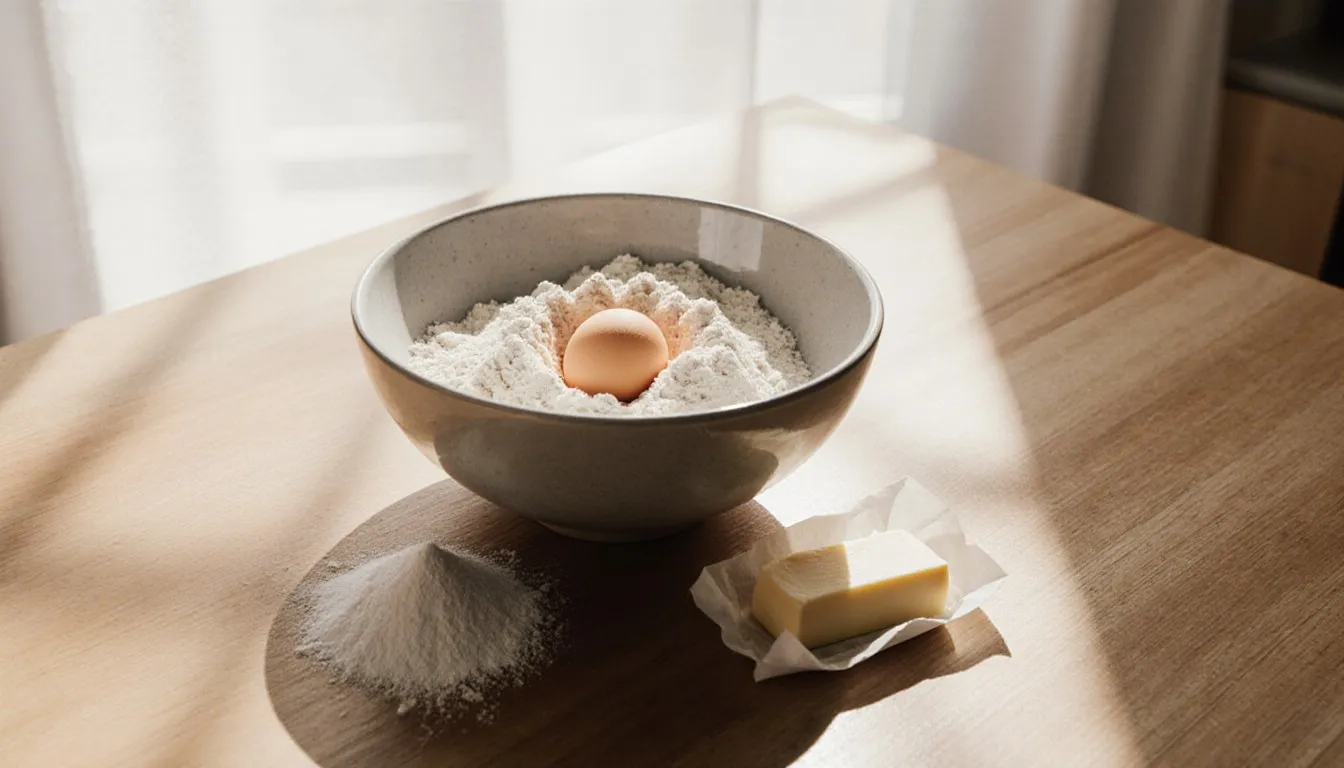
Before you swap anything into a bake, ask one question: what job is that ingredient doing in there? Swap the cinnamon for cardamom and the worst that happens is a cake you like less. Swap the butter for oil in that same cake and you have quietly removed the step that put air in it, and the batter will not say a word about it while you stir. It waits until it comes out of the oven with a crater in the middle. That one question, asked while you are still standing at the open pantry, catches most doomed baking substitutions before they cost you an afternoon and a $4 bag of chocolate chips.
Below, how to sort any ingredient list into flavor and architecture, the swaps I make on autopilot, the four that need a second adjustment to go with them, and the tells the batter gives you while there is still time to fix it. Learn to read those and you can size up a substitution nobody wrote a chart for.
Why does a baking substitution fail more often than a dinner one?
Because a savory pan is forgiving and an oven is not. If you are out of shallots for a pan sauce, you use half an onion, taste it, and adjust. The dish is open the whole time. You can add acid at minute eight, more salt at minute ten, a knob of butter at the end to pull it together. Nothing is locked in until you serve it.
A batter is a closed system on a timer. The moment it goes into the oven, every decision you made is final, and several of them are chemical reactions that started the second the liquid hit the dry ingredients. Baking soda begins fizzing on contact with acid. Flour proteins start linking into gluten as soon as they are hydrated and stirred. Sugar is already pulling water out of the flour and holding onto it. You cannot taste a cake at minute twelve and fix its structure.
So the same swap can be brilliant in one context and a disaster in the other. Yogurt for sour cream in a stroganoff is nothing. Yogurt for sour cream in a quick bread changes the fat content, the water content, and how much acid is available to react with the baking soda, all three at once. The savory side of this thinking gets its own treatment in the broader guide to cooking substitutes; here we are strictly in the oven.
What is that ingredient actually doing in the recipe?
Every ingredient in a bake is doing at least one of four jobs, and most are doing two or three at the same time. Naming the jobs is the whole trick, because you can only replace what you can identify.
- Structure: flour and eggs build the frame that holds the crumb up once the water bakes off. Stir wheat flour with liquid and it goes stretchy on you, and that stretch is the net. Eggs work the other way around: they stay loose until heat sets them, the way they do in a custard, and then they hold whatever shape they were in.
- Leavening: the lift. Baking soda needs an acid in the bowl (buttermilk, brown sugar, molasses, cocoa, yogurt, vinegar) to produce gas. Baking powder brings its own acid along, which is why it works in a batter with nothing sour in it. Whipped eggs, creamed butter, and steam all leaven too, mechanically rather than chemically.
- Moisture and fat: fat coats flour so it can’t form as much gluten, which is what makes a cake tender instead of chewy. Liquid hydrates the starch. Fat also carries flavor and, when it is solid and you cream it with sugar, holds the air pockets your leavener later inflates.
- Sugar, which is barely about sweetness: sugar hangs onto water, which is why a well-sugared crumb is still soft on day three. It keeps the flour from toughening up. It is where most of your color and that toasty bakery smell come from. And when you cream it into butter, the grit is the tool, every crystal dragging a pocket of air in behind it. Pull sugar out of a cookie and you lose spread, color, and shelf life along with the sweet.
Here is the practical version. An egg in a custard is doing structure. An egg in an angel food cake is doing leavening. An egg in a meatloaf is doing binding, and honestly not much else. Same ingredient, three different jobs, three completely different sets of things that could stand in for it, which is exactly why the guide to egg substitutes has to be read job by job rather than as one blanket ratio.
Which parts of a recipe are flexible, and which are load-bearing?
Read the ingredient list and sort it into two piles: things that add flavor and things that hold the building up. The flavor pile you can play with tonight, no math required.
Freely flexible: spices, extracts, zest, chips, nuts, dried fruit, the type of chocolate, whether it’s cinnamon or cardamom. Swap them by taste and preference. Two cautions. Keep the total volume of mix-ins roughly where the recipe had it, because two cups of chips in a dough built for one will weigh the crumb down and change how the cookies spread. And a wet mix-in counts as liquid: swapping dried cranberries for fresh berries adds water the recipe never budgeted for.
Load-bearing, handle with a plan: flour, eggs, leaveners, the fat, the sugar quantity, and the total liquid. Change any of these and you have changed the architecture. Salt sits in an odd middle spot. In a cake it is flavor. In yeast bread it is doing real work, tightening the gluten and slowing the yeast down, so cutting it changes the dough’s behavior, not just its taste.
My rule after twenty years of weeknight dinners: change one load-bearing thing at a time. If you are already subbing oil for butter, that is not the night to also try the whole wheat flour and the honey. When something goes sideways with three swaps in play, you have learned nothing, and you get to bake it wrong again next month. Long story short, one variable per bake.
Why “cup for cup” is the phrase that gets bakers in trouble
Because a cup is a measure of space, and baking runs on mass. Two ingredients that fill the same cup can be wildly different amounts of actual substance, and the batter responds to the substance.
Flour is the worst offender. Dip a cup into the bag and pack it down and you can pick up dramatically more flour than someone who spoons it in loosely and levels it off with a knife. Same recipe, same “one cup,” meaningfully different dough. Bakers blame that gap for more dry, dense crumbs than any substitution causes, and no swap has to be involved at all. King Arthur Baking publishes a weight chart for its ingredients for exactly this reason, and once you own a $15 scale, the whole category of problem disappears.
Now stack a substitution on top of that. Almond flour and coconut flour do not weigh what wheat flour weighs per cup, and coconut flour drinks liquid at a rate nothing else in the pantry matches. Brown sugar is measured packed, granulated is not. Powdered sugar is mostly air by volume. Honey is a liquid standing in for a solid, so it brings water into a batter that was balanced without it. Solid butter and liquid oil at one cup each are not the same amount of fat, and one of them can hold air while the other cannot.
The genuine exception: the gluten-free blends sold as “cup for cup” or “measure for measure” have been formulated by weight to match all-purpose flour in volume. That is the product doing the conversion for you. It is a real promise, and it is the only place I trust the phrase without checking. Everywhere else, if you can weigh the original and weigh the substitute, do that instead, and if you cannot, assume you are off and watch the batter closely.
The baking swaps that are genuinely safe to make on autopilot
These I make without a second thought, mid-recipe, hands covered in dough.
- Any milk for any other milk of similar fat, cup for cup. Whole for 2%, buttermilk for soured milk. Skim into a rich cake reads a little leaner, and that is the whole consequence. Where it stops: plain milk standing in for buttermilk in a soda-leavened batter leaves the soda nothing to react with, so that one needs the acid added back.
- One neutral oil for another, measure for measure. Canola, vegetable, sunflower, refined light olive. They pour the same and they bake the same. Read the bottle first, though: anything grassy and peppery, unrefined coconut, or toasted sesame will walk straight into the flavor of a vanilla cake, and a “light” olive oil that turns out to be extra virgin counts as grassy and peppery.
- Spices and extracts, one for another, teaspoon for teaspoon. Ground spices trade evenly, though cardamom and clove are strong enough that I start at half and taste the batter’s dry mix on a fingertip. If you are out of vanilla entirely, an equal amount of maple syrup or bourbon covers it in most cakes and cookies, and the vanilla extract substitute options go further, but the swap itself carries zero structural risk.
- White sugar for an equal weight of another dry granulated sugar, knowing brown sugar brings moisture, acid, and a softer chew with it. Same volume of substance, different flavor and color.
- Nuts, chips, dried fruit, chocolate type. Free, as long as the total stays near where the recipe put it, a cup of mix-ins for a cup. Double it and the dough cannot carry the load, so the cookies bake up squat and never spread. And anything wet, fresh berries or a juicy dried fruit, counts against your liquid rather than your mix-ins.
- Salt type, if you correct for crystal size. By weight they are identical, so 10 grams is 10 grams whatever the box says. By volume they are not: use about half as much fine table salt as the recipe’s Diamond Crystal kosher salt, or roughly 3/4 as much if the recipe means Morton kosher. Going the other way, 1 teaspoon of table salt is close to 2 teaspoons of Diamond Crystal. This is a volume problem wearing a flavor costume.
- Baking soda and baking powder for each other, at 3 parts powder to 1 part soda, since the acid math comes along for the ride. Going from soda to powder, use 3 teaspoons of baking powder for every 1 teaspoon of soda the recipe wanted, and cut the acid ingredient back or the batter goes sour and over-risen. Going the other direction, 1 teaspoon of powder becomes 1/4 teaspoon of soda plus 1/2 teaspoon of cream of tartar, or 1/4 teaspoon of soda plus 1/2 cup of buttermilk swapped in for 1/2 cup of the plain milk. More detail lives in the baking soda substitute and baking powder substitute guides, but those two numbers cover the weeknight version.
I keep a one-page version of this taped inside the cabinet door, organized by what each ingredient does rather than alphabetically. Structure, leavening, fat, sugar, four short columns, so at 6pm on a Tuesday I can run my finger down the column for whatever went missing and see what else in the house does that same job.
The ones that need a real plan first
Four categories change the chemistry enough that a swap has to be paired with a second adjustment. Walking into these blind is how you end up with a pan of something you serve with a spoon and a good attitude.
Leaveners. Swapping soda for powder or the reverse means also accounting for acid. Take the acid out of a soda-leavened batter and you get no lift plus a soapy, metallic aftertaste from unreacted soda. That flavor is unmistakable and unfixable.
Flour. Different flours bring different protein levels, different absorbency, and in the gluten-free case, no gluten net at all, which means something else has to do the binding. Whole grain flours also soak up more liquid, so a straight swap reads dry. The full picture is in the guide to flour substitutes.
Sugar. Cutting the amount or going to a liquid sweetener changes moisture, browning, spread, and tenderness simultaneously. Liquid sweeteners need two corrections and both have numbers. For every 1 cup of honey or maple syrup standing in for 1 cup of granulated sugar, pull about 1/4 cup of liquid out of the recipe, and drop the oven 25°F (about 15°C), because honey browns faster than sugar does. With honey, a pinch of baking soda, around 1/4 teaspoon per cup, settles its acidity. Anyone reworking this on purpose should start with the rundown on sugar substitutes for baking.
Fat. The single most common quiet failure. Oil for butter in a creamed cake removes the aeration step entirely, because you cannot cream air into a liquid, and no amount of baking powder fully makes up the difference. Butter is also roughly 15 to 20 percent water, so replacing it with pure fat like shortening or oil takes hidden liquid out of your recipe. The details live in the guide to butter substitutes.
How can you tell a substitution is working before the bake is ruined?
The batter tells you, if you know what to look at. Compare what is in your bowl to what the recipe describes and to what you remember from the last time you made it correctly.
- Creamed butter and sugar should go noticeably paler and lighter, closer to ivory than yellow, and hold a soft shape on the paddle. If your substitute fat stays glossy and dense after four or five minutes, it is not holding air, and your cake will be tight.
- Cake batter should fall from the spatula in a thick ribbon that sinks back in a second or two. Water-thin means too much liquid. Sitting in a stiff clump means too much flour or a thirsty substitute.
- Cookie dough should be scoopable and hold its shape on the sheet. If it slumps and spreads before it ever sees heat, it will spread into a single continental pancake in the oven. Chill it hard, or bake one test cookie and find out for the price of one cookie instead of three dozen.
- Whipped whites or cream should hold a peak that stands up when you lift the whisk. Any fat contamination and they never will.
- The oven itself is a monitor. Sweet, toasty, and caramel around the 20 minute mark is right. Sharply dark or acrid at the edges before the middle sets usually means a sugar swap that browns faster than what the recipe expected, and you can save it by tenting foil over the top.
One firm no. Do not taste raw batter or dough to judge a swap. Raw flour and raw eggs both carry a real risk of foodborne illness, and neither one is worth a bite of cookie dough. Judge by look, feel, and smell.
What to do when the bake still doesn’t turn out right
Cut it open and read it. Every failure mode points back at a specific job that went unfilled, and once you can name it, you will not repeat it.
- Dense and heavy: too much flour by weight, or a fat that could not hold air, or a leavener that had nothing to react with.
- Flat with a sunken middle: too much liquid or too much leavening. Over-leavened batter rises hard and fast, then collapses when the structure cannot keep up.
- Gummy, with a wet seam near the bottom: excess moisture or a starchy substitute that never fully set. Often it is simply underbaked, since extra liquid means extra time.
- Dry and crumbly: not enough fat or sugar to hold water, or a more absorbent flour that needed extra liquid you never added.
- Pale and anemic: less sugar, less dairy, or fewer proteins to brown. Nothing is wrong with the texture, but you lost the Maillard browning that makes a crust taste like something.
- Tunnels and a peaked, cracked top: overmixed, so the gluten built more net than a tender cake wants. Sometimes an oven running hot.
- Soapy or metallic: unreacted baking soda. Nothing saves it. Toss it and adjust next time.
Write down what you changed and what came out, right on the recipe card, in pen. My mother did it, I do it, and it is the only reason I know that my oatmeal cookies want the oil version and my yellow cake absolutely will not tolerate it. Two or three notes in the margin and you stop guessing forever, which beats any chart I could give you.
Tessa Calloway
Staff Writer
Tessa Calloway has spent twenty years cooking dinner on a weeknight clock and testing the shortcuts that survive contact with a real kitchen. She believes the best recipe is the one you can make with what's already in the house, and she has strong opinions about what actually needs to be homemade (less than you think) and what always does (dressing).