Sugar Substitutes for Baking: The Ratios, and What Each Swap Costs You
The sugar substitutes for baking that hold up, with exact ratios, plus what each swap does to browning, moisture, and texture before it hits the oven.
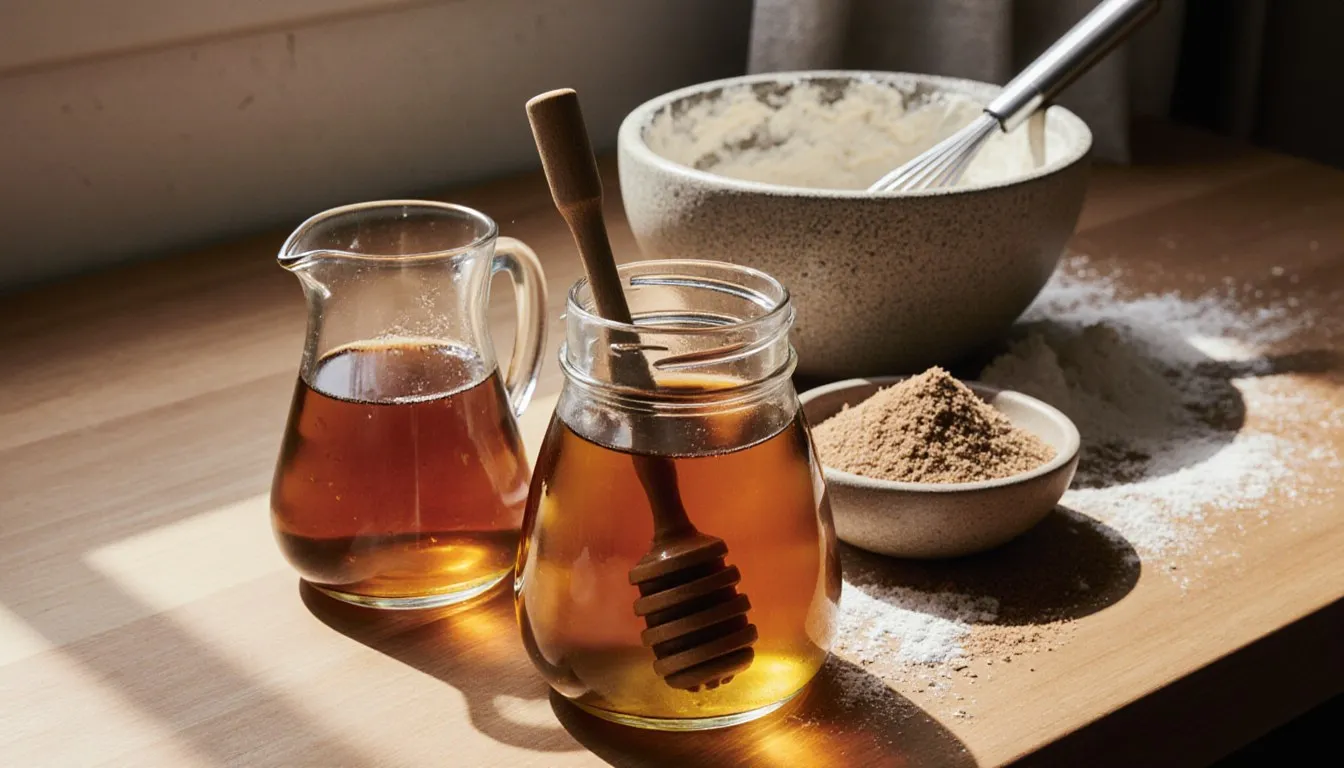
There is no sugar substitute that behaves exactly like sugar in a batter, and the ones that come closest are the ones that are still, chemically speaking, sugar. Honey and maple syrup get you the browning and the moisture but throw off your liquid. Coconut sugar swaps in cup for cup and quietly gives you a drier crumb. Erythritol sweetens and then refuses to brown at all. Every one of these swaps works somewhere and fails somewhere else, and once you know which of sugar’s jobs a substitute can cover, you can predict the finished bake before you turn the oven on.
Below: what sugar is actually doing in there, then each common substitute scored against that, with ratios you can use tonight.
What Does Sugar Actually Do in a Baked Good?
Sugar does four jobs, and only one of them is sweetness. That is the whole reason substitution gets messy.
Sweetness is the obvious one, and the easiest to replace. Practically everything on this list can hit the right sweetness level with a ratio adjustment.
Moisture is the sneaky one. Sugar holds onto water, and it holds onto it hard. That is why a cookie on day three is still chewy instead of sandy, and why a cake stays tender rather than tough. Pull the sugar and put nothing comparable back, and you will taste the difference by the second morning.
Browning is what gives you the golden top, the toasty smell coming out of the oven, and the crisp caramel edge on a shortbread. Some sweeteners can do that work and some cannot, and you find out the hard way: the cookies sit in there getting done without ever getting color, and you keep leaving them in, hoping. Sugar alcohols are the usual culprits.
Structure is the one people never see coming. In the creaming method, when you beat butter and granulated sugar together for three minutes, those sharp little crystals are physically cutting air pockets into the fat, and that aeration is a real part of your leavening. A liquid sweetener cannot do that. Sugar also keeps the batter loose a little longer in the heat, so it has time to climb before it sets. And in cookies, melting sugar is a big part of the spread.
Hold every substitute below up against those four and the trade-offs stop being surprises.
Can You Substitute Honey or Maple Syrup for Sugar in Baking?
Yes, and these are the best-performing swaps on the list for browning and moisture, as long as you correct for the liquid they bring with them.
For honey, use about 3/4 cup honey for every 1 cup of granulated sugar, since honey tastes sweeter than sugar does. Then reduce the other liquid in the recipe by roughly 1/4 cup per cup of honey used, add about 1/4 teaspoon of baking soda per cup to offset honey’s acidity, and drop the oven temperature by 25°F (about 15°C). Maple syrup works the same way: 3/4 cup syrup per cup of sugar, cut the other liquid by about 3 tablespoons per cup, same 25-degree temperature drop.
That temperature drop is not optional, and it is the step people skip. Honey and maple both brown faster and harder than granulated sugar, so a muffin baked at the original temperature comes out with a dark, almost lacquered top while the middle is still wet. Start checking about five minutes before the recipe’s earliest time, and go by a clean skewer and a top that springs back rather than the clock.
What you get in exchange is a genuinely moister, denser, longer-keeping bake. Honey banana bread on day three is better than it was on day one. Where these shine: quick breads, muffins, oatmeal cookies, granola, anything glazed, anything spiced. Ginger and cardamom in particular are happy next to maple.
Where they flop: delicate cakes built on the creaming method. An angel food, a chiffon, a classic yellow layer cake that depends on beaten sugar crystals for lift will come out short, tight, and heavy. You also cannot hide the flavor. Maple tastes like maple in a vanilla buttercream, and clover honey tastes loudly like honey in a sugar cookie. My mother used to say you can’t unring that bell, and she was right about honey in a shortbread.
Is Coconut Sugar a Good Substitute for Brown Sugar in Baking?
It is a solid near-1:1 swap, and it is the least disruptive substitute here, but expect a drier crumb than real brown sugar gives you.
Use 1 cup coconut sugar for 1 cup brown sugar, with no other adjustments. Nothing else in the recipe has to move, which is why this is the swap I reach for when I want the bake to behave and I am not in the mood to do math.
The dryness has a simple cause. Brown sugar is white sugar with molasses added back, and molasses is a moisture magnet. That is what makes brown sugar clump in the box and what keeps chocolate chip cookies chewy at the center. Coconut sugar, made from the boiled-down sap of the coconut palm, has its own caramel notes but not that same hold on water. So your cookies will be a touch crisper, your blondies a shade less fudgy.
Two more things worth knowing. Coconut sugar is coarser than most brown sugar, so it does not dissolve as completely into a creamed butter mixture. Give it an extra minute of beating, or pulse it in a spice grinder for a few seconds if you want a smoother batter. And the color is darker going in, which means your finished bake reads browner than the recipe photo. That is cosmetic, not a fault, but it will fool you into thinking a cake is done when it is not. Trust the skewer.
Best uses: chocolate chip cookies, oatmeal cookies, spice cakes, crumble toppings, anything already brown and rustic. Skip it in a white cake unless you are at peace with a beige one.
What Happens When You Bake With Erythritol, Xylitol, or Allulose?
These bulk sweeteners fill the same volume sugar does, which is their whole advantage, and they cover sweetness and body while doing very different things to browning and texture. They are not interchangeable with each other, so it is worth taking them one at a time.
Erythritol is roughly 70 percent as sweet as sugar, so you need about 1 1/3 cups to match 1 cup of sugar. It does not brown and it does not caramelize, so your cookies come out pale no matter how long you leave them in. It also recrystallizes as the bake cools, which is why erythritol cookies and cakes so often go slightly gritty or sandy by the next morning. And there is the cooling sensation on the tongue, a menthol-ish chill that reads fine in a chocolate mint brownie and strange in a plain vanilla cupcake. Chocolate, coffee, and spice cover it best.
Xylitol is close to sugar in sweetness, so 1:1 works. It browns a little better than erythritol and stays softer, with less of that gritty recrystallizing. It carries its own cooling note too. One hard rule that has nothing to do with baking and everything to do with your kitchen: xylitol is highly toxic to dogs, in small amounts. If a dog lives in your house, keep the bag sealed and up high, keep the cooling rack out of nose range, and know that a countertop raid is a veterinary emergency, not a wait-and-see.
Allulose is the interesting one, because it does brown. It is a rare sugar that participates in the Maillard reaction, so you get real color and real caramel notes, which none of the others give you. It is about 70 percent as sweet as sugar, so scale up the same way you would with erythritol. Two catches. It browns fast, sometimes too fast, so pull the temperature back 25°F and watch the edges. And it stays soft and syrupy as it cools, which means cookies spread wide and thin and never fully set. If you want an allulose cookie with structure, chill the dough hard, use a little less fat, and accept a chewy result rather than a crisp one.
One practical note across all three. Sugar alcohols are widely reported to disagree with people who eat much of them at a sitting, and bakers who cook for a crowd plan around it: cut the bars small, put out a smaller tray than you think you need, and say what is in them when you set them down. A guest who knows what they are eating can pace themselves; one who assumes it is a regular brownie cannot.
Can Stevia or Monk Fruit Replace Sugar in Baking?
Not on their own. Stevia and monk fruit are high-intensity sweeteners, hundreds of times sweeter than sugar by weight, so the amount that matches a cup of sugar for sweetness is a scant fraction of a teaspoon. You have just removed a full cup of bulk from the recipe and put nothing back.
Picture what that does. A cake batter loses the volume that was holding its structure open, so it bakes short and rubbery. Cookie dough loses the melting sugar that made it spread, so the cookies come out of the oven roughly the shape of the scoop, dense little domes with pale tops. Nothing browns, because there is no sugar there to brown. The creaming step becomes pointless, since there are no crystals to cut air into the butter.
Which is exactly why nearly every retail stevia or monk fruit “baking blend” on the shelf is mostly erythritol by volume, with a whisper of the intense sweetener carried along in it. The erythritol is doing the bulking. If you use one of those blends, read the package ratio (most are formulated to measure cup for cup against sugar) and then expect erythritol behavior: pale, cool-tasting, prone to going a bit sandy overnight.
If you want to use pure stevia or monk fruit drops, the honest approach is a partial swap. Replace up to half the sugar by sweetness, leave the other half as real sugar to do the structural work, and you will get a bake that is meaningfully less sweet but still recognizably itself.
Can Applesauce or Mashed Banana Replace Sugar?
Only partway. Replace up to half the sugar and you are fine; go all the way and you get something gummy that never quite finishes baking.
The working ratio: swap unsweetened applesauce or mashed ripe banana for the sugar by equal volume, up to half the total sugar called for, then reduce the other liquid in the recipe by about 1/4 cup per cup of puree you added. Fruit purees are mostly water, and unaccounted-for water is what turns the center of a loaf into pudding.
What you are actually getting from a puree is moisture and a little sweetness. What you are not getting is browning or structure, because the sugar content in a cup of applesauce is low and there is nothing there to build a crumb. Take a muffin recipe to 100 percent applesauce and you get a wet, tight, faintly rubbery thing with a pale top that reads underbaked no matter how long it sits in the oven. Ask me how I know.
Two notes from the actual kitchen. Buy unsweetened applesauce, or you have lost track of what you are adding. And banana is never neutral, so use it where you already want banana flavor: banana bread obviously, but also chocolate muffins, oat bars, and spice cakes, where it hides well. Both purees also make a denser final product, so give the batter a slightly longer bake at a slightly lower temperature and start checking with a skewer at the recipe’s earliest time.
Which Baked Goods Should You Never Substitute Sugar In?
Some recipes are sugar chemistry with a few other ingredients along for the ride. In these four, sugar is the structure, and there is no workaround worth your Saturday.
- Meringue. The sugar dissolves into the whipped egg whites and stabilizes the foam, and it is the reason a meringue holds its peaks and dries crisp instead of weeping into a puddle. Sugar alcohols do not dissolve and stabilize the same way. You get a slumped, sticky mess.
- Macarons. A meringue with even less margin for error, plus a precise ratio of powdered sugar to almond flour that determines whether you get feet or a cracked shell. This is not the recipe to experiment on.
- Caramel. The entire product is sugar breaking down under heat. Erythritol will melt and then recrystallize into a hard, cloudy disappointment as it cools. Allulose browns and will get you closer to a sauce, but it will never firm up into a real chew.
- Brittle, toffee, and hard candy. These depend on hitting exact sugar stages, hard-crack and the rest, and those stages are properties of sucrose. A substitute does not have them.
If you want a lower-sugar dessert and these are what you are craving, go make a fruit crisp with a coconut sugar topping instead. Better outcome, and you will not have wasted six egg whites finding out.
Sugar Substitute Ratios at a Glance
The scannable version, one line each. Copy it onto an index card and tape it inside a cabinet door where you will actually see it mid-recipe.
- Honey: 3/4 cup per 1 cup sugar. Reduce other liquid by 1/4 cup, add 1/4 tsp baking soda, drop oven temp 25°F. Moister and browner; tastes like honey. Skip in delicate creamed cakes.
- Maple syrup: 3/4 cup per 1 cup sugar. Reduce other liquid by 3 tablespoons, drop oven temp 25°F. Same moisture and browning gain, unmistakable maple flavor.
- Coconut sugar: 1:1 for brown sugar, no other changes. Drier crumb, less caramel depth, darker color going in. Coarse, so cream it longer.
- Erythritol: about 1 1/3 cups per 1 cup sugar. No browning, cooling aftertaste, can turn gritty overnight. Best in chocolate and spice bakes.
- Xylitol: 1:1. Browns slightly, stays softer, still cools on the tongue. Keep it well away from dogs.
- Allulose: about 1 1/3 cups per 1 cup sugar, oven temp down 25°F. Browns properly, stays soft, cookies spread thin and never crisp.
- Stevia or monk fruit: not usable alone. Use a bulked blend at the package ratio, or replace no more than half the sugar and leave real sugar to do the structural work.
- Applesauce or mashed banana: equal volume for up to half the sugar, minus 1/4 cup of other liquid per cup of puree. Moisture only, no browning, no structure.
One habit that will save you a hot minute of frustration: change one thing at a time. Swap the sugar or swap the fat, not both in the same bake, or you will have no idea which decision made the cake sink. The same one-change rule holds across baking substitutions and cooking substitutes in general, and it is the fastest way to learn what each swap actually does in your oven.
Store anything you made with honey, maple, or fruit puree in an airtight container at room temperature, and count on it staying good longer than the sugar version would. Anything made with erythritol or a stevia blend goes the other direction, so eat it the day you bake it, before the sweetener starts to recrystallize. And if a swap disappoints you the first time, try it in a spiced or chocolate recipe before you write it off. Half the failures on this list are really just a substitute standing somewhere too plain to hide.
Tessa Calloway
Staff Writer
Tessa Calloway has spent twenty years cooking dinner on a weeknight clock and testing the shortcuts that survive contact with a real kitchen. She believes the best recipe is the one you can make with what's already in the house, and she has strong opinions about what actually needs to be homemade (less than you think) and what always does (dressing).