Out of a Spice? Swap by the Job It’s Doing in the Dish
Out of a spice mid-recipe? The real logic behind spice substitutes: flavor roles, ground-to-whole ratios, blooming a weak swap, and when to skip it entirely.
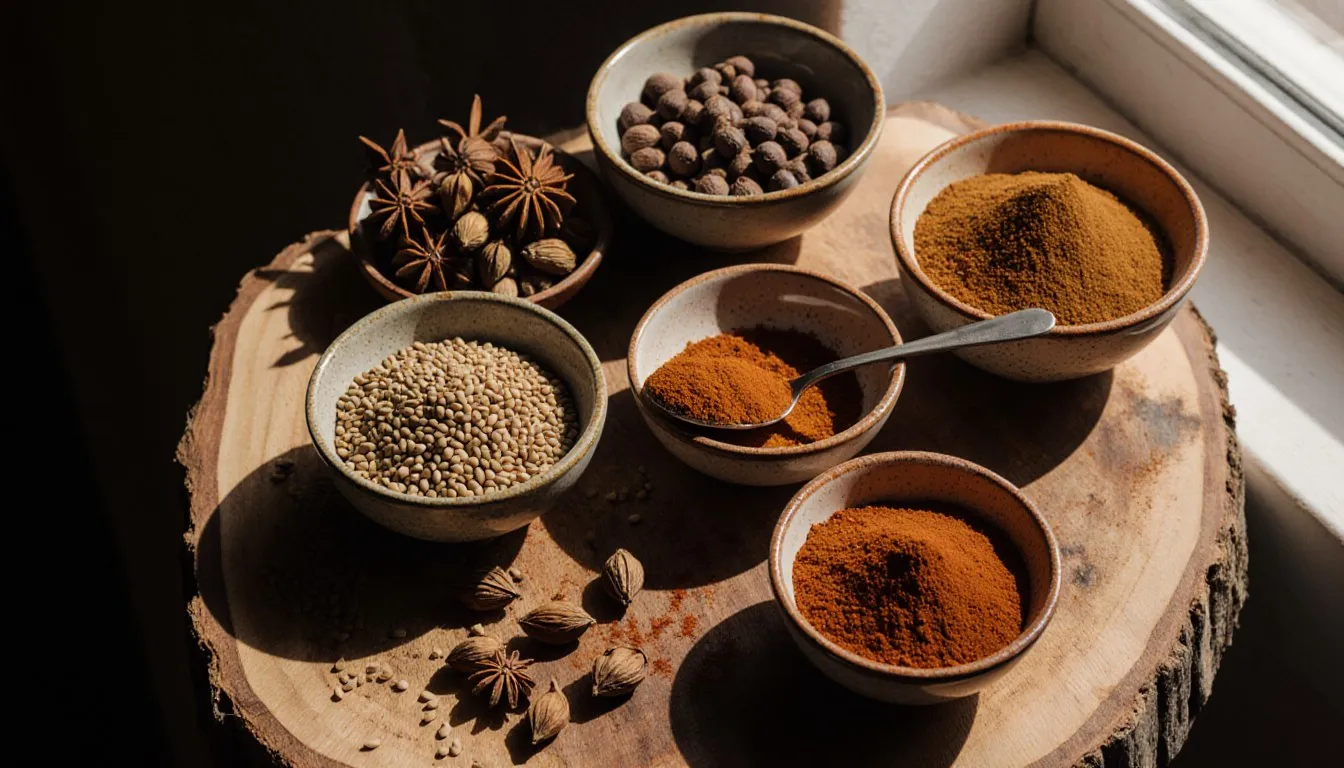
A spice substitution works when the stand-in does the same job the missing spice was doing, and it fails when you match the color of the powder instead. Out of allspice for a spice cake? Half a teaspoon of cinnamon plus a quarter teaspoon each of cloves and nutmeg per teaspoon called for, and the cake will be fine, because all four of those are doing warm-sweet work. Cumin is also a brown powder in a small glass jar, and it will ruin your cake.
That is the whole trick, and once you have it you stop needing a lookup page for every jar in the cabinet. Below: how to read what a spice is actually contributing, the ground-to-whole conversion that saves you from a scorching-hot mistake, how to rescue a swap that is running thin, when a blend can stand in for its own components, and the handful of cases where the honest answer is to leave the spice out.
What Makes One Spice a Decent Stand-In for Another?
Ask what the dish would miss if you simply left the spice out. That answer is the job, and the job is almost always one of four things: heat, an earthy savory backbone, warm sweetness, or a bright floral or citrusy top note. Color and aroma ride along as secondary jobs, and sometimes they are the entire point.
Sweet paprika in a goulash is mostly doing color and a gentle fruity sweetness, with hardly any heat. Match cayenne to it spoon for spoon and you get a pot of heat where the dish wanted color and gentle fruit, and dinner tastes like a different recipe entirely. A better move is a smaller amount of a mild ground chile, or paprika’s smoked cousin if you can live with smoke in the dish. Meanwhile cumin in a pot of black beans is doing earthy backbone, and ground coriander seed on its own is too bright and lemony to carry that load, though the two together are a classic pairing for a reason.
So before you reach for anything, name the job in one word. Then find a spice from the same family (there is a list further down) and start at half the called-for amount. You can always add. Every cook learns that one the hard way, usually with cloves.
Ground vs. Whole: Getting the Ratio Right
There is no single conversion that holds across the rack. Dense seeds like cumin grind down close to their whole volume, so three quarters of a teaspoon of ground per teaspoon of whole is the safe start there, while light, airy spices collapse further and can drop to a third of the whole amount. Crushed or cracked lands in between. Grinding multiplies surface area, so the same mass of ground spice hits the pot with far more of its aroma exposed and ready to leave; start low and taste.
Direction matters as much as the number. Whole spice gives up flavor slowly, which is perfect in a braise, a stock, a pickling brine, or anything simmering for an hour. Drop whole coriander seed into a ten-minute pan sauce and you will get seeds in your teeth and very little coriander. Ground spice is the opposite: immediate, and gone by the end of a long cook, which is why a stew that tasted seasoned at hour one tastes flat at hour three.
Two practical adjustments to the ratio:
- Toast whole spice before you grind it. Dry skillet, medium heat, shake the pan, pull them when they are a shade darker and smell nutty. Toasted-and-ground closes most of the gap between fresh whole spice and the tired ground stuff in your cabinet.
- Count-based spices need measuring, not math. Cardamom pods, cloves, and star anise are wildly different sizes. Crack the pods, tip the little black seeds into a measuring spoon, and apply the ratio to what is in the spoon rather than guessing by pod count.
If a recipe calls for ground and you only have whole, and you have no grinder, a heavy skillet pressed down on the seeds against a cutting board works. My mother did it with the bottom of a coffee mug for thirty years and never once considered it a compromise.
How to Make a Thin Substitute Taste Like It Belongs
Bloom it. Warming a spice in hot fat, or dry-toasting it in a skillet, releases the volatile oils that carry nearly all of its aroma, and that alone can take a mediocre substitute from “something is missing” to “close enough that nobody asks.”
The technique is short and unforgiving. Get a couple of tablespoons of oil or butter warm over medium heat, add the ground spice, and stir for 20 to 30 seconds until it smells loud, then add your onions or liquid to stop the cooking. Whole seeds can take a minute or two. Go by your nose, not the clock, because the window between fragrant and acrid is about fifteen seconds wide, and burnt cumin has no rescue. Butter gives you a little more grace than oil because the water in it slows things down.
Those aromatic oils are fat-soluble, so a hot fat wakes them up and then carries them through the whole dish instead of leaving them stranded in a dusty pocket. That is why a spoonful of warm oil does more for a tired jar of cumin than another spoonful of the cumin.
Two more moves that prop up a weak swap. Split the dose, half at the beginning so it melds and half in the last few minutes so it stays bright. And add a small acid hit at the end, a squeeze of lemon or a splash of vinegar, which sharpens a muted spice profile without adding more of the spice you do not have much of. The other levers a dish gives you, salt, fat, acid, and sweetness, are all in play here, and the broader logic of trading one ingredient for another runs through the whole business of cooking substitutes.
Building a Substitute Blend From What’s Already in the Cabinet
Most “exotic” spices in a recipe are blends, which means you can rebuild them from three or four jars you already own. Start with the dominant note, add the supporting one, and finish with the accent at a quarter of the volume.
- Chili powder, per tablespoon: 2 teaspoons sweet paprika, ½ teaspoon ground cumin, ¼ teaspoon garlic powder, ¼ teaspoon dried oregano, and cayenne by the pinch for heat. It comes out brighter and less smoky than most jars, since many jarred chili powders lean on darker chiles like ancho that plain paprika cannot fake. Fine in a pot of chili or a taco filling where it simmers; thin as a dry rub, where there is no liquid to round it out. Adjust to taste; the ratios move around by brand anyway, and there is a fuller breakdown if you want the whole range of substitutes for chili powder.
- Garam masala, per teaspoon: ¾ teaspoon ground cumin, ¼ teaspoon allspice, and a good crack of black pepper. Cinnamon and a scrape of cardamom get you closer if you have them. It reads flatter than the jar because your cumin is doing the work of three spices, so stir it into a braise or a pot of lentils and let it cook a few minutes. Do not use it the way the real blend gets used, sprinkled over the dish at the table, where the aroma is the entire job. The deeper set of alternatives to garam masala goes further than a pantry fix.
- Curry powder, per tablespoon: 2 teaspoons ground turmeric for color and earth, 1 teaspoon ground cumin, ½ teaspoon ground coriander, and a pinch of cayenne and ginger. Bloom it in fat before anything else goes in, because raw turmeric that heavy tastes chalky. It lands earthier and more bitter than a commercial curry powder, which usually has fenugreek and a warm-sweet backbone you are not adding, so it carries a chicken curry or a rice dish and falls short in the sweeter coconut-milk ones.
- Five-spice powder, per teaspoon: equal parts ground star anise, fennel, and cinnamon, with a small pinch each of cloves and black pepper standing in for Sichuan peppercorn. Without the peppercorn there is no citrus buzz at the top, so the blend tastes sweeter and more anise-heavy than the jar, and you will want a quarter less of it than the recipe says. Good in a pork braise, a marinade, or anything roasted long enough to mellow; too blunt where the powder goes on at the end and stays raw.
Now the honest limit. Some spices carry a single compound that nothing else in a home cabinet produces, and no amount of stacking gets you there. Sichuan peppercorn’s whole job is a buzzing numbness on your lips, which nothing else in a typical spice rack produces; the closest a blend gets is a hint of its citrus edge. Asafoetida’s sulfurous savory hum is its own animal. Fenugreek’s bitter maple note is unmistakable. Saffron is famously unfakeable, though people have long reached for a pinch of turmeric to at least get the color. In these cases stop building and read the next section.
When a Spice Isn’t Worth Faking
When the spice is the dish, leave it out rather than substitute it, and adjust your expectations instead of your ingredients. Once a spice is the reason a dish has its name, any stand-in just makes the pot taste like a copy of something better.
Star anise is the smell that reaches you before the pho bowl does, and cinnamon standing in gives you a nice beef soup that no one would call pho. Caraway is the flavor people mean when they say rye bread. Cardamom is what makes chai taste like chai. Sumac’s job on a plate of onions is sour, and paprika is the same color with none of the sour.
In those dishes you have two good options and one bad one. Cook the dish without it and call it what it is, a plain version, seasoned generously everywhere else so nothing tastes underdressed. As my mother put it, better a plain thing done well than a fancy-schmancy thing done wrong. Or cook something else tonight and buy the spice tomorrow, and salt the plain version a little harder in the meantime. The bad option is forcing a swap that will make the whole pot taste faintly wrong in a way you can’t point at, and once you notice it at the first bite you will taste it in every bite after.
A Quick Framework by Flavor Family
Group the cabinet by family and any spice becomes swappable, including the ones nobody writes a page about. Within a family, start at half the called-for amount and adjust up from there; jumping between families is a change to the dish itself, not a ratio problem.
- Warm-sweet: cinnamon, cassia, allspice, nutmeg, mace, cloves, cardamom. The most forgiving family in the cabinet. Cloves and cardamom are the strong ones, so cut them to a third when they replace cinnamon.
- Earthy-savory: cumin, coriander seed, turmeric, sweet and smoked paprika, ancho, caraway, mustard powder. These carry backbone in beans, stews, rubs, and curries. Turmeric brings color more than flavor; smoked paprika brings smoke that will not leave.
- Anise-licorice: fennel seed, anise seed, star anise, licorice root. Nearly interchangeable by intensity, with star anise the loudest by a distance. Use a quarter of what you would use of fennel.
- Bright and citrusy: coriander seed, sumac, amchur, ground ginger, lemon pepper, green cardamom. These lift a heavy dish. Sumac and amchur also bring real sourness, so they are not a straight swap for coriander.
- Sharp heat: black and white pepper, cayenne, chile flake, mustard powder, ground ginger. Different heats with different arrival times: black pepper is quick and aromatic, cayenne blooms and lingers, mustard is nasal and fades fast.
Dried leafy seasonings play by different rules and are worth treating separately, which is what a guide to herb substitutes is for.
Do Pre-Mixed Blends and Single Spices Swap for Each Other?
A blend can stand in for one of its own components in a savory dish if you start at half and accept the extras it drags along. Curry powder covers for turmeric in a rice pilaf and delivers similar color, plus cumin, coriander, and often fenugreek you did not order. Five-spice covers for star anise in a braise, roughly a quarter teaspoon of powder per pod, and brings cinnamon and fennel with it.
Sweet baking is where this falls apart. Garam masala shares cinnamon and cardamom with a spice cake and also contains cumin and black pepper, and those two do not belong anywhere near a frosting. Same problem with chili powder standing in for paprika: the garlic and oregano in it are invisible in a chili and glaring on deviled eggs.
Going the other direction, a single spice standing in for a whole blend always reads thin, because you have replaced four voices with one. Use the dominant component (cumin for curry powder, star anise for five-spice) at about two thirds of the blend amount, then patch in whatever supporting spices you own using the framework above. Two additions already close most of the gap, and a third is usually what makes the pot taste like somebody chose the seasoning on purpose.
Does an Old, Faded Spice Need a Bigger Substitute Amount?
Increase a faded spice by about half, never double it, and only if it still smells like itself when you rub a pinch in your palm. Warmth from your hand releases what aroma is left, and if you get dust and a vague brown smell, more of it will not help.
Here is why doubling backfires. Staling is the loss of volatile oils to air, light, and heat, and what stays behind is the woody, bitter, resinous material that never evaporates. Add twice as much and you are adding twice as much of the part you did not want, along with grit that muddies a sauce and a chalky texture in a rub. Faded cumin doubled tastes like sawdust with ambition.
The standard advice holds that ground spices keep their punch for around a year and whole spices for two to three, stored somewhere cool and dark. The rack mounted on the wall beside your stove is the worst possible place for them, gorgeous as it looks. A quick warming in a dry skillet will revive a merely tired jar for one dish. It cannot resurrect one that has been open since a previous apartment.
Buy small jars, buy whole where you can, and skip the warehouse-size container of anything you use twice a year. A jar of ground coriander big enough to last five years will be flavorless for four of them.
The cabinet gets a lot easier the day you make one house blend of your own. Toast and grind equal parts cumin and coriander with a little black pepper, keep it in a small jar by the stove, and it will patch a hole in a taco filling, a lentil soup, or a roast chicken rub without any further thinking. Label it with the date, because in eight months you will not remember, and by then it will have quietly stopped tasting like anything.
Tessa Calloway
Staff Writer
Tessa Calloway has spent twenty years cooking dinner on a weeknight clock and testing the shortcuts that survive contact with a real kitchen. She believes the best recipe is the one you can make with what's already in the house, and she has strong opinions about what actually needs to be homemade (less than you think) and what always does (dressing).