Sauce Substitutes: The Five Jobs Every Sauce Is Actually Doing
Sauce substitutes get simple once you read what a sauce is doing: salt, acid, sweet, body, umami. Pantry swaps, real ratios, and when to skip it.
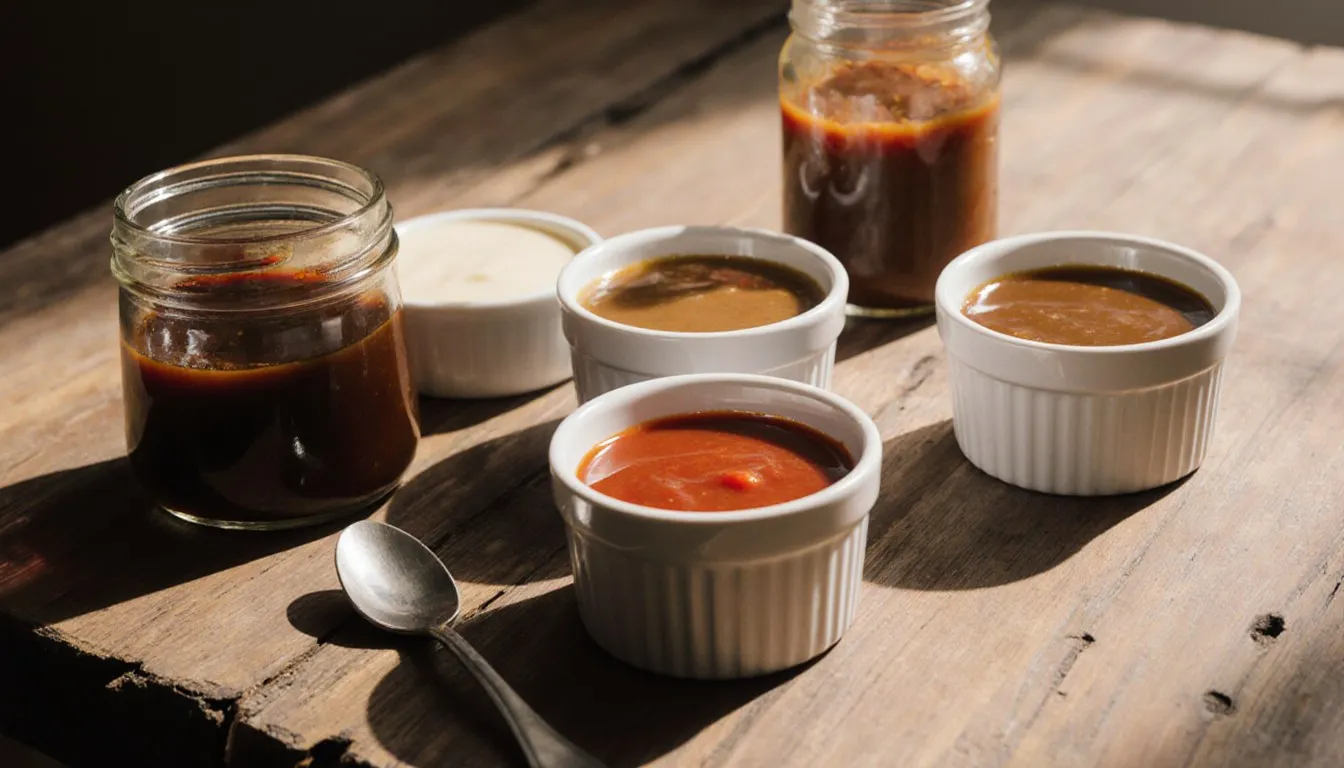
Nearly every bottled sauce is salt, acid, sweetness, body, and umami in some ratio, and you can rebuild any of them from the pantry door. Ask what the sauce is contributing to the dish in front of you, cover those jobs with what you already own, and the swap holds. A tablespoon of Worcestershire in chili and a tablespoon of Worcestershire in Caesar dressing want two completely different replacements, and once you can hear that difference you stop needing a lookup table for every bottle in the fridge door.
Below, the major sauce families, what each one is really contributing, and how to cover it with pantry staples. There are full mix-your-own recipes for the ones worth making from scratch, plus a couple of honest warnings about where a swap collapses.
What’s actually in a sauce, and why that matters more than the label
Pour a spoonful of any bottled sauce onto a plate and taste it flat, no food attached. What hits you is a ratio. Ketchup is sweet and sour with a tomato backbone. Soy sauce is salt and savory depth with almost no body. Alfredo is fat and salt with no acid at all, which is exactly why it feels heavy after four bites.
Here is the shorthand I use at the stove, with the pantry item that covers each job:
- Salt: the seasoning backbone. Covered by salt itself, soy sauce, miso, anchovy, olive brine, grated hard cheese.
- Acid: the brightness that keeps a rich dish from going flat. Covered by vinegar, citrus juice, pickle brine, yogurt, tomato.
- Sweetness: balance and browning. Covered by sugar, brown sugar, honey, molasses, jam, fruit juice.
- Body: whether the sauce clings or runs off. Covered by fat (butter, oil, cream), starch (flour, cornstarch), or reduction.
- Umami: the savory weight that makes food taste finished. Covered by tomato paste, mushrooms, Parmesan rind, soy sauce, fish sauce, miso, Worcestershire.
Most sauces do two or three of these jobs well and coast on the rest. Your swap only has to match the ones the recipe is leaning on. A tablespoon of Worcestershire in a pot of chili is there for salt and umami, so a splash of soy sauce plus a pinch of brown sugar gets you home. That same tablespoon in a Caesar dressing is doing acid and anchovy funk, and the soy-and-sugar trick will taste wrong. Same bottle, different job, different answer. My mother used to say a sauce is just seasoning that found a place to sit, and twenty years later I still think that’s the most useful thing anyone told me about cooking.
This is the same logic that runs underneath every swap in the wider world of cooking substitutes. Match the function, then worry about the name.
Out of a bottled umami sauce? Here’s the family they all belong to
Soy sauce, Worcestershire sauce, oyster sauce, and fish sauce are one family wearing four coats. All four are salty, all four are fermented or aged into deep savoriness, and all four exist to make a dish taste like it has been cooking longer than it has. Where they part ways is sweetness and body: oyster sauce is thick and noticeably sweet, hoisin more so, fish sauce is thin and sharply funky, soy sauce sits in the middle, and Worcestershire brings tamarind sourness and spice along with the salt.
Which means you can usually cross-substitute inside the family with a small correction. Going from a thick sauce to a thin one, add sweetness and a little body back. Going the other direction, pull sugar out and expect a looser sauce.
- Replacing oyster sauce with soy sauce: use equal soy, then add about half a teaspoon of sugar per tablespoon and a scant quarter teaspoon of cornstarch slurried in cold water to get the cling back.
- Replacing fish sauce with soy sauce: use equal soy, and if you want the funk, mash in a small piece of anchovy or a quarter teaspoon of miso.
- Replacing Worcestershire with soy sauce: use equal soy, plus a squeeze of lemon or a splash of cider vinegar for the missing tartness, and a pinch of brown sugar.
Where this breaks: a dipping sauce or a finishing drizzle, where the sauce is the whole flavor and nothing else is covering for it. In a stir-fry with garlic, ginger, aromatics, and a hot pan, nobody will catch you. In a bowl of nuoc cham, they will. Each of these has its own exact ratios worth having on hand, so if you want the precise numbers for a single bottle, there are full breakdowns for the soy sauce substitute, the worcestershire sauce substitute, the oyster sauce substitute, and substitutes for fish sauce.
No ketchup or BBQ sauce in the fridge, what covers that job?
Tomato paste, vinegar, and sugar. That trio is functionally what ketchup is, and you can build a credible stand-in on the stove in under ten minutes. Ketchup’s job is concentrated tomato umami plus sweet-sour balance plus enough body to sit on a burger without sliding off, and paste already gives you the first and the third.
For about a cup:
- 6 oz tomato paste (one small can)
- 1/3 cup water
- 2 tablespoons cider vinegar or white vinegar
- 2 tablespoons brown sugar
- 1/2 teaspoon salt
- 1/2 teaspoon onion powder, 1/4 teaspoon garlic powder
Whisk it all in a small saucepan over medium-low and let it bubble gently for about five minutes, until the raw tinny edge of the paste cooks off and it smells like ketchup instead of like tomato paste. Taste it hot, then taste it again once it cools, because it will read sweeter warm than it does cold. Adjust the vinegar last.
To push it toward barbecue sauce, add a tablespoon of molasses, half a teaspoon of smoked paprika, a teaspoon of mustard (yellow is fine), and a splash of Worcestershire. Simmer another five minutes so it thickens and the spices stop tasting dusty. Whether you want the smoke is a personal call, and I will say the same thing I say about every shortcut: if your version of dinner involves a bottle from the store, that is a perfectly good dinner.
What changes: homemade runs less sweet and less glossy than the commercial version, because the store bottle carries far more sugar and a stabilizer or two. Where it breaks is cold and undisguised, as the dipping ketchup next to a plate of fries. Straight from the fridge the thinner body slides off, the lower sugar reads sharp and tomato-forward, and everyone at the table notices. It also falls down in a sticky oven glaze written around the store bottle, the kind that is supposed to lacquer onto meatloaf or ribs, since the sugar doing that lacquering is exactly what you left out. Stir in two more tablespoons of brown sugar and simmer it a few minutes longer if a glaze is the whole point. If you are glazing ribs or chicken in the oven, that lower sugar means less blackening, which is usually a gift. Store it like any leftover, airtight in the fridge, and use it within three to four days.
What replaces mayonnaise in a sauce or dressing?
Plain full-fat yogurt, straight across, one for one, is the swap that works most often. Mayo is doing two things in a dressing or a cold sauce: it is carrying fat, and it is an emulsion that keeps everything creamy and suspended. Yogurt covers both, and it brings its own acidity, so cut back the lemon or vinegar in the recipe by about a third or the whole thing goes sour on you.
Yogurt will not stand up to heat. Stir it into a hot sauce and it curdles into something grainy, so keep it in the cold lane: potato salad, slaw, tuna salad, dips, ranch-style dressings.
If you want actual mayonnaise and there is none in the house, an emulsion takes about three minutes. Whisk one egg yolk with a teaspoon of lemon juice or vinegar and half a teaspoon of Dijon, then drizzle in 3/4 cup of neutral oil in the thinnest possible stream while whisking hard. It will look broken and hopeless, then all at once it thickens and holds. That moment is the whole trick. Go slow at the start and you can speed up once it grabs. A pinch of salt at the end.
The safety part is not optional: raw eggs can carry salmonella, so use pasteurized eggs (in the shell or a carton of pasteurized yolks) for any sauce that never gets cooked, keep it refrigerated, and use it within three to four days. Do not serve raw-egg mayonnaise to young children, pregnant people, older adults, or anyone with a weakened immune system. Sour cream, mashed avocado, and blended silken tofu each fill the creamy-cold-binder role too, with different flavor consequences, and the richer breakdown of what each one does lives in mayonnaise substitutes.
Can you fake a cream sauce without heavy cream or a roux?
You can, and the version I make on a weeknight is butter, whole milk, and a lot of grated cheese. Alfredo-style sauce is fat plus salt plus enough emulsified body to coat pasta, and cheese happens to supply all three at once.
Melt 4 tablespoons of butter in a wide skillet over low heat. Add 1 cup of whole milk and warm it until it steams, never a boil. Off the heat, add 1 cup of finely grated Parmesan a handful at a time, swirling until each one disappears. Then, and this is the part people skip, ladle in half a cup of the starchy water your pasta cooked in and toss the drained pasta directly in the pan for a minute. The starch in that water is what turns a milky puddle into a sauce that clings.
The trade-off is honest: milk-based sauce is thinner and less stable than a cream version, and it will break if it gets hot enough to bubble. Two ounces of cream cheese whisked in gives it real insurance and a slight tang. Skim milk makes a watery sauce and I would rather you use whole milk cut with a spoonful of butter than reach for the skim.
Grate the cheese yourself if you possibly can. The pre-shredded bags are coated with anti-caking starch that turns a smooth sauce grainy, and you’ll spend a hot minute chasing clumps around the pan that never had to be there.
No jarred marinara, what’s the fastest real substitute?
Tomato paste plus liquid. Three tablespoons of paste whisked into one cup of water or chicken broth gives you roughly the concentration of a thin tomato sauce, and it takes about a minute. Warm a glug of olive oil with a sliced clove of garlic first, let it go golden and fragrant, add the paste and cook it for a full minute until it darkens a shade, then pour in the liquid with a pinch of dried oregano, a pinch of sugar, and salt. Simmer ten minutes.
Cooking the paste before the liquid goes in matters more than any other step here. Raw tomato paste has a flat metallic taste that stays flat; a minute in hot oil turns it sweet and roasted.
Canned tomatoes beat paste whenever you have twenty minutes and the sauce is the point of the dish. A 28-ounce can of crushed or whole tomatoes, crushed by hand, simmered with garlic and olive oil and a basil sprig until it thickens, tastes fresher and more layered than anything you can reconstitute from a tube. Use the paste route for a fast weeknight pasta, a pizza base, or a cup of sauce a recipe calls for as one component. Use canned tomatoes for a Sunday pot of anything. If your problem is specifically a recipe calling for plain canned tomato sauce, there’s a dedicated answer under tomato sauce substitute.
Missing a sweet-tangy sauce like hoisin or sweet chili sauce?
These live in their own family: sweet, salty, sticky, with acid and heat dialed up or down. Hoisin is the darker, funkier end of it, thickened with fermented soybean and heavy on the molasses register. Sweet chili sauce is bright, thin-sticky, garlicky, and sweeter than most people expect. Plum sauce, teriyaki, duck sauce, and most bottled glazes are variations on the same shape.
Because sugar is the dominant note, these are the most forgiving sauces in your fridge to improvise. The generic template: something sweet, something salty, something sour, something aromatic. Two tablespoons of jam (apricot for sweet chili, plum for hoisin) plus a tablespoon of soy sauce plus a teaspoon of rice vinegar plus a grated clove of garlic will glaze a chicken thigh. Add chili flakes or sriracha for the heat. What you give up is the dark, fermented-soybean funk that makes hoisin taste savory rather than fruity: a jam version reads sweeter, thinner, and jammier, and it glazes rather than clings. A teaspoon of miso or a scrape of peanut butter whisked in pulls it back toward hoisin’s register, and a minute of simmering thickens it enough to coat. Where it will not pass is anywhere hoisin is served alongside the food rather than cooked into it, a bowl of pho, a plate of moo shu pancakes, a dipping saucer next to lettuce wraps. There the sauce is the flavor and the jam is obvious.
Where it goes wrong is in the sugar load. These sauces burn fast under direct heat, and a homemade version with jam in it burns faster. Brush glazes on during the last few minutes of cooking, not at the start, and keep them off the hottest part of the grill. For measured versions rather than my eyeball template, there are exact ratios for the hoisin sauce substitute and the sweet chili sauce substitute.
Can you make gravy without pan drippings?
Yes, and a butter-and-broth gravy is respectable enough that I make it on purpose, not just when there’s no roast to deglaze. Drippings supply fat plus browned meat flavor; butter covers the fat, and you build the browned flavor back deliberately.
The ratio to memorize is 2 tablespoons butter and 2 tablespoons flour per cup of liquid for a pourable gravy. For 2 cups:
- Melt 4 tablespoons of butter in a saucepan over medium heat. Let it keep going past melted until the milk solids turn golden and it smells nutty, about 2 to 3 minutes.
- Whisk in 1/4 cup of flour and cook the roux, whisking, until it turns the color of peanut butter. Start checking at 3 minutes. A blond roux tastes like paste; a browned one tastes like gravy.
- Pour in 2 cups of warm beef or chicken broth in a slow stream, whisking constantly. It will seize into a paste before it loosens. Keep whisking.
- Simmer 5 to 8 minutes, until it coats the back of a spoon and a finger swiped through leaves a clean trail.
Season at the very end, after the reduction has concentrated whatever salt was in the broth. To make it taste like it came off a roast, add a teaspoon of soy sauce for depth, a spoonful of miso, or a handful of mushrooms browned hard in the butter before the flour goes in. A splash of sherry or white wine cooked down in the pan first gets you most of the way to a deglaze.
Lumps come from cold liquid hitting hot roux too fast. Warm the broth, add it in stages, and whisk like you mean it. If lumps happen anyway, push the gravy through a fine strainer and tell nobody.
The one question to ask before any sauce swap
Ask what the bottle tastes like on its own, before it ever hits the pan. Put a spoonful on a plate, taste it flat, and name the two jobs it is doing loudest: salt and umami, sweet and sour, fat and body. Those two are what your swap has to cover, and everything else in the bottle is detail you can skip. That four-second habit is what replaces the lookup table, and it works on a sauce you have never bought before.
Once you know the answers for the sauces you reach for weekly, get ahead of the problem by making the two base sauces on a quiet Sunday instead of at 6:40 on a Tuesday. A batch of the tomato-paste ketchup and a double batch of the butter-and-broth gravy take about twenty-five minutes together, cooled quickly before they go in the fridge airtight. The ketchup keeps three to four days; the gravy is more perishable, one to two days by the USDA's clock, so freeze what you will not use by then. The gravy sets up solid and cold; reheat it gently with a splash of broth whisked in and it comes back pourable. It also freezes well in a jar with an inch of headroom, for up to three months, and thaws overnight in the fridge without breaking, which the milk-based cream sauce will not do.
The one variation worth trying next is a compound-butter shortcut for the umami family. Mash a tablespoon of miso and a teaspoon of soy sauce into a stick of softened butter, roll it in parchment, and keep it in the freezer. A coin of that melted over rice, noodles, roasted vegetables, or a pan of mushrooms covers salt, fat, and savory depth in one move, and it is the fastest sauce in the house on a night when nothing else sounds possible.
Label the jar with the date before it goes in the freezer, because a frozen puck of miso butter and a frozen puck of plain butter look identical in February.
Tessa Calloway
Staff Writer
Tessa Calloway has spent twenty years cooking dinner on a weeknight clock and testing the shortcuts that survive contact with a real kitchen. She believes the best recipe is the one you can make with what's already in the house, and she has strong opinions about what actually needs to be homemade (less than you think) and what always does (dressing).