Gravy Comes Down to One Ratio: Learn It Once, Make It Forever
How to make gravy from pan drippings or from scratch, with the fat-flour-liquid ratio, the roux method, and fixes for lumpy or thin gravy.
Memorize this and you can stop looking up gravy forever: one tablespoon of fat, one tablespoon of flour, one cup of liquid. That is a cup of finished gravy, thick enough to coat a spoon and pool properly around mashed potatoes. Everything else in gravy, drippings or no drippings, turkey or chicken or sausage, is a variation on those three numbers. Most recipes bury those numbers inside a list of steps, which is why the ratio never sticks even after a dozen batches. Learn the three numbers and the steps stop mattering: you can build gravy in any pan, at any volume, without a card propped against the sugar bowl.
Below: the ratio and how to scale it, the two ways to build gravy (from a roasting pan, and from nothing at all), why cornstarch is a different animal from flour, and the exact rescue moves for lumpy and thin. Nobody’s Thanksgiving needs a gravy emergency at 4:45 while the turkey rests.
What’s the actual ratio for gravy?
One tablespoon fat to one tablespoon flour to one cup liquid. Cooks write it as 1:1:8, because a cup is eight tablespoons, and that shorthand is worth internalizing. The fat and flour cook together into a roux, which is just the thickener; the liquid is the gravy.
Scaling is straight multiplication:
- 1 cup of gravy: 1 tablespoon fat, 1 tablespoon flour, 1 cup stock or drippings-and-stock.
- 2 cups: 2 tablespoons fat, 2 tablespoons flour, 2 cups liquid.
- 4 cups (holiday territory, feeds eight generously): 4 tablespoons fat (that’s a half stick of butter, if you’re going that route), 4 tablespoons flour, 4 cups liquid.
A few honest notes on the numbers. This ratio gives you a pourable gravy, the consistency most people want on the table. If you like it thicker, the kind that sits up on a biscuit, push toward a tablespoon and a half of each per cup of liquid. If you want it looser, closer to a jus with body, drop to two teaspoons of each. Do not change the fat and flour independently. They work as a pair, and extra flour without extra fat to coat it is exactly how gravy turns pasty.
Make more than you think you need. Gravy is the one thing at a holiday table that runs out first, and doubling costs you nothing but a bigger pan. My mother made a full quart for six people and we still scraped the boat.
How do you make gravy from pan drippings?
Drippings gravy tastes best because the flavor is already in the pan waiting for you. Those dark stuck-on patches under the roast are the fond, concentrated roasted meat, and all you’re doing is dissolving them. Get them into the liquid and you have gravy nobody needs to season much.
Pull the roast out and let it rest on a board. Tip the roasting pan and look at what’s in the bottom: a layer of clear or golden fat floating on top of darker juices. You want to separate those. A gravy separator (the pitcher with the spout coming off the bottom) does it in about thirty seconds, since the spout draws from underneath the fat line. No separator? Pour everything into a glass measuring cup, give it ten minutes in the fridge or freezer, and skim the fat off the top with a spoon. It firms up and lifts right off.
Then build:
- Measure your fat back into the roasting pan (set it over two burners on medium) or into a skillet. For four cups of gravy, you want 4 tablespoons of that fat. If the bird didn’t give you enough, make up the difference with butter.
- Whisk in an equal amount of flour. Cook it, whisking, for a solid two minutes, until it smells nutty and toasted and has gone the color of peanut butter. This is the step people rush. Raw flour tastes like raw flour, and no amount of stock will hide it.
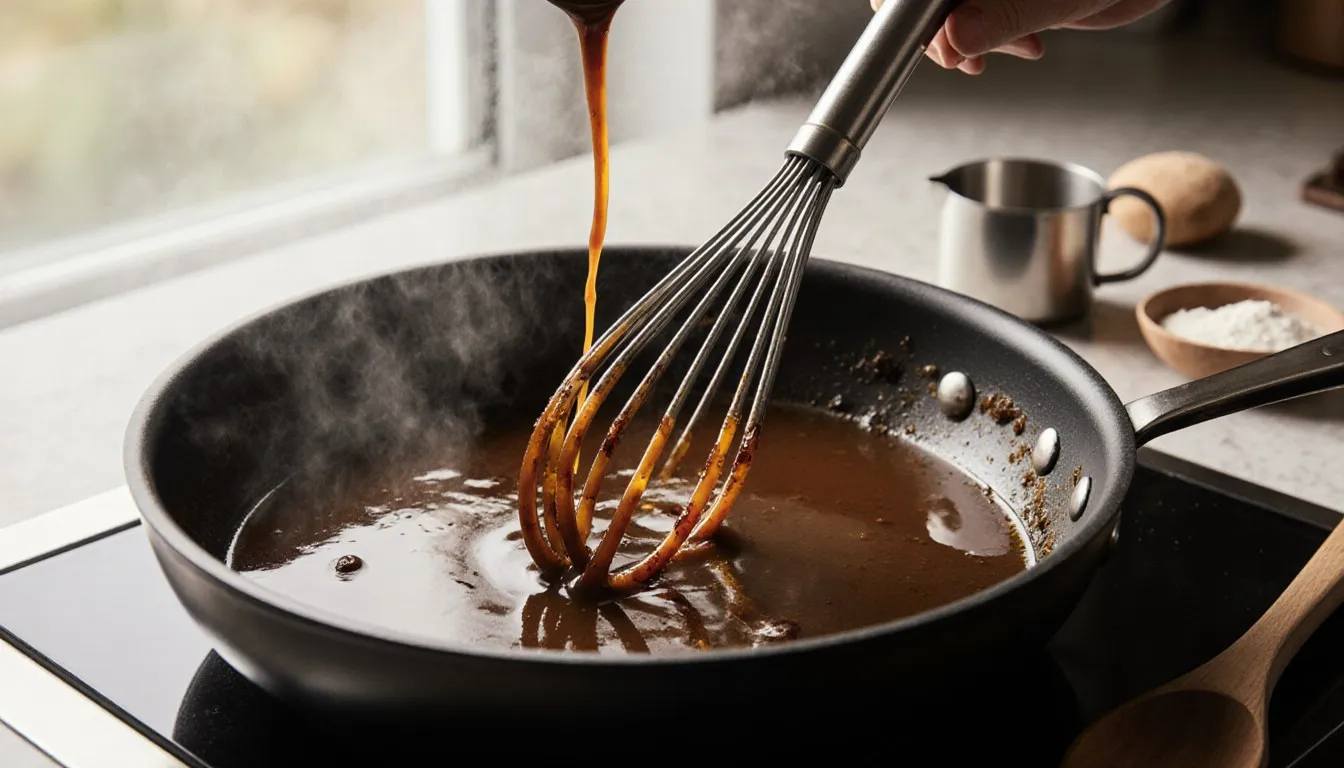
- Pour in the defatted pan juices plus enough warm stock to reach your total liquid. Warm liquid, added a little at a time, whisking hard between additions. Scrape the bottom as you go so all that fond dissolves into the gravy. That scraping is the deglazing everybody talks about, and it’s really just stubborn whisking in the corners.
- Bring it to a simmer and hold it there a few minutes. Gravy does not reach full thickness until it actually simmers. Do not judge the consistency before it bubbles or you’ll thicken a gravy that was already going to be fine.
Season at the very end, and taste before you reach for the salt. Drippings from a brined turkey are already salty, and the gravy concentrates as it simmers. Salty drippings plus a long simmer is how most holiday gravies end up too salty to fix at the table. If yours gets away from you, stretch it with unsalted stock a few tablespoons at a time rather than trying to cover it with butter or cream.
One more thing about turkey gravy specifically: you will not get four cups of liquid out of a turkey, no matter how big the bird. Roast the neck and giblets alongside the turkey, then simmer them in a quart of stock while the bird cooks. That gives you the volume plus a deeper flavor, and it costs you a pot you were going to wash anyway. If you want the smoothest possible turkey gravy for a crowd, pour the finished thing through a fine strainer into the gravy boat.
How do you make gravy without drippings?
No roast, no fond, no problem. Gravy from scratch is the same ratio with butter standing in for the drippings, and it is a Tuesday-night skill worth having. This is what you make for a store-bought rotisserie chicken, for meatloaf, for mashed potatoes on a night when the potatoes are the entire point.
Melt the butter in a saucepan over medium heat. Whisk in the flour, same amount, and cook it two to three minutes, whisking, until it goes from pale and pasty to the color of a brown paper bag and smells toasty. Go longer for a darker, deeper gravy; a properly browned roux is most of the flavor you’d otherwise be getting from the pan.
Then pour in your warm stock, a splash at a time, whisking between additions until it’s smooth. Simmer for five minutes or so, until it coats the back of a spoon.
Since the stock is carrying all the flavor here, it matters more than it does in a drippings gravy. A good boxed stock works. So does bouillon: a concentrated paste or cube dissolved in hot water gives you a savory backbone, and there’s nothing to apologize for there. Just taste before salting, because bouillon brings plenty of its own. If you’re sorting out which carton to buy in the first place, the difference between broth and stock is worth knowing.
Things that make a from-scratch gravy taste like it came off a roast:
- Brown the roux further than feels comfortable. Past the paper-bag stage and on toward the color of an old penny, which is another two minutes of whisking after the toasty smell arrives. Know the trade before you commit: a dark roux thickens noticeably less than a pale one, so add an extra half tablespoon of flour per cup of liquid to make up the difference. Pull it off the heat the moment the smell turns sharp instead of nutty. Scorched flour is bitter, and there is no whisking that back.
- Sweat a finely minced shallot or a few sliced mushrooms in the butter before the flour goes in. Mushrooms in particular bring the savory depth that fond would have.
- A splash of dry sherry, white wine, or brandy into the roux before the stock. Let it cook down for thirty seconds to take the raw edge off.
- A teaspoon of soy sauce or a small spoonful of tomato paste. Both are savory and dark, and neither one tastes like itself once it’s in there.
- A sprig of thyme or a bay leaf simmering in the pot, fished out before serving.
And if you want the cream-and-sausage version, the peppery Southern kind that goes over biscuits, white gravy is its own build with its own rules.
What’s the difference between a flour roux and a cornstarch slurry?
Flour thickens by cooking into fat first; cornstarch thickens by dispersing in cold water and then hitting heat. That difference in method drives everything else about them, and they are not interchangeable partway through a recipe.
A flour roux gives you an opaque, matte, classic-looking gravy with flavor of its own from the toasted flour. It’s forgiving on the stove, it reheats well, and it holds up to a long low simmer. It needs that couple of minutes of cooking time up front, and it needs fat.
A cornstarch slurry (equal parts cornstarch and cold water, whisked smooth, then stirred into simmering liquid) thickens almost instantly and leaves the gravy glossier and more translucent. It’s a lifesaver when the gravy is already made and you’re out of time. It also has limits. Cornstarch thins out if you boil it hard or hold it hot too long, and a night in the fridge turns it into something you can cut with a spoon, jellied and faintly slick on the tongue when you reheat it. Cornstarch has roughly twice the thickening power of flour, so if you’re swapping, use about half as much.
I stopped using cornstarch for the holiday gravy years ago, after a Thanksgiving where the boat sat on the warmer through two rounds of seconds and came back thin as broth. For a table where the gravy has to wait on people, cornstarch is the wrong call. Use flour and stop thinking about it.
For a holiday gravy that sits on a warmer for an hour and gets reheated for leftovers, use flour. For a quick pan sauce or a last-minute rescue, cornstarch. And if you’re cooking for someone avoiding gluten, a cornstarch slurry is the easier road than trying to make a roux behave with alternative flours.
What you cannot do is dump dry flour or dry cornstarch straight into hot gravy. That is the lump factory, which brings us to the next part.
Why is my gravy lumpy, and how do I fix it?
Lumps happen when dry starch meets hot liquid without anything separating the granules first. Each grain gelatinizes on the outside instantly, seals itself off, and floats around as a little dumpling with dry flour trapped inside. The two ways people cause it: sprinkling flour directly into the pan liquid, and pouring cold stock into a hot roux all at once.
Prevention is the whole game, and it’s three habits:
- Coat the flour in fat first (that’s the roux), or in cold water first (that’s the slurry). Never bare into hot liquid.
- Warm your stock. Cold liquid into a hot roux seizes it. A minute in the microwave is plenty.
- Add the liquid in stages, whisking to smooth between each one. The first addition is the important one: get that paste completely smooth before the next splash goes in.
Already lumpy? You have not lost anything. Pull it off the heat and whisk hard, right down into the corners of the pan, for a full minute. A flat whisk works better than a balloon whisk in a roasting pan. Most modest lumps beat out.
Still lumpy? Pour the whole thing through a fine-mesh strainer into another pot, pressing on the solids with the back of a spoon. Thirty seconds, and nobody at the table will ever know. Keep a strainer near the stove on a holiday for exactly this reason.
Genuinely broken, with pasty clumps that won’t strain out? An immersion blender fixes it in about five seconds, or a regular blender will (fill the jar no more than halfway, hold the lid down with a towel, and pulse; hot liquid expands and will blow the lid off a full blender). Blended gravy comes out a shade lighter and slightly thicker. Nobody has ever complained.
My gravy is too thin or too thick, now what?
Both are easy, and both are fixable while people are sitting down.
Before you touch anything, make sure the gravy has actually simmered for two or three minutes. Under-simmered gravy looks thin and isn’t. Wait for it to bubble, give it a couple minutes, then judge.
Still thin: whisk a tablespoon of cornstarch with a tablespoon of cold water until it’s completely smooth, then stir that into the simmering gravy in a thin stream. Give it a minute to take hold before adding more, because it thickens fast and it is much easier to add than to undo. That whole batch of slurry, both tablespoons of it, will noticeably thicken about two cups of gravy. For a single cup, stir in half, give it a minute, and add the rest only if it still runs thin off the spoon. Or, if you have time, just simmer it uncovered and let it reduce, which concentrates the flavor at the same time.
Too thick: whisk in warm stock a couple tablespoons at a time until it’s where you want it. Warm, not cold, and off a hard boil while you do it, so the sauce doesn’t seize or break. Taste after, since you’ve diluted the seasoning along with the texture. Water works in a pinch, but stock keeps the flavor intact.
One more that catches people: gravy thickens as it cools. A gravy that looks perfect in the pan will be noticeably stiffer by the time the boat reaches the far end of the table. Pull it a touch looser than you think you want, and warm the gravy boat with hot tap water before you fill it.
Can you make gravy ahead of time?
You can, and on a holiday you absolutely should. Roux-based gravy reheats beautifully, which is exactly why flour beats cornstarch for anything you plan in advance.
Make it up to two days ahead using stock built from the turkey neck and giblets (or good boxed stock), cool it quickly, and refrigerate it in a covered container. Refrigerate within two hours of cooking, and keep the fridge at 40°F (4°C) or below. It will set up like pudding when cold. That’s the roux doing its job. It loosens the moment it hits heat.
To reheat, put it in a saucepan over medium-low and whisk as it loosens, adding warm stock a splash at a time until it’s pourable again. A cold gravy usually wants a quarter cup or so of extra liquid per two cups. Bring it to a rolling boil before serving, not just warm. Then, on the day, whisk in whatever fresh drippings the roast gives you and taste again. You get the depth of real drippings without the fifteen minutes of frantic whisking while everything else goes cold.
Gravy also freezes well for two to three months in a zip-top bag laid flat. Thaw it overnight in the fridge, never on the counter, or use cold water or the microwave if you need it faster. It may look separated when it thaws; steady whisking over low heat brings it back. Leftover gravy keeps one to two days in the fridge, a shorter window than the leftover turkey it came from, so use it first. Reheat it to a rolling boil, and don’t let the gravy boat sit out on the table more than two hours.
Once the ratio lives in your head, you’ll start seeing it everywhere, in pan sauces, in the base of a chowder, in the beginning of most homemade sauce recipes worth knowing. Tomorrow, pour the last of the gravy over toast with a fried egg on top and call it the best thing you ate all weekend.
Tessa Calloway
Staff Writer
Tessa Calloway has spent twenty years cooking dinner on a weeknight clock and testing the shortcuts that survive contact with a real kitchen. She believes the best recipe is the one you can make with what's already in the house, and she has strong opinions about what actually needs to be homemade (less than you think) and what always does (dressing).