Dipping Sauces: The Five Formulas I Actually Use
The best dipping sauces come from five base ratios you can memorize. Exact amounts, smart swaps, rest times, and honest fridge storage windows.
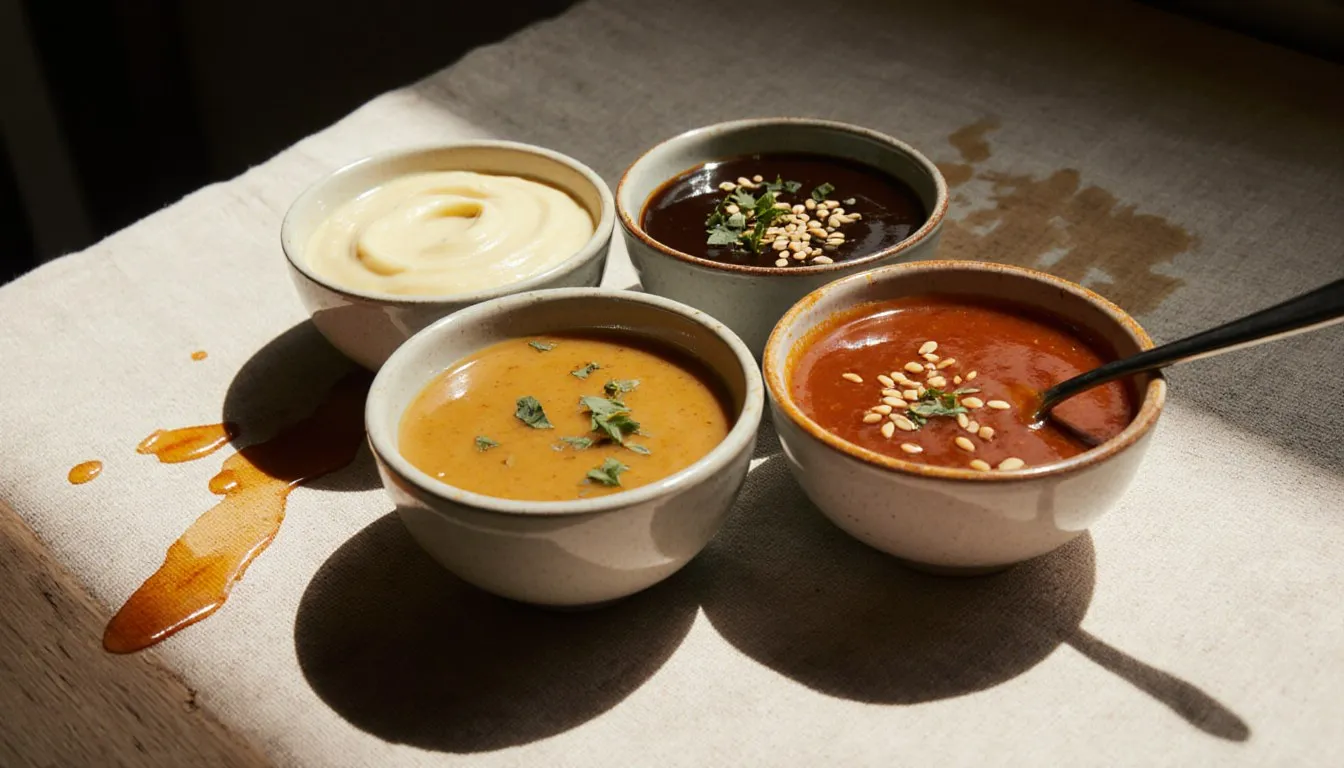
A good dipping sauce is three parts: a base, an acid, and a punch note. Memorize that and you never need a recipe card again. Half a cup of mayo, a tablespoon of something sour, a teaspoon or two of something loud, stirred cold in a cereal bowl while the fries finish. That’s it. That’s the whole trick, and it works whether the base is mayonnaise, yogurt, soy sauce, melted butter, or straight vinegar.
Below are the five ratios I keep in rotation, what to reach for when the pantry lets you down, which sauces want twenty minutes alone in the fridge before they’re any good, and how long the leftovers are actually safe to keep. Fair warning: once you cook this way you will stop buying the little tubs, and you will start judging them.
What actually makes a good dipping sauce?
Balance, and the fact that it’s a supporting actor. A dipping sauce exists to give a bite of fried, grilled, or roasted something a jolt of contrast. Fried food is fat and salt with no acid in it anywhere, which is exactly why a fry tastes better dragged through something tangy. Grilled meat is smoke and char, so it wants sweetness or heat pushing back.
Three components do all the work:
- The base carries everything and decides the texture. Mayonnaise and sour cream are thick and rich. Greek yogurt is thick and tart. Soy sauce is thin and salty. Melted butter is thin and rich. Vinegar is thin and sharp.
- The acid wakes it up. Lemon juice, lime, rice vinegar, cider vinegar, pickle brine, a spoonful of the liquid from a jar of pepperoncini.
- The punch note gives it a personality. Garlic, sriracha, mustard, honey, smoked paprika, grated ginger, chopped herbs, a little fish sauce if you’re feeling brave.
Salt sits outside the three because it belongs in everything. Taste before you serve, always. A creamy dip that tastes fine off the spoon frequently tastes like nothing on a potato, because the potato is already salted and it flattens whatever it touches. Season a dipping sauce slightly louder than you think is right.
This is the one sauce family that lives entirely on cold ratio work, no roux, no reduction, no pan. Anything that needs a stove and a whisk (which is most of the rest of the homemade sauce recipes worth knowing) is a different animal.
The five-minute master ratios worth memorizing
Each of these makes roughly half a cup, enough for two to three people working through a sheet pan of something. Scale straight up; the ratios hold.
The creamy one (mayo base)
Half a cup mayonnaise, one tablespoon acid, one to two teaspoons punch, salt to taste. Lemon juice plus a grated garlic clove gives you an aioli-style dip. Lemon plus a tablespoon of sriracha gives you the pink sauce that vanishes fastest at my house. Cider vinegar plus two teaspoons of smoked paprika turns it into something that belongs next to grilled chicken.
The tangy one (yogurt or sour cream base)
Half a cup full-fat Greek yogurt or sour cream, two teaspoons acid (yogurt brings its own tang, so ease off), one to two teaspoons punch, plus a good handful of chopped soft herbs if you have them. Dill, chives, parsley, mint. Use full-fat. Nonfat Greek yogurt goes chalky and thin the second it hits warm food, and no amount of lemon rescues it.
The salty-sweet one (soy base)
Three tablespoons soy sauce, two tablespoons rice vinegar, one tablespoon honey or sugar, one teaspoon toasted sesame oil, plus grated garlic or ginger. Thin, glossy, sharp. This one is for dumplings, spring rolls, and anything you can pick up with chopsticks.
The rich one (butter base)
Four tablespoons butter, melted gently and skimmed, or browned if you want more nuttiness, plus a squeeze of lemon and a pinch of salt. That’s drawn butter, and it’s the entire reason people order crab. Keep it warm, not hot. Butter that sits over a flame separates and turns greasy on the plate.
The sharp one (vinegar base)
Quarter cup vinegar, one tablespoon sugar, half a teaspoon salt, a pinch of chili flakes, whisked until the sugar dissolves. This is the palate-scrubbing dip that goes next to fried spring rolls and fatty pork, and it costs about eleven cents to make.
How do you make a creamy dip without it tasting like plain mayo?
Acid first, then umami, then aromatics. Most homemade dipping sauce that tastes flat is missing acid, not seasoning, and people keep adding salt to fix a sourness problem. One tablespoon of lemon juice per half cup of mayo is the floor. Push to a tablespoon and a half if the dip is going next to something very rich, like fried cheese curds or a burger.
Umami is the step most home cooks skip. A half teaspoon of any of these into half a cup of creamy base changes the whole thing:
- Worcestershire sauce for savory depth and a little funk.
- Soy sauce for straight salted depth, though it will grey the color slightly.
- Fish sauce if you’re not squeamish. It disappears completely and makes everything taste more like itself.
- Tomato paste, which also gives you color, or grated parmesan for salt plus body.
For garlic, grate it on a rasp rather than mincing it. Grated garlic dissolves into the base; minced garlic sits in it as crunchy hot pellets and keeps getting stronger by the hour. My mother used to say a little garlic goes a long way and a lot of garlic goes further than you meant, which I did not appreciate until I served a garlic dip I’d made the night before and cleared the room.
Honey mustard follows the same math, just with a split base: three tablespoons mayonnaise, two tablespoons Dijon, one and a half tablespoons honey, one teaspoon cider vinegar. Adjust the honey up for kids, down for adults.
What’s the best dipping sauce for fries, nuggets, and other fried food?
Something creamy and tangy, thick enough to cling. That’s the entire spec. Fried food is hot, crisp, and greasy, so the sauce has to be cold, sharp, and thick enough to stay on the fry between the bowl and your mouth. A thin sauce runs off and pools, and you end up with a soggy plate and a dry fry.
The three I make on repeat for fries:
- Sriracha mayo: half a cup mayo, one tablespoon sriracha, two teaspoons lime juice, one grated garlic clove. Heat, acid, cling, ninety seconds of work.
- Smoky fry sauce: half a cup mayo, two tablespoons ketchup, two teaspoons pickle brine, one teaspoon smoked paprika, a few grinds of black pepper. The pickle brine is doing the heavy lifting there, so don’t skip it for plain vinegar if you can help it.
- Ranch-style buttermilk dip: quarter cup mayo, quarter cup sour cream, two tablespoons buttermilk, one tablespoon each chopped dill and chives, half a teaspoon each garlic powder and onion powder, a squeeze of lemon. Homemade ranch and bottled ranch are barely the same food.
Cling comes from fat and thickness, which is why mayonnaise-based dips beat yogurt-based ones on fries specifically. If a dip is running off your nuggets, stir in another spoonful of mayo or sour cream rather than reaching for cornstarch. Nobody wants a thickened cold sauce; it goes gluey and slightly sweet in a way you can taste.
And serve fried-food dips cold, straight from the fridge. The temperature contrast against a hot fry is half the pleasure, and a room-temperature bowl of mayo is nobody’s idea of a good time.
Building an Asian-style dipping sauce at home
Start at three parts soy sauce to two parts rice vinegar to one part sweetener, then add sesame oil and aromatics to taste. That skeleton covers an enormous range of dipping sauces across East and Southeast Asian cooking, and once it’s in your head you can shift it around without measuring.
Three tablespoons soy, two tablespoons rice vinegar, one tablespoon honey, one teaspoon toasted sesame oil, one grated garlic clove, and a teaspoon of chili garlic sauce or a good pinch of chili flakes. Add a thinly sliced scallion and a pinch of toasted sesame seeds if you want it to look like you tried. For dumplings I go heavier on the vinegar; for grilled meat I go heavier on the honey so it can stand up to the char.
A few things that matter more than they sound:
- Toasted sesame oil is a finishing oil, not a cooking oil, and a teaspoon is plenty for half a cup. It bullies everything else if you pour with a heavy hand.
- Rice vinegar is milder than cider or white vinegar. If you swap, use less and expect a sharper edge.
- Check whether your rice vinegar is seasoned. Seasoned rice vinegar already has sugar and salt in it, so cut the honey and taste before you add any salt.
Soy sauce carries most of this ratio on its back, and the bottle in your door is a genuinely old fermented product with a long, slow production process behind it. If you’ve ever wondered what’s actually happening in there, how to make soy sauce is its own rabbit hole and a good one.
Do dipping sauces need time to sit before serving?
Some do, and it’s usually the ones with raw garlic, dried spices, or chili in them. Anything with dried herbs and spice powders (ranch-style dips, smoked paprika sauces, anything using garlic powder or onion powder) needs at least 20 to 30 minutes in the fridge for the powders to hydrate. Straight out of the bowl they taste dusty and separate. After half an hour they taste like a sauce.
Rough guide:
- Rest 30 minutes or more: ranch-style dips, anything with dried spice blends, sauces with raw garlic that you want mellowed and evenly distributed.
- Rest 10 to 15 minutes: soy-based sauces with grated garlic or ginger, so the aromatics bleed into the liquid. Vinegar-based dips need about this long for the sugar and salt to fully dissolve.
- Serve immediately: butter-based dips (they firm up cold and have to be re-warmed anyway), anything with delicate fresh herbs at the front, and citrus-forward sauces where you want the lemon bright rather than dulled.
The one to watch is raw garlic in a creamy base. It keeps getting louder for hours, so a dip that’s perfect at dinner can be borderline aggressive as a next-day leftover. If I’m making garlic mayo ahead, I use half the garlic I would for same-day and let time do the rest.
Chili-based sauces go the opposite direction in a useful way. Chili flakes and chili garlic sauce spread their heat evenly through the base after twenty minutes, so the dip stops having hot spots and just tastes uniformly warm.
What if you’re out of a key ingredient?
Substitute inside the category and adjust for what changes. Every swap here is one I’ve made mid-cook with the sheet pan already in the oven.
- Mayo to Greek yogurt or sour cream: 1:1. Tangier and thinner, so cut the added acid by about half. It won’t cling to fries as well, and it will loosen noticeably against hot food. Fine for vegetables and grilled meat, weaker for anything from the fryer.
- Sour cream to plain full-fat yogurt: 1:1, slightly tangier. Nonfat yogurt is not a substitute here at any ratio; it goes watery and thin.
- Soy sauce to tamari: 1:1, and tamari is the gluten-free option. Slightly rounder and less sharp.
- Soy sauce to coconut aminos: start with 1:1, then taste. Coconut aminos are noticeably sweeter and less salty, so cut the honey and add salt at the end.
- Honey to maple syrup: 1:1. Thinner, with a distinct maple flavor that’s lovely in a soy-based dip and odd in a garlic mayo.
- Rice vinegar to cider vinegar: use about three-quarters as much. Sharper and fruitier, and it changes the character of a soy dip more than most people expect.
- Lemon juice to lime: 1:1, more floral and a little more bitter. Lime is better with chili and cilantro; lemon is better with dill and garlic.
- Buttermilk to milk plus acid: one cup milk plus one tablespoon lemon juice, rested ten minutes. Works fine in a ranch-style dip. It gives you the tang without buttermilk’s body, so add an extra spoonful of sour cream.
- Sriracha to chili garlic sauce or sambal: start with two-thirds the amount. Both are hotter and less sweet than sriracha, and chunkier in the bowl.
- Fresh garlic to garlic powder: a quarter teaspoon powder for one clove, and give it the full 30-minute rest so it hydrates.
What I won’t swap: fresh herbs for dried in a cold dip. Dried dill in a yogurt sauce tastes like dust no matter how long you rest it. If the fresh herbs aren’t in the house, build a different sauce.
How long do homemade dipping sauces keep?
Keep them refrigerated at 40°F (4°C) or below in a sealed container, and treat the base as the clock. Egg- and dairy-based sauces are the ones to be careful with.
- Mayonnaise-based dips: 3 to 4 days refrigerated. This tracks the general USDA guidance for refrigerated prepared foods, and I don’t push it.
- Yogurt and sour cream dips: 3 to 4 days, though fresh herbs in them will darken and go limp by day two, so they’ll taste tired before they’re unsafe.
- Buttermilk ranch-style dips: 3 to 4 days, and give it a good stir; separation is normal.
- Soy- and vinegar-based sauces with no dairy: about 1 to 2 weeks refrigerated. The salt and acid do a lot of the work here, though fresh grated garlic and ginger will fade and eventually turn slightly off, so make it in small batches.
- Butter-based dips: refrigerate within two hours and use within 3 to 4 days. Re-warm gently, never in a rolling boil, and expect some separation.
Two hard rules I don’t bend. Anything perishable left at room temperature for more than two hours goes in the bin (one hour if it’s above 90°F/32°C outside, which is most of a July cookout). And never return a dip to the container after it’s been sitting out with people double-dipping in it; portion out a serving bowl and refrigerate the rest separately from the start.
Freezing: don’t. Mayonnaise and yogurt both break when frozen and thaw grainy and weeping. Soy and vinegar sauces technically freeze fine, but they take five minutes to make fresh, so what exactly are you saving?
Common dipping sauce mistakes (and the easy fixes)
Nearly every dip that goes wrong goes wrong in one of four ways, and each has a one-ingredient fix.
Too thin: add more of the thick base, a spoonful at a time. Mayo, sour cream, or Greek yogurt. For a soy or vinegar sauce that you want clingier, whisk in a teaspoon of honey; the sugar gives it body without the gluey texture you get from starch.
Too flat: it needs acid, not salt. Add half a teaspoon of lemon juice or vinegar and taste again. Nine times out of ten that’s the whole problem. If it’s still dull after the acid, then reach for salt, or better, a half teaspoon of Worcestershire or fish sauce.
Too hot: more fat and a little sweetness. Another spoonful of mayo or sour cream, plus a quarter teaspoon of honey. Water dilutes the flavor along with the heat and leaves you with a sad, thin, still-spicy sauce. In a soy-based dip, a splash more rice vinegar plus a little honey pulls the heat back without wrecking the balance.
Too sweet: acid and salt, in that order. A squeeze of lemon in a creamy dip, a splash of rice vinegar in a soy dip. Sweetness is the hardest thing to walk back, which is why I always add honey last and in half-teaspoon increments.
One more, and it’s the most common of all: making the sauce after the food is done. Cold dips want to be mixed before the fryer goes on, so the ranch has had its half hour and the garlic mayo has settled while the wings were cooking. A sauce made in a hurry with hot food waiting on the counter is a sauce nobody tasted properly.
Keep one creamy ratio and one soy ratio in your head and you’re covered for almost anything you can pull off a grill or out of a fryer. Mix a double batch of the sriracha mayo next time, keep half in a jar, and stir a spoonful into potato salad or spread it on a sandwich later in the week.
Tessa Calloway
Staff Writer
Tessa Calloway has spent twenty years cooking dinner on a weeknight clock and testing the shortcuts that survive contact with a real kitchen. She believes the best recipe is the one you can make with what's already in the house, and she has strong opinions about what actually needs to be homemade (less than you think) and what always does (dressing).