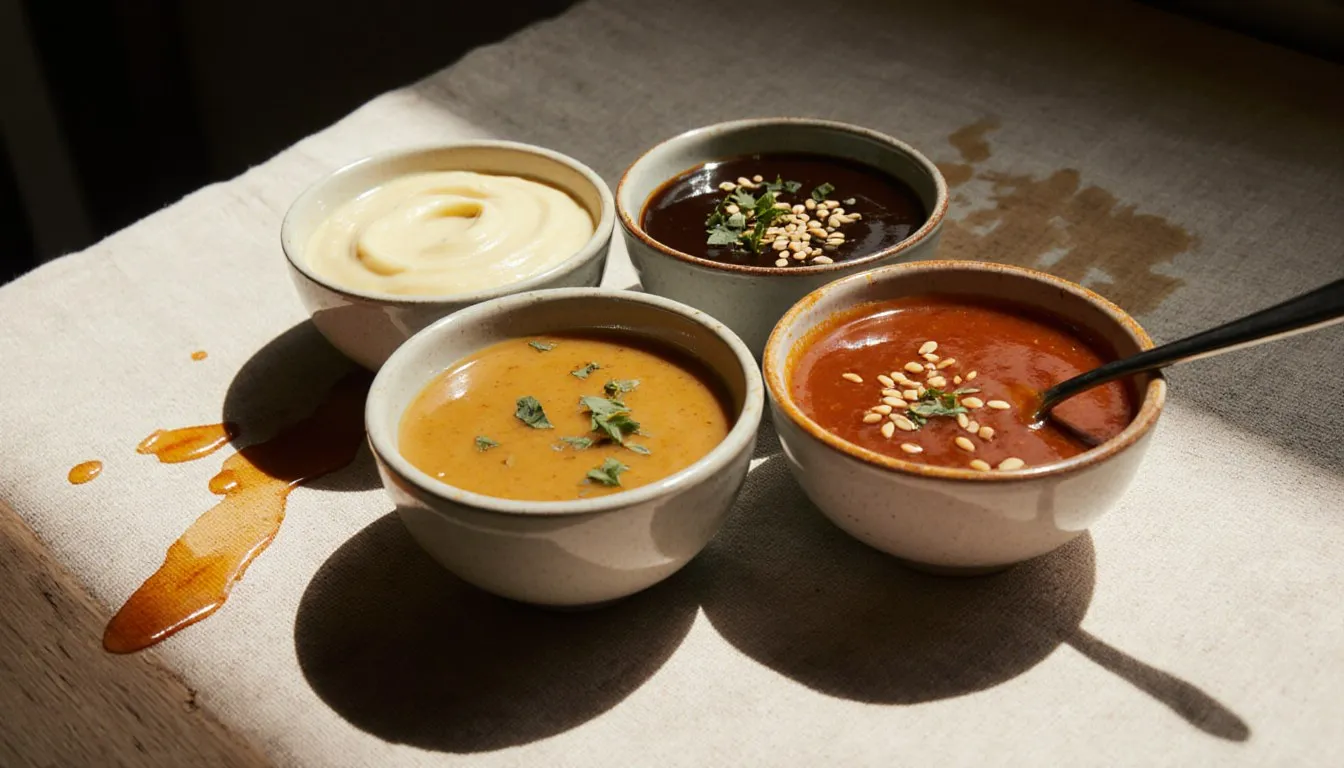
Homemade Sauce Recipes, Sorted by What They Actually Do to a Plate
A working map of homemade sauce recipes, grouped by what each one does: coats, dips, thickens, brightens. Four base techniques and where to start tonight.
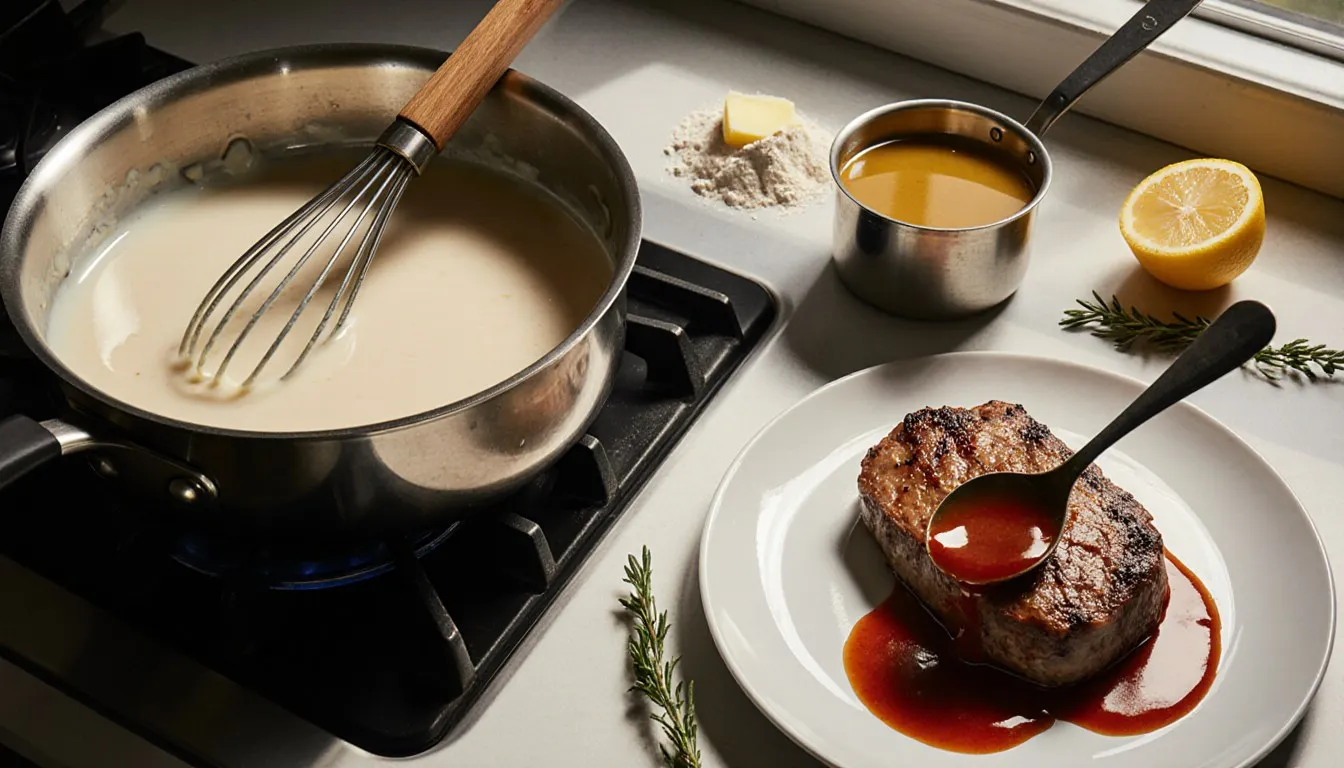
Almost every sauce you will ever make at home is one of four moves: you cook flour in fat, you scrape up the brown bits in a hot pan, you whisk fat into liquid until it holds, or you boil something down until it clings to a spoon. Learn those four and you can walk into a recipe you have never read and know what it is going to do before you turn on the burner. What changes from one recipe to the next is which liquid goes in, how much fat rides along with it, and how long you let the pan work.
So this is a map. Below, the sauces sorted by job: the ones that coat, the ones you dip into, the ones that thicken a braise, the ones that cut through fat and wake a dish up. Each group tells you what technique it runs on, where it typically goes wrong, and which one to make first if you have never made a sauce from scratch in your life.
What makes a sauce worth the extra pan?
Five minutes and one more thing to wash. That is the actual price, and it is worth paying when the sauce is mostly technique and cheap ingredients, and not worth paying when the jarred version is doing something you cannot easily do at home.
Worth it, nearly always: a pan sauce, because the flavor is already stuck to the bottom of the skillet you just cooked in and you are throwing it away otherwise. Gravy, for the same reason. Vinaigrette, which takes ninety seconds and beats the bottled stuff so decisively it is almost unfair. Garlic and oil for pasta. Anything where the store version is mostly sugar, water, and stabilizers, which covers most barbecue sauce and nearly all bottled ranch.
Not worth it, at least not on a Tuesday: soy sauce, which is a months-long ferment and a genuinely industrial process. Fish sauce. Sriracha, unless you want the project. Good canned San Marzano tomatoes, which are a legitimate ingredient and not a shortcut you owe anyone an apology for. I keep jarred marinara in the pantry and I use it, and then I doctor it with a smashed garlic clove and a knob of butter and nobody at my table has ever asked.
The rule I cook by is about the pan. If the flavor is already stuck to something I have to wash anyway, the sauce gets made, which covers gravy, every pan sauce, and the vinaigrette I whisk in the bottom of the salad bowl while the oven finishes. Anything that needs a fermentation cellar, a caramelizing kettle, or a free Saturday goes in the cart, and I spend that time on the rest of dinner.
The handful of base techniques behind almost every sauce
Four moves cover the category. Everything else is seasoning and confidence.
- Roux: equal parts fat and flour by volume, cooked together before liquid goes in. Two tablespoons of butter and two tablespoons of flour will thicken about a cup of milk to a pourable sauce; use three of each if you want it thick enough to coat pasta and stay put. Cook the raw flour smell off before the liquid goes in, about two minutes for a white roux, longer and darker for gumbo territory. This is béchamel, this is most gravy, this is the base of half the casseroles in America.
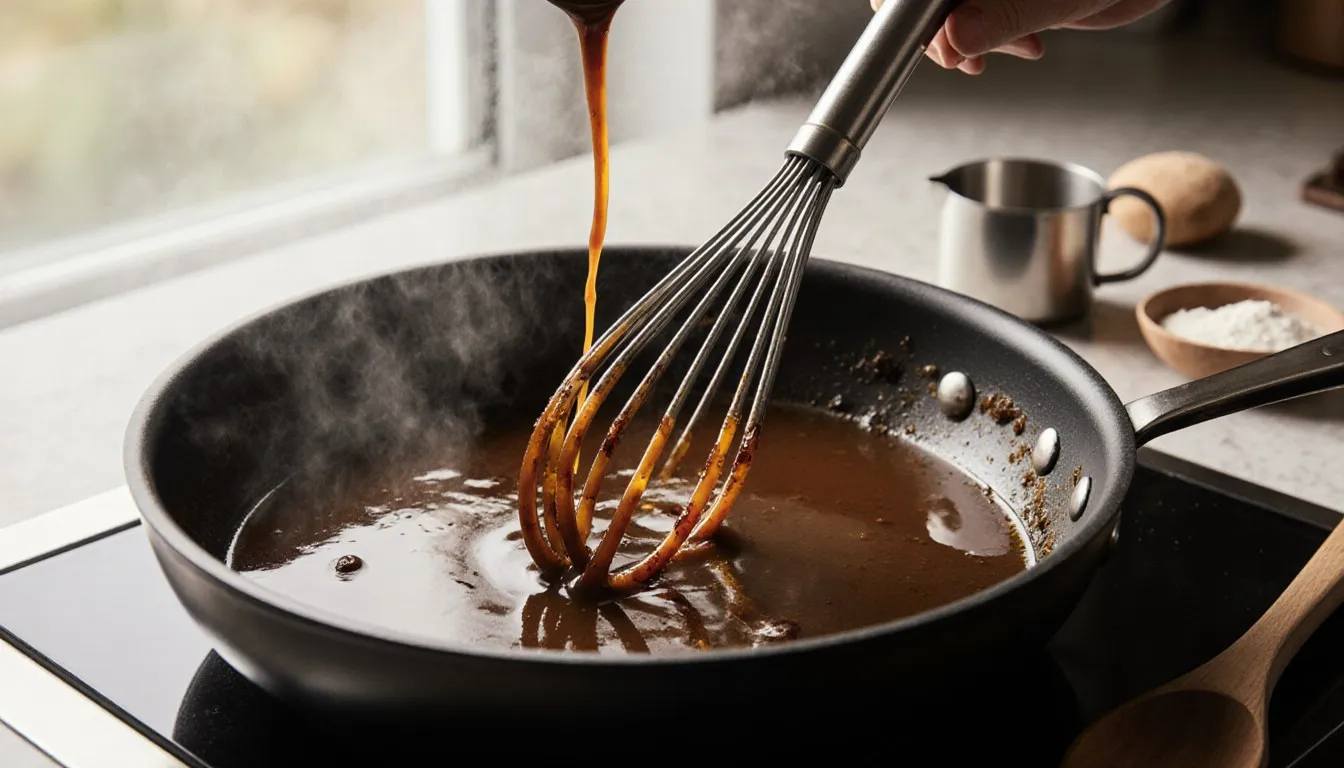
- Deglazing and the pan sauce: sear something, take it out, pour in wine or stock while the pan is still hot, and scrape. Those brown bits are the whole point. Reduce by about half, swirl in cold butter off the heat, done. It takes about as long as the meat needs to rest.
- Emulsion: forcing fat and water to hold hands. Vinaigrette, mayonnaise, hollandaise, beurre blanc. All of them work on the same principle and all of them break for the same reasons, which we will get to.
- Reduction: the laziest technique and often the best one. Simmer until water leaves and flavor concentrates. No thickener, no fuss, just time and a wide pan. Wide matters more than people think; a saucepan with a small surface reduces at a crawl.
The five so-called mother sauces (béchamel, velouté, espagnole, hollandaise, and tomato) are the classical French version of this same map, usually credited to Escoffier’s reworking of an older list. It is a genuinely useful family tree, and if you want it on paper, our printable one-page sauce chart lays out all five and the offshoots that come from each. But you do not need the vocabulary to cook. You need to know that flour thickens, fat emulsifies, and heat concentrates.
Sauces for pasta: where most home cooks start
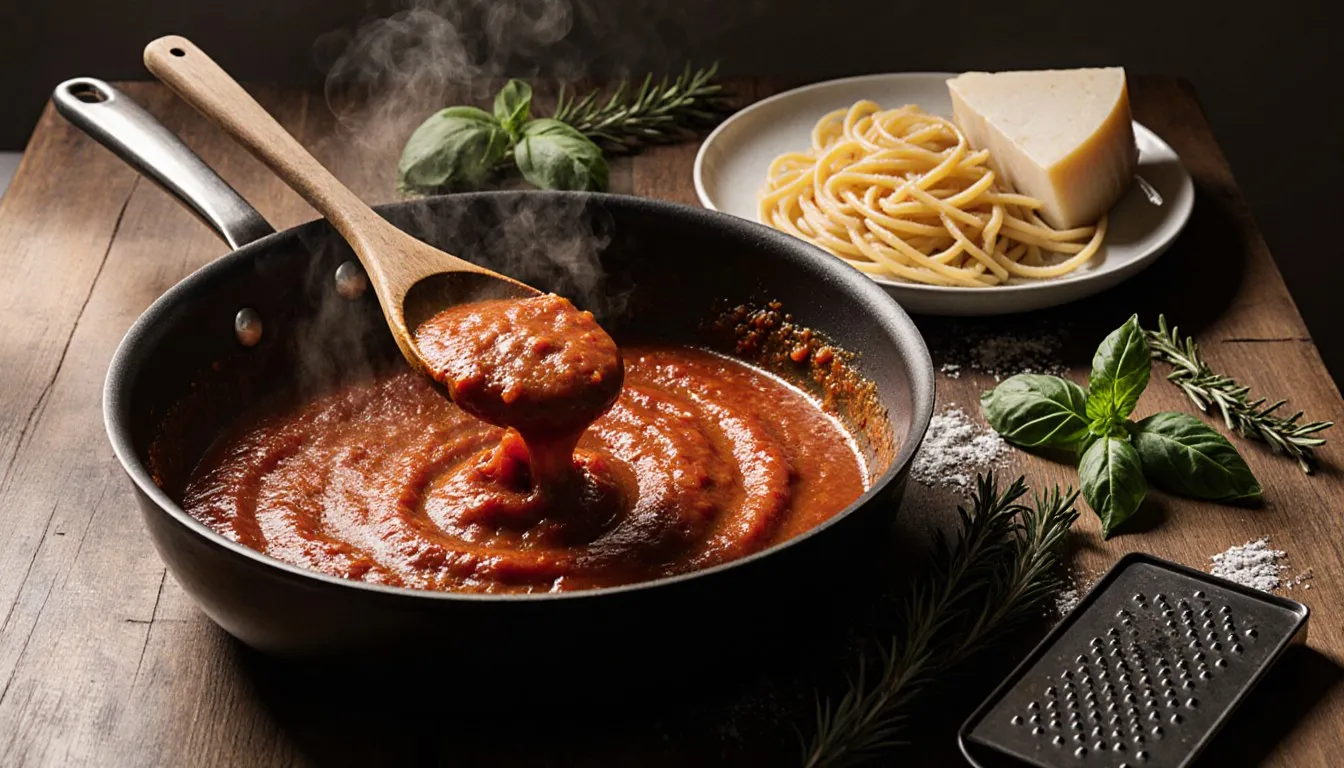
Pasta is where almost everyone makes their first sauce from scratch, and the reason is that pasta forgives you. If the sauce is a little thin, the starchy cooking water and a hard minute of tossing in the pan will pull it together. If it is a little thick, a splash of that same water loosens it.
The broad shape of the category: tomato-based sauces, which range from a raw summer tomato toss to an all-afternoon simmer; cream sauces, which are rich and fast and unforgiving of high heat; oil-based sauces, which are the fastest of all; and meat sauces, which are really reductions wearing a different hat. Save your pasta water. I mean it. Reserve a mug of it before you drain, every single time, because it is the one ingredient you cannot go back for. Ask me how I know.
Most first-timers make the same two mistakes: they drain the pasta bone dry and then dump sauce on top of a naked pile in a bowl, and they undersalt the cooking water. Sauce and pasta should finish cooking together in the pan for a minute or two. That is the step that turns two separate foods into one dish. If you want the full rundown of which sauce goes with which shape and how long each one actually needs, our guide to pasta sauces walks through the lot.
Gravy: the pan sauce every home cook eventually needs
Gravy is a roux built in the roasting pan with the fat that just came off the meat, which is why it tastes like the roast and a jar never will. The working ratio is two tablespoons of fat and two tablespoons of flour per cup of liquid, and if you want it thicker, go to three and three rather than adding flour at the end.
Where gravy parts ways with a plain pan sauce is the thickener. A pan sauce leans on reduction and a little butter and stays glossy and loose. Gravy uses flour and stays opaque and spoonable, because it is going on mashed potatoes and it has a job to do there. Both start with drippings and a hard scrape.
Two things save gravy more often than anything else. First, pour the drippings into a clear measuring cup and let the fat rise so you can measure it properly instead of guessing; a fat separator is the one gadget I will defend. Second, add the liquid warm and in stages, whisking, because a big cold splash into a hot roux is how lumps are born. If lumps show up anyway, a sieve fixes it and nobody has to know. The full method, including how to build gravy when there are no drippings at all, lives in our guide to how to make gravy.
Dipping sauces: the fast, no-cook category
If you have never made a sauce from scratch, start here, because most dipping sauces are a bowl, a whisk, and no heat whatsoever. Mayonnaise plus one assertive thing gets you most of the way: mayo and sriracha, mayo and chipotle, mayo and lemon and a mountain of dill. Yogurt plus acid plus herbs gets you the rest. Neither one can break if you never put it near a burner.
The thing that separates a good dip from a flat one is salt and acid, in that order. Taste it, add a pinch of salt, taste again. Then add lemon or vinegar in small amounts until it goes from pleasant to bright. A teaspoon at a time, tasting between each one, and stop the moment it turns lively instead of sour. If it is still flat after that, it wants salt, not more lemon.
One safety note, because it matters: if you are making mayonnaise or aioli from scratch with raw egg yolks, use pasteurized eggs, especially if you are feeding anyone pregnant, very young, elderly, or immune-compromised. Raw-egg sauces should stay refrigerated and get eaten within a few days. Our full lineup of dipping sauces covers the ratios for each style if you want somewhere to start tonight.
Cream, butter, and oil sauces: the rich end of the spectrum
These are the fast, luxurious ones, and they all share the same weakness: too much heat and they split. Cream sauces want a gentle simmer with lazy bubbles at the edge and nothing more. Butter sauces want to come off the heat entirely before the last of the butter goes in.
The lineup, roughly from richest to simplest:
- Cream and cheese sauces: cream reduced slightly, then cheese melted in off the heat. Grate your own cheese, because the anti-caking powder on pre-shredded cheese is exactly what makes a sauce grainy. Our guide to alfredo sauce handles the classic version.
- Cream with aromatics: the same base with garlic bloomed in butter first, which is a different animal on the plate and worth its own treatment; garlic cream sauce covers it properly.
- Butter sauces: emulsions of cold butter into a small amount of hot liquid, the beurre blanc family. Glossy, fragile, spectacular over fish. Butter sauce for pasta is the weeknight version.
- Oil sauces: the leanest of the rich sauces, which sounds like a contradiction until you have had garlic oil pasta sauce done right, with the garlic taken barely to gold and pulled before it browns.
A word on garlic in oil: do not store homemade garlic-in-oil at room temperature. Low-acid garlic sitting in oxygen-free oil is a known botulism risk. Refrigerate it, use it within three to four days, and treat any batch you have left on the counter as trash. Not worth the gamble, ever.
Global sauces worth making from scratch
Some sauces are inseparable from a specific technique or a specific tradition, and those are the ones where the homemade version is a real upgrade rather than a small one. Others in this group are the opposite, fascinating to understand and completely reasonable to buy.
The genuinely worth-it ones tend to be fresh and uncooked. Tzatziki sauce is the clearest example: strained yogurt, cucumber squeezed dry, garlic, lemon, dill, and the store version is never as sharp or as cold-tasting as the one you made an hour ago. Salt the grated cucumber and let it drain before it goes in, or you will end up with soup. Shawarma sauce, the garlicky white sauce that comes with the wrap, is a similar story: five ingredients and a whisk.
Then there are the ones that are educational to attempt and honest work to finish. Traditional soy sauce is a long ferment with koji mold and a brine, measured in months, and if you want to see what that actually involves, how to make soy sauce lays out the real process rather than pretending it is a weeknight job. Real wasabi is a rhizome grated fresh to order, and most of what gets served as wasabi is horseradish, mustard, and green coloring; how to make wasabi covers what you are actually working with.
Whichever direction you go, the herbs and spices carry these sauces almost entirely. Dried dill in tzatziki tastes like dried dill. Toasting whole cumin and grinding it yourself takes two minutes and changes a sauce more than any technique in this article.
Sauces built for one specific dish
This is the matchmaking category, sauces that exist to go with exactly one thing and are usually better for the narrowness. There is no general theory here, just good pairings that people worked out over time.
- Buffalo wing sauce: cayenne pepper sauce emulsified with melted butter. Melted butter is what makes it wing sauce rather than hot sauce on a wing, and it is what keeps the coating clinging to the skin. Figure on a stick of butter to a cup of cayenne sauce, whisked warm. I once poured cold hot sauce straight into hot butter and watched it split into an orange slick that ran off the wings and pooled on the plate. Warm both, whisk them together off the heat, and the coating stays where you put it.
- Sauce for crab cakes: creamy, lemony, restrained. Crab is delicate and expensive and the sauce should stay out of its way.
- Quesadilla sauce: the smoky, faintly spicy cream sauce that comes on the side at the restaurant and that people ask about more than almost anything else on the menu.
- Ravioli sauce: sauce chosen around a filling rather than around the pasta. Brown butter and sage for squash, a light tomato for cheese, cream for mushroom.
- Tempura sauce: the dashi, soy, and mirin dipping broth, thin on purpose so it does not soften the crust.
The lesson that carries across all of them: match the sauce’s weight to the food’s weight. Heavy cream sauce on delicate crab flattens it. Thin dipping broth on a rich braise disappears. Get that balance right and the specific recipe matters a lot less than you would think.
What’s the difference between broth, stock, and a sauce base?
Stock is made from bones and gets its body from gelatin, broth is made mostly from meat and vegetables and stays lighter, and a sauce base is either one cooked down and thickened until it stops behaving like a liquid. That is the short version.
What it means at the stove: stock chilled in the fridge sets up like soft jelly, and that gelatin is what gives a reduced pan sauce its glossy, lip-sticking quality. Broth will not do that on its own, which is why a sauce built from broth usually needs a little flour, a cornstarch slurry, or a lot more patience. If your reduction tastes right but feels watery, gelatin is what is missing.
Also worth knowing: most store-bought broth is salted and most store-bought stock is not, so a carton that tastes fine straight can turn aggressively salty once you reduce it by half. Buy the unsalted version for anything you plan to cook down, and salt at the end. Our full comparison of broth vs stock gets into how each one is built and where they are interchangeable.
Store-bought staples worth knowing how to make: oyster sauce and pomegranate sauce
Some bottled sauces are so ordinary in the pantry that it never occurs to anyone they could be made at home. Two of them are worth a look, for opposite reasons.
Oyster sauce I buy, and I am not sorry about it. It is the thick dark glaze behind a lot of stir-fries, and the bottled version is a caramelized reduction with oyster extract and thickeners doing a job that takes a factory a few minutes and takes me an afternoon. If you want to try it anyway, simmer a pint of shucked oysters in their own liquor with a splash of water until they are cooked through, strain and press out every drop, then reduce that liquid hard with a spoonful of soy and a little sugar until it coats the back of a spoon and holds a line when you drag your finger through it. Expect roughly a quarter cup of finished sauce from that pint, which tells you why the bottle exists. The homemade one is fresher and considerably less sweet, and it is a weekend job. Our guide to oyster sauce covers the method and what to substitute if shellfish is off the table.
Pomegranate sauce is the one I actually make, and there is a jar of it in my fridge right now. The thick tart syrup sold as pomegranate molasses is just pomegranate juice reduced down, four cups going to about three-quarters of a cup, with a tablespoon of sugar and a squeeze of lemon if the juice is sharp. Keep it at a lazy simmer in a wide pan and start watching at the forty-minute mark; you want it to coat a spoon and fall in a slow ribbon while it is still hot, because it thickens a good deal more as it cools. Take it too far and you get candy in a jar, which I have done. It goes on roasted vegetables, into dressings, over lamb, and into marinades. Pomegranate sauce has the ratios and the reduction cues.
Dressings that live in the sauce family
A salad dressing is a cold sauce, full stop. It is an emulsion, it runs on the same fat-plus-acid math as every other one, and treating it as a separate category is the reason so many people who cook well still pour dressing out of a bottle.
The base ratio is three parts oil to one part acid, and that is a starting point rather than a rule. Sharper vinegars want more oil, mild rice vinegar or citrus wants less. Mustard is the workhorse emulsifier; half a teaspoon holds a vinaigrette together far longer than whisking alone. Honey, egg yolk, and mayonnaise do the same job with different results.
The two worth singling out sit at opposite ends. Celery seed dressing is the sweet-tart creamy one from church potlucks and diner salad bars, and it is the dressing that converts people who claim not to like salad. Walnut oil salad dressing is the other direction entirely, nutty and grassy and expensive, best on bitter greens with something sharp like blue cheese. Walnut oil goes rancid quickly, so keep it in the fridge and smell it before you pour; if it smells like old crayons, out it goes.
Why did my sauce break, curdle, or turn out thin?
Almost always one of three things: the heat was too high, the fat went in too fast, or there was never enough thickener to begin with. Diagnose which one and the fix is usually straightforward.
It broke, meaning the fat separated into an oily layer. Heat, nine times out of ten. Butter emulsions and hollandaise want gentle warmth, never a boil. Pull the pan off the heat, take a spoonful of the broken sauce, and whisk it drop by drop into a fresh tablespoon of warm liquid or a fresh egg yolk, then work the rest in slowly. Rebuilding an emulsion from a small stable base works far better than beating the broken pot and hoping.
It curdled, meaning the dairy went grainy. Usually acid meeting dairy at high heat, or a lot of tomato and wine hitting cream that was already simmering hard. Temper instead: warm the cream with a ladle of the hot liquid before it goes into the pot, and keep the whole thing under a boil afterward. Full-fat dairy handles acid better than low-fat, which is one place where the lighter option genuinely will not work.
It is thin. Reduce it first, because that costs nothing but time and improves the flavor. If it needs help, a cornstarch slurry (one tablespoon cornstarch whisked into one tablespoon cold water per cup of liquid, then simmered a minute) thickens clear and glossy and works fast, but it thins back out if it boils hard for long. A flour-based roux thickens opaque, holds up to longer cooking, and needs a couple of minutes to lose the raw taste. Never dump dry cornstarch or flour straight into hot liquid unless you enjoy picking out lumps. For the two thin-sauce problems that come up most, our guides to thicken alfredo sauce and thicken curry sauce work through the specific fixes for each.
White gravy and a few more places to start
White gravy is a béchamel built on sausage or bacon fat, heavy on black pepper, and it is the one every Southern cook I know can make half asleep. No roasting pan involved, no drippings from a bird, just whatever the sausage left behind in the skillet and enough milk to turn it pourable. Fat, flour, milk, pepper, salt, and a hard opinion about how much pepper is correct.
If you are still browsing and want one recipe to make this week, pick by what your kitchen already smells like. Roast chicken in the oven? Make the pan sauce, it will take you the length of the resting time. Pasta night? Garlic and oil, done in the time the water boils. Something fried or breaded on the plate? A dipping sauce, whisked in a bowl, no heat required. Salad as the whole dinner? A real vinaigrette, and never again the bottle.
The order matters less than the repetition. Make the same three sauces four or five times and you stop measuring, which is the entire goal.
How to store and reheat homemade sauce
Cool it quickly, get it into the fridge within two hours of cooking (one hour if your kitchen is above 90°F), and store it in a shallow container rather than a deep one so it chills fast. Most cooked sauces keep three to four days refrigerated, which is the USDA’s general guidance for cooked leftovers, and I hold to it even when something smells perfectly fine on day six.
What freezes well and what does not:
- Freezes beautifully: tomato sauces, meat sauces, stock-based sauces, pesto (freeze it in an ice cube tray with a film of oil on top). Three months is a reasonable window for best quality.
- Freezes acceptably: gravy and other flour-thickened sauces. They separate on thawing and look alarming, then come back together with gentle heat and a whisk. Cornstarch-thickened sauces do worse and often go watery for good.
- Do not bother freezing: cream sauces, butter emulsions, mayonnaise-based anything, and yogurt sauces. They break and stay broken.
Reheat low and slow. A saucepan over medium-low with a splash of stock, water, or milk to loosen beats the microwave for anything containing dairy or emulsified butter, where a hot spot will split the sauce in seconds. If you are reheating a sauce that contains meat or drippings, bring it to 165°F all the way through, which is the standard for reheating leftovers safely, and stir so there are no cold pockets.
One last thing on preserving sauce long-term: home canning is the one corner of this where improvising is genuinely dangerous. Tomato sauce needs added acid and a tested process to be safely canned, and low-acid sauces need pressure canning, not a boiling water bath. Follow a tested, published canning recipe exactly or use the freezer instead. My mother’s line was that the freezer never poisoned anybody, and on this one she was completely right.
Tessa Calloway
Staff Writer
Tessa Calloway has spent twenty years cooking dinner on a weeknight clock and testing the shortcuts that survive contact with a real kitchen. She believes the best recipe is the one you can make with what's already in the house, and she has strong opinions about what actually needs to be homemade (less than you think) and what always does (dressing).