Pancakes, Crepes and Waffles: One Batter Family, Three Dessert Endings
Pancakes, crepes and waffles come from one batter with three dial settings. The ratios that separate them, plus how to send each one out as dessert.
Pancakes, crepes and waffles are the same four ingredients arguing about proportions. Flour, egg, dairy, fat, that’s the whole family, and what separates them is how much egg you add, how much fat you add, and whether anything in the bowl is trying to make it rise. Get those three dials right and you can walk one bowl of batter in any of the three directions. And once you understand the dials, a dessert version gets decided in the bowl: more sugar, more fat, a flavoring that reads sweet, all of it settled before the pan is even hot.
That’s the part most people skip. They make their usual Saturday-morning pancake, pour chocolate sauce on it at nine at night, and wonder why it tastes like breakfast wearing a costume. Below is what each batter is doing, how to push a base recipe toward whichever one you need, and what changes when the plate is going out after dinner.
What makes a pancake, a crepe, and a waffle different?
Four variables do all the work: egg ratio, fat, leavening, and how thick the batter is when it hits the heat. Set those four and the shape follows: a puffed round, a foldable sheet, or a pocketed slab.
A pancake batter is thick, roughly the consistency of a slow pour, and it leans on a chemical leavener. Baking powder, or baking soda paired with something acidic like buttermilk, throws off carbon dioxide, and that gas gets trapped in a batter stiff enough to hold it. That’s your puff. Pancake batter typically runs about one egg per cup of flour, sometimes less, because too much egg makes it tight and eggy instead of tender.
Crepe batter goes the other way on every dial. More egg, usually two or three per cup of flour, and enough milk to thin it to heavy cream. No leavener at all. The egg is doing the structural work, setting fast in a hot pan into a sheet you can pick up with your fingers. That high liquid ratio is why a crepe spreads to the edges of the pan on its own when you tilt it.
Waffle batter sits closest to pancake batter but with the fat pushed up, often noticeably more butter or oil per cup of flour than you’d put in pancakes. Fat is what fries the outside of the waffle against the hot plates and gives you that shatter. The iron itself does the rest: it cooks from both sides at once under pressure, so the exterior sets and dries while the inside stays soft and steamy.
Sugar matters too, and it matters more than most recipes admit. Sugar browns, and it browns fast. A dessert-bound batter with a couple of tablespoons more sugar in it will color quicker and go bitter at the edges if your heat is where you’d normally keep it. Take the burner down a notch when you sweeten the batter up.
Is there one batter that can become all three?
Yes, and it’s the single most useful thing to know about this family. Start with one cup of all-purpose flour, one cup of milk, one egg, two tablespoons of melted butter, a pinch of salt, and a tablespoon of sugar. That’s the middle setting. From there:
- Toward crepes: add a second egg (a third if you want them sturdy enough to roll and sauce) and another half to three-quarters cup of milk, until the batter coats a spoon thinly and runs off in a sheet. Skip any leavener entirely. Then rest it.
- Toward pancakes: hold the milk at one cup, add two teaspoons of baking powder, and leave the batter lumpy. If you swap the milk for buttermilk, cut the powder to one teaspoon and add half a teaspoon of baking soda so the acid has something to react with.
- Toward waffles: keep the pancake proportions but double the butter to four tablespoons, add two teaspoons of baking powder, and add sugar. Fat and sugar together are what make a waffle crisp rather than merely cooked.
My mother’s line was that you can always thin a batter but you can never un-thin it, and I have yet to catch her wrong on it. Hold back the last quarter cup of milk and add it once you see how the batter behaves. Flour absorbs differently depending on how you measured it and what the weather’s doing.
Worth knowing that the family is bigger than three. A Dutch baby, sometimes called a German pancake, uses a crepe-thin batter with no leavener at all, poured into a screaming-hot buttered skillet and finished in the oven, where the steam alone climbs the sides into a bowl-shaped, custardy pancake. One skillet, about twenty minutes, and it starts sinking the second it leaves the oven, so carry it to the table still puffed and let everyone watch it settle. And a buckwheat galette, the savory Breton cousin of the crepe, swaps in buckwheat flour for a nuttier, greyer, more fragile sheet. Buckwheat has no gluten, so galette batter tears more easily and wants a slightly thicker pour.
What turns a pancake into a dessert instead of breakfast?
Three things: the batter gets richer, the stack gets shorter, and something on the plate has to be cold or sharp.
Richer first. Dessert pancakes want more sugar, more butter, and usually a flavoring that reads as sweet rather than neutral: vanilla, browned butter, cocoa, citrus zest, a little almond extract. If you’re making a chocolate pancake, replace about three tablespoons of the flour per cup with unsweetened cocoa and add sugar to compensate, because cocoa is bitter and will flatten the whole thing otherwise.
Shorter stack next. A breakfast stack is four or five pancakes because it’s a meal. Dessert is two, maybe three, and made smaller, four inches across rather than six. Diameter is a portion control tool and nobody uses it. Small pancakes also stay hotter to the last bite, which matters when there’s ice cream involved.
Then the contrast. A stack of warm pancakes with warm syrup poured over it is monotone, and monotone at the end of a rich meal reads as heavy. Give the plate something that isn’t warm and sweet: crème fraîche, mascarpone loosened with a splash of cream, lightly sweetened whipped cream, macerated berries with their bright juice, a squeeze of lemon over the top. Acid is what keeps the last bite from feeling like a chore.
For layering, spread between the pancakes rather than piling everything on top. Lemon curd, chocolate hazelnut spread, jam thinned with a spoonful of hot water so it doesn’t tear the surface. Then a dusting of powdered sugar over the whole thing right before it leaves the kitchen, never earlier, because it dissolves into a damp film within a couple of minutes. If you want to lean fully into pancakes as a plated cake, the broader collection of easy dessert recipes has more ways to think about that end of dinner.
Why are crepes the easiest of the three to fill for dessert?
Because they’re thin enough to fold four ways without cracking, and because they hold sauce the way a paper towel holds water. That’s the whole advantage.
A pancake is too thick to fold, so anything you add sits on top and slides off. A waffle has pockets but no give. A crepe folds into a triangle, a cigar, a purse, or a stacked round cake, and each of those shapes traps filling somewhere it can’t escape. Roll a crepe around pastry cream and sliced strawberries and you’ve made something that looks like it took real skill, which is a lie you’re welcome to tell.
Crêpes Suzette is the classic dessert crepe and the one worth learning properly. Folded crepes are warmed in a sauce of butter, sugar, and orange, usually with orange liqueur, and the sauce is often flamed at the table. The sauce has to reduce to a syrup thick enough to soak into the folds. The flame is theatre, and it’s over in about fifteen seconds. If the pan is crowded, the sauce won’t reduce, and you’ll get soggy crepes swimming in orange butter. Work in batches of four.
A note on the flambé, and I mean this: pull the pan off the burner before adding liqueur, keep your face and sleeves back, keep a lid within reach to smother it, and never pour from the bottle directly into a hot pan. If any of that makes you uneasy, skip it. The sauce is just as good without ever meeting a flame. Alcohol content in a flamed sauce is reduced but not eliminated, so it’s not automatically appropriate for everyone at the table, and worth mentioning if kids are eating.
Other fillings that hold up: pastry cream with a whisper of rum, ricotta sweetened and lightened with whipped cream and lemon zest, dark chocolate ganache while the crepe is still warm enough to melt it slightly, sliced banana with dulce de leche, poached pears with their syrup reduced down. Keep the filling to about two tablespoons per crepe. Overfilled crepes split at the fold, and there’s no fixing it once it’s on the plate.
The rest of the batter is not negotiable, by the way. Crepe batter needs at least thirty minutes in the fridge, because the flour has to hydrate and the gluten has to relax before a sheet will lift clean instead of tearing at the first fold.
How do you get a waffle crisp enough to hold ice cream?
Cornstarch, more fat, and a hotter iron than you think. In that order of importance.
Replace about a quarter of the flour with cornstarch, so four tablespoons out of every cup. Push it much past that and the waffle goes sandy and fragile, splitting under a heavy scoop, and it’s the wrong swap entirely for any batter you want chewy or foldable. Cornstarch has no gluten, so it dilutes the protein network that makes waffles chewy, and it crisps hard as it dries out on the iron. Cooks have swapped part of the flour for cornstarch in fried coatings for the same reason for a very long time. It works on a waffle for exactly the same reason it works on chicken.
Push the fat up. Four tablespoons of melted butter per cup of flour is a good dessert starting point, and some cooks go higher. The fat on the surface of the batter is essentially frying the exterior against the plates.
Get the iron properly hot and leave it alone. Most irons with a dial want to be at the upper end for a crisp dessert waffle, and most people open them too early. Wait until the steam coming out the sides slows to almost nothing. Steam is water leaving; while it’s pouring out, the outside is still wet. When it quiets, the crust has set. Opening the iron before that point splits the waffle in half, and there’s a sound you’ll learn to dread.
Two more things that matter more than any recipe tweak:
- Never stack finished waffles. They steam each other soft in under a minute. Rack them in a single layer on a wire rack in a 200°F (95°C) oven, where the dry heat actually improves them while you finish the batch.
- Separate the eggs if you want the best version. Yolks into the batter, whites whipped to soft peaks and folded in at the end. It’s the classic Belgian waffle move and it produces an interior so light that the crisp shell has something to contrast against. It costs you one extra bowl and about four minutes.
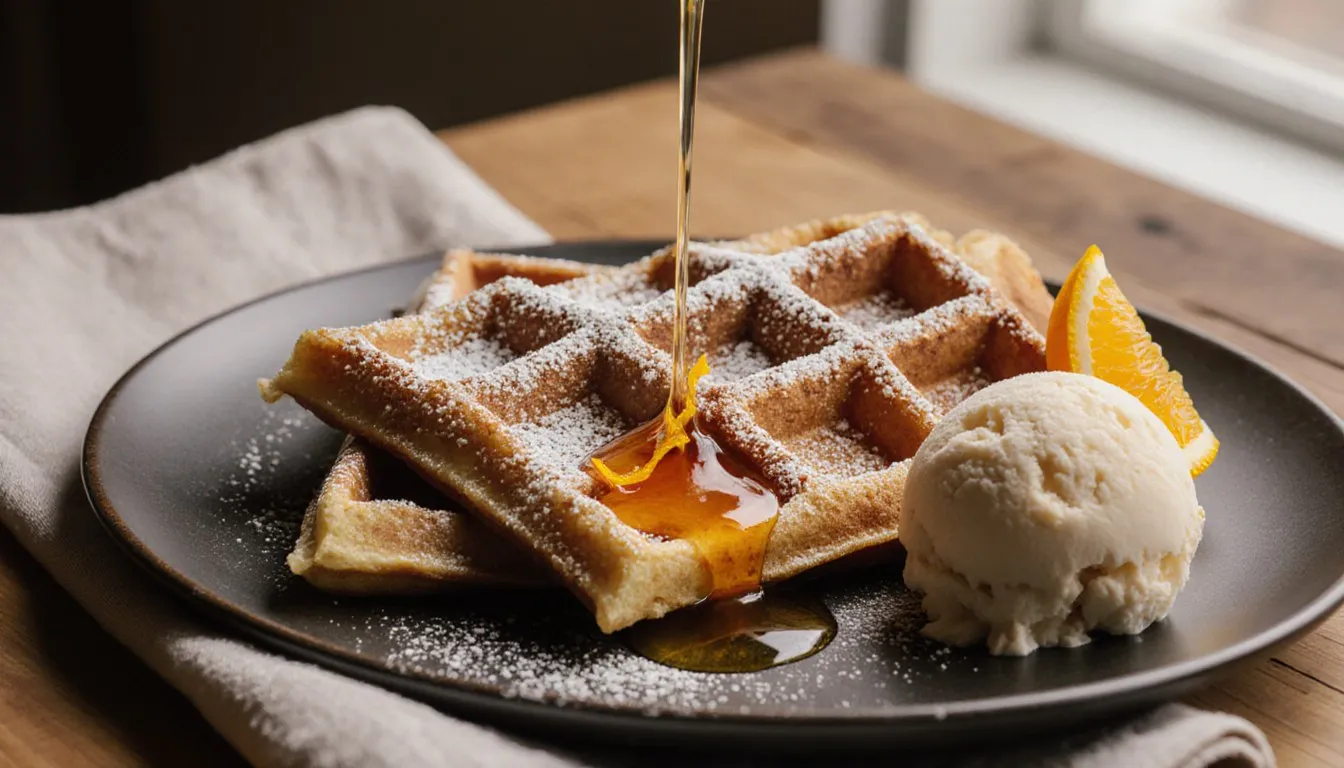
For serving under a scoop, make the waffle smaller than the full iron if you can, so the ratio of crisp edge to soft middle goes up. Sit the scoop slightly off center rather than dead middle, so half the waffle stays dry for the last few bites. And warm your caramel or chocolate sauce so it’s pourable but not hot enough to melt the ice cream on contact.
What mistakes ruin a dessert version of these three?
The same five, over and over. Three of them happen with the batter still in the bowl, and the other two at the stove.
Overmixing. Pancake and waffle batter should be lumpy. Visible lumps of dry flour, the kind that make you want to keep whisking. Every extra stroke develops gluten, and gluten makes pancakes rubbery and waffles chewy instead of crisp. Twelve to fifteen strokes with a fork, then walk away. Crepe batter is the exception; it can be blitzed smooth in a blender because it has so little flour relative to liquid that gluten development is less of a threat, and you actively want it lump-free.
Skipping the rest. Crepe batter should rest at least thirty minutes, and an hour or more is better. Resting lets the flour hydrate fully and lets the gluten you just developed relax, so the crepes cook tender instead of tough and the batter spreads more evenly. This is the step people skip and then wonder why their crepes tear. Pancake batter benefits from about ten minutes of rest too, enough for the leavener to start working and the flour to drink.
Wrong pan temperature. Too cool and pancakes spread thin and pale before they set. Too hot and a sweetened batter goes dark before the middle cooks. Medium is right for pancakes; the water-drop test still works, where a flick of water should sizzle and skitter rather than sit and steam or vanish instantly. Crepes want a pan hotter than you’d use for pancakes, medium to medium-high, so the thin batter sets on contact instead of gluing itself down.
Using a breakfast-lean batter for a dessert plate. A thin, barely sweetened pancake under ice cream tastes like a napkin. Dessert needs the fat and sugar built in.
Under-buttering the crepe pan. Not a heavy slick, just a swipe with a folded paper towel dipped in melted butter between every crepe. And accept that the first crepe is a sacrifice. Every cook I know throws the first one out, or eats it standing at the stove, which is what it’s for.
Can the batter be made ahead for a dinner party?
Crepe batter yes and gladly, pancake batter with a compromise, waffle batter not really.
Crepe batter is the make-ahead champion of the three. Because it has no leavener to exhaust, it holds well covered in the fridge overnight, and many cooks insist it’s actively better the next day after a long hydration. It separates as it sits, which is normal; whisk it gently back together, and if it thickened up, thin it with a splash of milk until it coats a spoon again. Cooked crepes hold even better than the batter: stack them with squares of parchment between, wrap tightly, refrigerate for a couple of days or freeze, then reheat in a dry pan for a few seconds a side. For a dinner party this is the move. Crepes made that afternoon, filled and sauced to order after dinner. If you want the full technique from the beginning, making crepes from scratch is worth reading through once before you host.
Pancake batter is a different story, because your leavener starts working the moment it gets wet and the bubbles it makes don’t wait for you. Batter made hours ahead gives you flat, dense pancakes. The compromise is to mix your dry ingredients (flour, sugar, leavener, salt, cocoa if you’re using it) in one covered bowl and your wet ones in another, then combine while the pan heats. That’s ninety seconds of work at dessert time instead of ten minutes.
Waffle batter is the same problem, worse, because you’re also relying on that lift for the light interior under the crisp shell. Do the same dry-and-wet split. Better still, cook waffles ahead, cool them completely on a rack, and re-crisp them in a hot oven or a toaster right before serving. A waffle re-crisped from cold comes back genuinely good, near enough to fresh that nobody at the table will run the comparison. What it costs you is a hot oven at the moment dessert is meant to go out, which is the one thing a stack of cooked-ahead crepes never asks for.
Refrigerated batters containing egg and dairy should be kept cold and used within about a day. If it’s been sitting on the counter while you ate dinner, it goes down the drain. Not worth the risk over a cup of flour.
Which one should you make tonight?
Depends on how many people are eating and how much of the evening you want to spend at the stove.
- Two people, no special equipment, twenty minutes: pancakes. Small ones, extra butter and sugar in the batter, a spoonful of jam between each layer, cold cream on top.
- Six or more, and you want to look like you tried: crepes. Make them in the afternoon, stack them with parchment, fill and fold to order. It’s the only one of the three where cooking ahead costs you nothing.
- Kids at the table, ice cream in the freezer: waffles. The pockets hold sauce, everyone builds their own, and the iron does the work while you sit down.
- Four people, one skillet, and you want a showstopper: a Dutch baby. Crepe-thin batter, hot buttered pan, straight into a hot oven, out in about twenty minutes puffed to the sky. Powdered sugar and lemon, or roasted plums, or apples softened in butter and brown sugar first.
- Nobody wants to stand at a stove: this isn’t your night. Something from the no-bake desserts direction will serve you better.
If you make just one of these part of your regular rotation, make it the crepe batter. It lives in the fridge for a day, it costs about a dollar to make, and it turns into dessert for six with whatever’s in the fruit bowl. Mix a batch on a Saturday afternoon, let it rest while you get on with your day, and decide later what goes inside.
Tessa Calloway
Staff Writer
Tessa Calloway has spent twenty years cooking dinner on a weeknight clock and testing the shortcuts that survive contact with a real kitchen. She believes the best recipe is the one you can make with what's already in the house, and she has strong opinions about what actually needs to be homemade (less than you think) and what always does (dressing).