Desserts Around the World, Sorted by What Your Pantry Can Handle
A working cook’s guide to desserts around the world: which teach a technique worth stealing, which are weeknight-doable, and which need a shopping run.
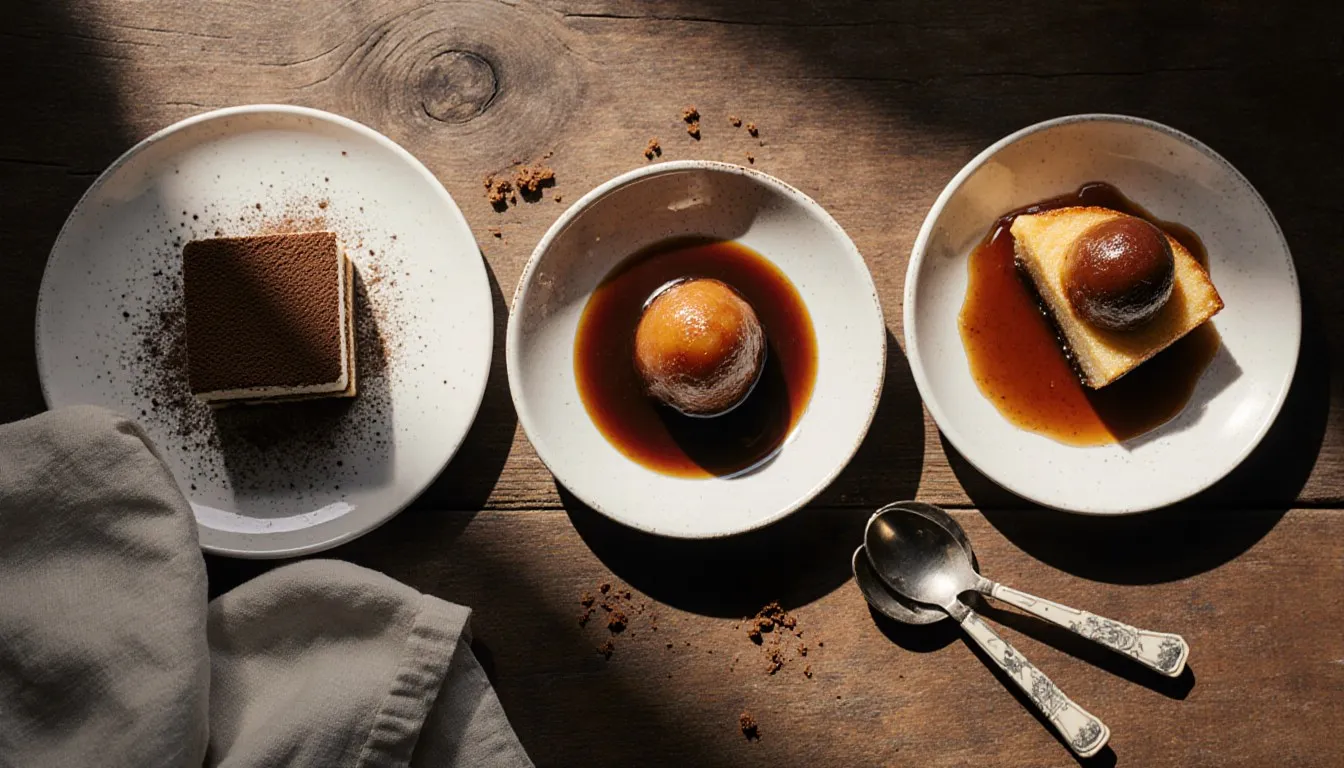
Roughly half the desserts on this list can be made tonight with what is already in your kitchen, and the ones that can’t will tell you exactly which single jar to buy first. That is the sort I care about. A world dessert earns a place in your rotation when it hands you a technique you will use again on something else, and most of the famous ones do: draining ricotta, reducing milk, cooking sugar syrup to a stage, grinding your own cardamom. Below, the traditional desserts from other countries that pay you back, what each one teaches, and an honest verdict on which need a special shopping run before you start.
What makes a dessert worth learning instead of just admiring?
One test: after you make it once, does anything else in your kitchen get better? Sticky toffee pudding teaches you a brown sugar and cream sauce you will pour over ice cream for the rest of your life. Alfajores teach you what cornstarch does to a cookie, which changes how you think about every shortbread you bake after. Mooncakes teach you a great deal about pressing a mold and almost nothing you will reuse on a Tuesday.
Showpieces are their own category, and worth recognizing as one before you start softening butter at nine at night. A mooncake buys you an occasion, a gift box, and a story. A brown sugar sauce buys you fifty future desserts. Both are good reasons to cook; just know which trade you are making tonight.
The other thing I look for is ingredient logic. Every dessert tradition solved the same problem (make something sweet and rich) with whatever was in the house. Places with a lot of dairy and no refrigeration cooked milk down. Places with sesame turned it into candy. Places with rice made rice sweet. Once you see the logic, each step in a recipe answers a question you can already ask yourself: what grew here, what kept without a fridge, what had to be cooked down before it spoiled. And they get easier to adapt when your grocery store lets you down, which it will.
None of this replaces the basics. Get your easy dessert recipes down first if the weeknight rotation still feels shaky. This is the wide-world detour.
Why do tiramisu and cannoli hold up better at home than most Italian desserts?
Because neither one asks you to bake anything, and both live or die on how you handle soft cheese, and handling soft cheese comes down to two habits anybody picks up in one afternoon: drain it properly, and keep it cold until the last minute.
Tiramisu is an assembly job. Whip a yolk and sugar base, fold in mascarpone, whip cream or whites separately, dip dry ladyfingers (savoiardi, the crisp ones, not the soft cakey kind) in cooled espresso for about one second per side, layer, chill at least six hours. The one hill I will die on: cook the egg base. Whisk the yolks and sugar in a bowl set over barely simmering water until the mixture thickens enough to coat the back of a spoon and reaches 160°F (71°C), which is the safe cooked-egg standard, then cool it before the mascarpone goes in. Raw-egg tiramisu is traditional and I am still saying no, especially if you are feeding anyone pregnant, very young, elderly, or immune-compromised. Pasteurized eggs are the other clean answer.
Cannoli teach you ricotta. Whole-milk ricotta straight from the tub is too wet, and a wet filling turns a crisp shell to cardboard in about twenty minutes. Drain it in a fine sieve lined with cheesecloth, in the fridge, overnight. Sweeten with powdered sugar, never granulated, because the cornstarch in powdered sugar helps hold the filling together and granulated sugar draws out more water. Fill the shells within an hour of serving. Sheep’s milk ricotta is the classic in Sicily. Cow’s milk swaps in one for one by weight and drains the same way, but it tastes milder and much less tangy, so grate in the zest of half an orange or a pinch of cinnamon per pound to give the filling something to say. Where the swap falls down is cassata, where that grassy sheep’s milk tang is most of what you are tasting.
The shells are the part worth outsourcing. Frying them takes a hot minute and a set of metal tubes, and good bakery shells exist. Nobody has ever asked me who fried the shell.
What’s the real difference between a proper trifle and a sticky toffee pudding?
One is layered cold and forgives everything, the other is a baked cake that has to be timed. Trifle is the weeknight one. Sticky toffee pudding is the Sunday one, and it is worth the Sunday.
A trifle is sponge or ladyfingers, a soak (sherry classically, fruit juice if you’d rather), fruit, custard, and whipped cream, in that order, in a glass bowl so the layers show. Britain is very relaxed about custard from a tin, and so am I; if you want the from-scratch version, the site’s guide to custard with milk walks it, and the tinned-powder route has its own writeup. Assemble it in the morning, let it sit all day, serve it cold. It gets better sitting, which is a rare and precious property in a dessert.
Sticky toffee pudding is a date cake with a technique in it. Chop dates, cover them with boiling water, stir in a half teaspoon of baking soda, and let them sit until the dates collapse into a paste, about ten to fifteen minutes. The soda softens the fruit fast and gives the cake its dark, almost fudgy crumb. That mixture goes into a standard creamed butter and sugar batter. The sauce is butter, dark brown sugar, and heavy cream simmered together until it coats a spoon, and you pour some over the hot cake so it soaks in, then serve the rest at the table. Bake at 350°F (175°C) and start checking at 30 minutes; it is done when the center springs back and a skewer comes out with moist crumbs, not batter.
Why do so many Indian desserts start with reducing milk instead of whipping cream?
Because cooking milk down concentrates the sugars and the milk solids, and that does the job cream does in a European custard, with a toasted, faintly caramel flavor cream never gives you. Once you understand the reduction, three famous desserts stop being separate recipes.
Kheer is rice simmered slowly in whole milk until the milk thickens and the grains break down, sweetened toward the end and perfumed with cardamom, saffron, or rosewater. Keep the heat low and scrape the sides back in; that browned film on the pan wall is where the toasted milk flavor concentrates, and stirring it back through the pot is most of what gives kheer its depth. Kulfi is the same idea taken further: milk reduced by about half, sweetened, poured into molds and frozen without churning. Because so much water has cooked off and no air has been beaten in, kulfi freezes dense and slow-melting instead of icy, which is why it works without an ice cream machine. That is the single most useful trick in this whole article for anyone who has tried and failed at no-churn frozen desserts.
Gulab jamun goes the other direction and turns concentrated milk into dough. Traditionally it is khoya, milk cooked down to a solid; at home, the standard shortcut is one cup of full-fat milk powder to three tablespoons of flour and a scant quarter teaspoon of baking soda, moistened with two to three tablespoons of milk or cream, just enough to bring a soft dough together. It fries like khoya and gives you the same spongy middle, a little lighter in flavor and paler in color. Nonfat milk powder is the version that fails: with no butterfat in it, the balls set up rubbery and refuse to drink the syrup. Two things decide whether yours are good. Roll the balls smooth, with no cracks, or they split in the oil. And fry them in oil on the low side of medium, turning constantly, so the insides cook through before the outsides darken; if they brown in a minute, your oil is too hot. They go into warm cardamom-rose syrup and need a good half hour to drink it up.
Beyond baklava: what do halva and knafeh do differently with tahini and semolina?
Halva is a candy-making lesson disguised as a snack, and knafeh is a lesson in the temperature of syrup. Neither one is phyllo work, so if layered pastry has scared you off this part of the world, start here. (Baklava’s long history and the story behind turkish delight are covered on their own elsewhere; this is the rest of the sweet table.)
Tahini halva is sesame paste bound with a hot sugar syrup cooked to the firm-ball stage, then folded together and pressed into a pan to set. The instructive part is the folding. Stir it just enough to combine and it sets into that dense, flaky, layered block. Beat it hard and the emulsion breaks, the oil weeps out, and you get a greasy paste. Anyone who has watched tahini seize when they added water too fast to a sauce already knows this ingredient’s temper. Work fast, fold, stop.
Knafeh layers a mild, stretchy cheese between shredded kataifi pastry or a fine semolina base, bakes it until the top is deep gold, and gets flooded with sugar syrup scented with orange blossom or rosewater. Nabulsi cheese is the traditional choice; low-moisture mozzarella cut with ricotta, roughly two parts mozzarella to one part well-drained ricotta by weight, is the common home substitute. It stretches convincingly and browns the same, though it is milder and a little sweeter than the original, so lean harder on the orange blossom in the syrup. Fresh mozzarella packed in water is the one to skip: it weeps into the pastry as it bakes and leaves you a soggy base no amount of extra oven time will crisp. The syrup rule is the one to remember: hot pastry meets cool syrup, or cool pastry meets hot syrup, never hot to hot, or the whole thing goes limp instead of staying crisp at the edges. Make the syrup first and let it cool while the pan bakes.
What’s worth knowing about Latin American desserts once you go past flan and tres leches?
That most of the region’s sweets are built on two things you can keep in a cupboard: sweetened condensed milk and cornstarch. Learn what each one does and a dozen recipes open up at once.
Dulce de leche is condensed milk cooked until the sugars brown and the texture goes thick and spreadable. The safe methods are the open ones. Pour the condensed milk into a shallow baking dish, cover with foil, set it in a larger pan with an inch of hot water, and bake at 425°F (220°C), stirring every half hour, until it is the color of an old penny. The stovetop version in a heavy saucepan works too, with more stirring. About the famous boil-the-unopened-can trick: a sealed can heated with the water level dropping below it can burst, and I am not willing to write the sentence that sends somebody to the emergency room. If you use it anyway, the can must stay fully submerged the entire time and cool completely before opening.
Alfajores are the cornstarch lesson. The dough runs heavy on cornstarch relative to flour, sometimes close to half and half, and since cornstarch brings no gluten, the cookies bake up pale, short, and so tender they nearly dissolve. Sandwich two with dulce de leche and roll the edges in coconut. Steal the ratio idea for your own shortbread sometime: swapping a few tablespoons of flour for cornstarch softens the crumb noticeably.
Tres leches cake and flan are the region’s headline acts and get their due everywhere, including a proper tour of traditional mexican desserts if that is the country you want to go deep on.
Why does cardamom show up in half of Scandinavia’s desserts?
The story usually told is that cardamom came north along the old trade routes and simply stayed. However it got there, Swedish baking now treats it the way American baking treats cinnamon: as the default warm spice in an enriched dough. Once you taste a cardamom bun next to a plain one, the reason is not mysterious.
Kanelbullar are the everyday version, cinnamon buns with cardamom worked into the dough itself, rolled, twisted into knots rather than spiraled flat, brushed with egg and scattered with pearl sugar. They are less sweet and less gooey than an American cinnamon roll, which is the point, because they are built for fika, the Swedish coffee break that stops offices and kitchen tables most afternoons of the week. Take the knot seriously, by the way. Folding the dough back on itself keeps the cinnamon butter suspended through the middle of the bun, where a flat spiral lets most of it slide out and pool on the pan, and the restrained sugar leaves you tasting cardamom and butter instead of frosting. Sweden even marks Kanelbullens dag, cinnamon bun day, on October 4.
Semla is the seasonal one, a cardamom bun eaten in the run-up to Lent, hollowed out, filled with almond paste moistened with the crumbs and a little milk, topped with a thick cap of whipped cream and the bun’s own lid, dusted with powdered sugar. It is a two-bite-wide, fancy-schmancy thing and it disappears fast.
Freshly ground cardamom is the whole trick here. Buy green cardamom pods, crack them, and grind the little black seeds yourself in a mortar or a spice grinder right before baking. Pre-ground cardamom loses its top notes within months and tastes soapy and flat by comparison. Use it generously in enriched dough, on the order of a teaspoon or more of freshly ground seed per batch, because the butter and milk mute it.
What do mooncakes and mango sticky rice have in common as make-at-home projects?
Almost nothing, which is the useful comparison. One is a multi-day pastry tradition with special equipment and the other is a three-ingredient dessert most people could make tomorrow, and both get filed under the same vague heading of Asian sweets.
Cantonese mooncakes, made for the Mid-Autumn Festival, need a golden inverted sugar syrup, a small amount of alkaline water for color and browning, a filling of lotus seed paste or sweet red bean often wrapped around a salted duck egg yolk, and a mold to press the pattern. Then, after baking, they rest for a couple of days while oil from the filling migrates into the skin, softening it and turning it glossy. Straight from the oven they are hard and disappointing, which trips up almost everyone the first time. Treat it as a weekend project, an occasion, and a gift, and know that buying good ones from a bakery in autumn is a completely respectable choice. If you do make the syrup, one batch keeps for months in a jar and turns up again in caramels, nougat, and ice cream bases, which the guide to inverted sugar syrup gets into.
Mango sticky rice needs glutinous rice, a can of coconut milk, sugar, salt, and ripe mango. Soak the rice for several hours or overnight, steam it (do not boil it like ordinary rice, it turns to glue), then stir in warm sweetened, salted coconut milk and let the rice sit covered for about twenty to thirty minutes to absorb it. Save a little coconut milk, thickened with a pinch of salt and a bit of starch, to spoon over the top. The salt is not optional. It is the whole reason the dish tastes balanced instead of cloying, and skipping it is the single most common home mistake.
Which of these can you make tonight with a normal pantry?
Here is the honest sort. Pantry means flour, sugar, butter, eggs, milk, cream, cornstarch, baking soda, cinnamon, and canned goods most of us keep.
Make it tonight, nothing special required:
- Trifle. Sponge or store cake, custard, fruit, cream. Assemble in the morning.
- Sticky toffee pudding, if you have dates. The sauce is butter, brown sugar, cream.
- Kheer. Rice, whole milk, sugar, and patience at a low simmer.
- Dulce de leche, given a can of sweetened condensed milk and ninety minutes.
- Alfajores, since cornstarch is already in the cupboard for gravy.
One shopping run first (buy the item, not the whole aisle):
- Tiramisu: mascarpone and crisp savoiardi.
- Cannoli: whole-milk ricotta and bakery shells.
- Kulfi and gulab jamun: full-fat milk powder, green cardamom, rosewater.
- Kanelbullar and semla: cardamom pods, pearl sugar, almond paste.
- Mango sticky rice: glutinous rice and coconut milk.
- Knafeh: kataifi pastry and orange blossom water.
Save it for a day you want a project:
- Mooncakes. Molds, inverted syrup, alkaline water, and a two-day rest.
- Tahini halva. The syrup has to hit a stage and the folding window is short.
- Fried cannoli shells from scratch, if you have the tubes and the nerve.
Anything on the first list slots straight into a normal week. If the no-bake ones are what you’re after in general, the site’s roundup of no-bake desserts has more in that direction.
How do you store rosewater, tahini, glutinous rice flour, and the rest?
Short version: the dry goods are easy, the fats and the dairy are where things go wrong.
- Tahini: unopened, a cool dark cupboard is fine. Once open, the sesame oil will eventually go rancid, so refrigerate it if you use it slowly. It stiffens cold; let it come to room temperature and stir the separated oil back in. If it smells sharp or bitter like old nuts, throw it out.
- Rosewater and orange blossom water: cool, dark, tightly capped. They do not spoil so much as fade, and a faded bottle just means a weaker perfume. Buy small bottles; you use a teaspoon at a time.
- Glutinous rice flour and pearl sugar: airtight at room temperature, away from heat. Rice flour keeps well but picks up odors, so don’t leave it open next to the onions.
- Cardamom: whole pods in a sealed jar hold their flavor far longer than ground. Grind what you need.
- Sweetened condensed milk: the unopened can is shelf-stable. Once opened, or once cooked into dulce de leche, it becomes a perishable dairy product. Transfer it out of the can into a clean jar, refrigerate it, and freeze it if you want it around longer.
- Anything with dairy, eggs, or cheese in it, which covers tiramisu, filled cannoli, kheer, kulfi, and knafeh: refrigerate promptly, and follow the standard guidance for cooked perishable food, which is 3 to 4 days in the fridge. Kulfi lives in the freezer and is a different case, but wrap it well or it will taste like your freezer. When something has sat out at room temperature for more than two hours, discard it. That rule is not negotiable and it is not worth a night of regret over a bowl of pudding.
Filled cannoli are the exception that will not wait even that long. They are a serve-now dessert, and any that survive dinner belong in the trash the next morning rather than the fridge, texturally speaking.
If you want one thing to try this week, reduce a quart of whole milk by half over low heat, sweeten it, hit it with ground cardamom, and freeze it in paper cups with a spoon standing in each one. You will have kulfi by tomorrow, and a permanently better understanding of why every no-churn frozen dessert you have made before came out icy.
Tessa Calloway
Staff Writer
Tessa Calloway has spent twenty years cooking dinner on a weeknight clock and testing the shortcuts that survive contact with a real kitchen. She believes the best recipe is the one you can make with what's already in the house, and she has strong opinions about what actually needs to be homemade (less than you think) and what always does (dressing).