Types of Bread, Sorted by What Actually Changes the Loaf
The types of bread worth knowing, sorted by leavening and flour: what each crumb and crust does, which loaf goes with which meal, and how to store it.
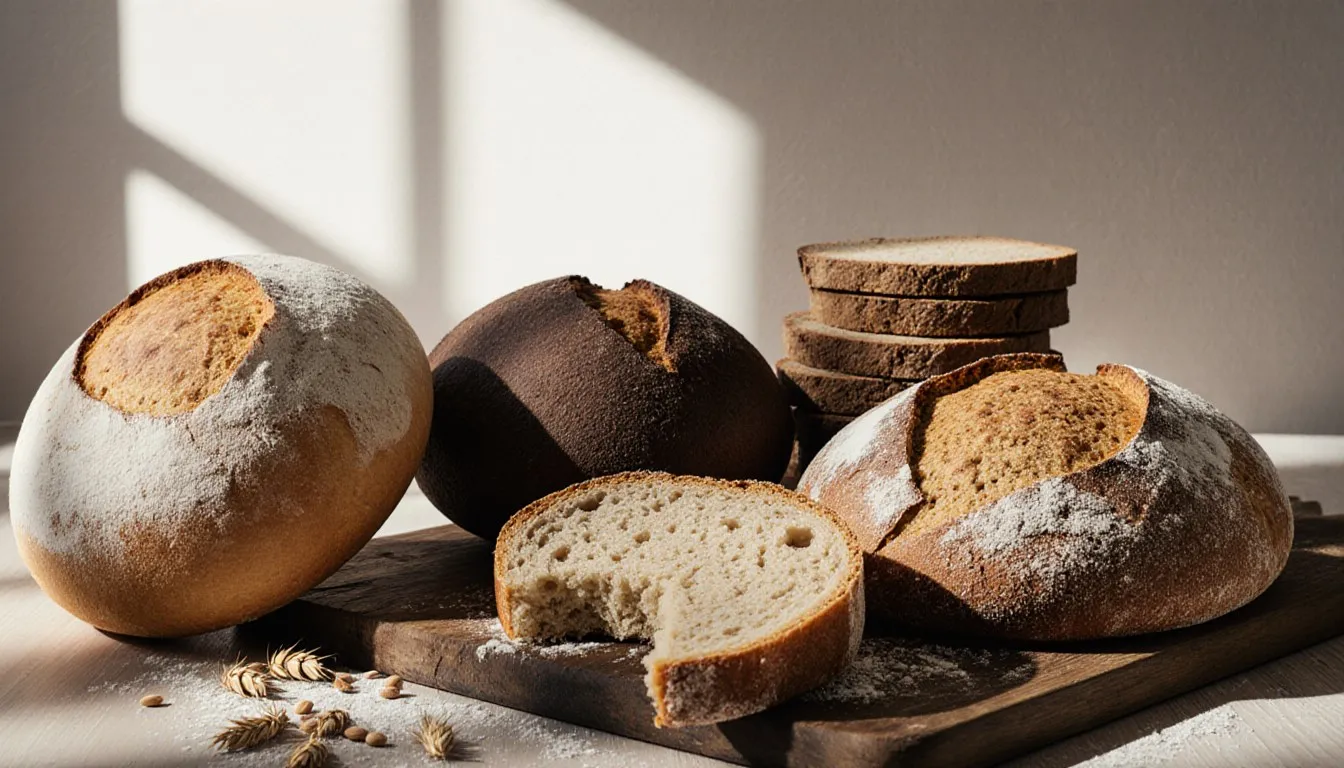
Two variables explain nearly every loaf on the shelf: how the dough was leavened, and how much fat, egg, sugar, and milk got folded into it. A baguette and a brioche start from the same four things, flour, water, salt, and yeast, and end up as a hollow-crumbed shell that shatters when you tear it and a loaf that slices like pound cake. Those two levers did all of that work. Learn to read them and you can stand in front of any loaf, anywhere, and guess the crumb before the knife goes in.
So this guide sorts bread the way a cook does, by leavening first, then by what the flour and the extras do to the texture: yeast breads, naturally fermented breads, quick breads, flatbreads, enriched breads, lean crusty breads, and the whole-grain and alternative-flour category that behaves like none of the above. By the end you will know which loaf holds up under a stew and which one you should have bought yesterday instead of today.
What actually separates one loaf from another?
Four levers, in rough order of how much they change the outcome.
- Leavening: what makes the dough rise. Commercial yeast, a wild starter, chemical leaveners like baking soda and baking powder, steam alone, or nothing at all. This one decides the flavor and the timeline more than anything else on the list.
- Enrichment: fat, eggs, milk, and sugar. Add them and the crumb goes soft, tight, and tender, the crust goes matte and golden instead of crackly, and the loaf keeps a day or two longer.
- Flour: how much gluten-forming protein is in it, and how much bran and germ came along. Bread flour builds a strong chewy net. Whole wheat and rye fight that net. Rice flour has no net at all.
- Hydration and heat: a wet dough baked screaming hot, 450 to 500°F (230 to 260°C), gives you big irregular holes and a crackling crust. A stiffer dough at a moderate 350 to 375°F (175 to 190°C) gives you an even, sliceable crumb.
Notice what is not on that list. Shape tells you almost nothing, and neither does color. A dark loaf can be dark from rye, from molasses, from caramel coloring, or from a baker who likes a bold bake. Round versus oblong is a decision someone made with their hands three hours before you saw it. I have been handed pale, squishy loaves that were sourdough and dark, rustic-looking ones that came out of a plastic bag with twelve ingredients on the label. Read the four levers instead. Leavening, enrichment, flour, and hydration will tell you more from the ingredient list than the crust ever tells you from across the counter.
One more thing worth saying up front, because it saves people a lot of grief: no category here is better than another. A tortilla is not a lesser bread than a naturally fermented country loaf. They solve different problems on different nights.
What are yeast breads, and why do they rise the way they do?
Yeast breads are risen with commercial baker’s yeast, and they cover most of what people picture when they hear the word bread: sandwich loaves, dinner rolls, hamburger buns, baguettes, cinnamon rolls, pizza dough. The yeast eats sugars in the flour and gives off carbon dioxide. That gas gets trapped in a stretchy protein web, the dough inflates, and the oven sets it in place.
That web is gluten. Wheat flour has two proteins, glutenin and gliadin, that do nothing much while they are dry. Add water and work the dough, whether by kneading, folding, or just letting time do it, and they link up into sheets elastic enough to hold a bubble without tearing. More protein and more working gives you chewier, more open bread. Less of both gives you the soft, fine, even crumb of a supermarket sandwich loaf, which is exactly what that loaf is engineered for. Nobody wants a tuna sandwich falling through a hole in the bread.
Active dry versus instant yeast
Both are the same organism, dried differently. Active dry yeast comes in larger granules and has traditionally been dissolved in warm liquid first, a step bakers call proofing, which also confirms the yeast is still alive. Instant yeast is milled finer and can be stirred straight into the flour. You can swap them roughly one for one in a home recipe. Instant tends to get moving a little faster, so start checking the dough sooner rather than trusting the clock. Two places the swap falls down. Instant in a long cold ferment or a bread-machine cycle timed around active dry will overshoot, so pull the yeast back by about a quarter and shorten the bulk rise. And going the other way, stirring active dry straight into the flour skips the proofing step, which is the only place a dead packet gets caught before it costs you a loaf. If your jar has been open since last winter, dissolve it in warm liquid and watch for foam first.
Two things kill more home loaves than bad yeast ever has. Liquid that is too hot, which is why lukewarm means lukewarm, comfortable on your wrist and nothing more. And salt dumped directly on top of the yeast in a dry bowl. Salt is a necessary brake, it tightens the gluten and keeps fermentation from running away, but give it its own corner of the flour.
Judge the rise by the dough, never the clock. A cool kitchen in February can double the time listed in any recipe. The dough is ready to shape when it has roughly doubled and a floured finger pressed into it leaves a dent that springs back slowly and only partway. If you want the full walkthrough with your hands in the bowl, how to make bread covers the mixing, kneading, and shaping in real detail, and bread recipes is where to go once you want something specific to bake.
What makes sourdough and other naturally fermented breads different?
Sourdough uses a starter, a living culture of wild yeasts and lactic acid bacteria kept alive on flour and water, instead of a packet. The wild yeasts do the lifting. The bacteria produce lactic and acetic acid, and those acids are the tang, the slight chew, and the reason a good sourdough tastes like something even with nothing on it.
The trade-off is time. Commercial yeast is bred to be fast and predictable. A wild culture works on its own schedule, which stretches the process from a few hours to most of a day, sometimes two with an overnight rest in the fridge. That long fermentation is doing real work: it develops flavor compounds a quick rise never gets to, and it relaxes the dough so the crumb opens up. It is also why sourdough is a weekend project and a yeasted sandwich loaf is a Tuesday.
Keeping a starter is less fussy than the internet makes it sound. Flour, water, a jar, and a feeding schedule. One kept on the counter wants feeding daily; one in the fridge can go a week or more between feedings. A starter you have not touched in a hot minute usually comes back with two or three feedings, even if it has gone gray on top and smells like nail polish remover. That dark liquid on top is hooch, the alcohol a hungry starter throws off when it has eaten everything you gave it. Pour it off, feed it, wait.
Naturally fermented breads run wider than San Francisco-style loaves. German and Eastern European rye breads are traditionally soured, and for rye it is closer to a requirement than a preference, because acidity keeps rye’s enzymes from turning the crumb gummy. Italian bakers have their own long-fermented doughs. Even Amish friendship bread works off a passed-along fermented starter, though that one lands in sweet quick-bread territory rather than here.
A note on labels: plenty of bread sold as sourdough is yeasted dough with added acid or a splash of vinegar for flavor. Nothing wrong with it as bread. It will not have the chew or the keeping quality of a truly fermented loaf. Read the ingredient list if it matters to you.
What are quick breads, and when should you reach for one instead?
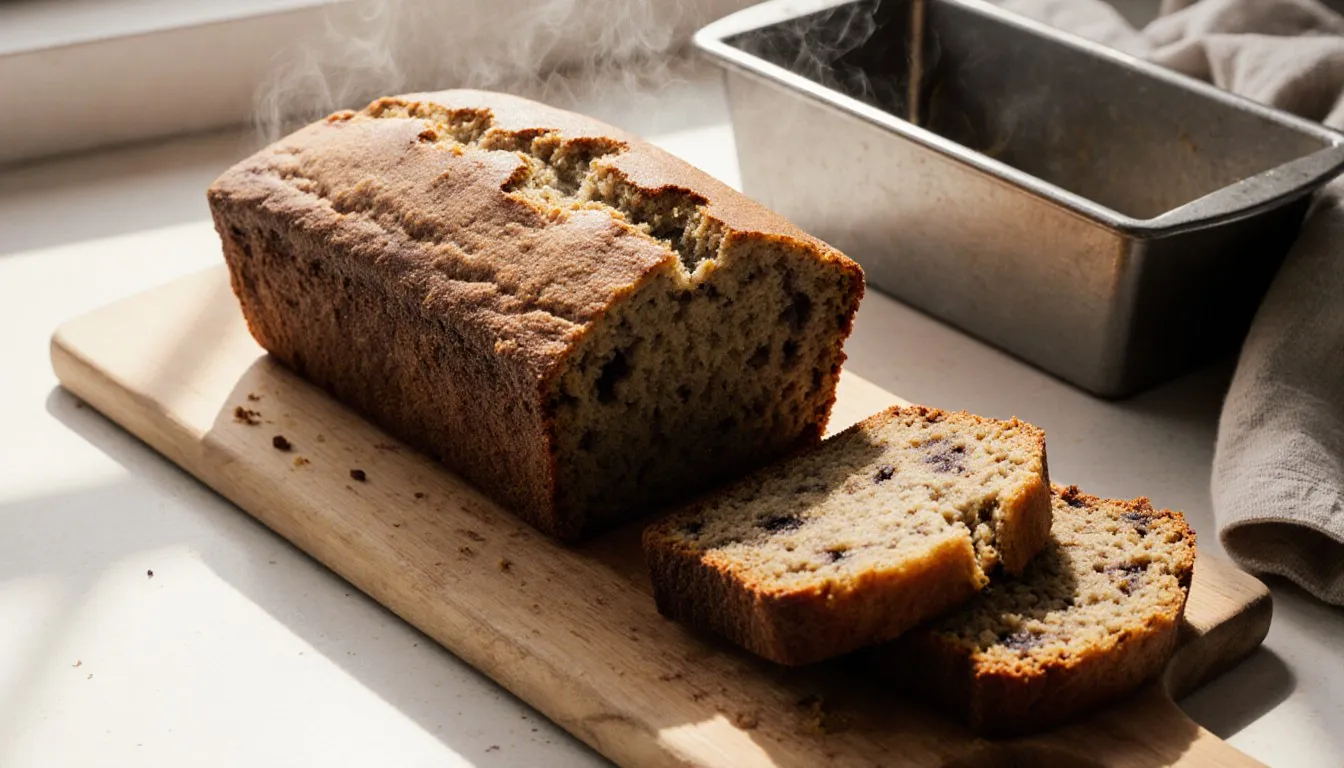
Quick breads skip yeast entirely and use chemical leaveners, which means no rise time. Batter into pan, pan into oven. Banana bread, cornbread, biscuits, muffins, scones, Irish soda bread, and most coffee cakes live here. This is the category for the night you decided at 6:40 that dinner needed bread with it.
The two leaveners are not interchangeable, and knowing why fixes most quick-bread failures.
- Baking soda is pure alkali. It needs an acid in the batter to react: buttermilk, yogurt, sour cream, molasses, brown sugar, lemon juice, cocoa that is not Dutch-processed. It reacts the moment it gets wet, so the pan goes in the oven promptly. The usual working ratio is about a quarter teaspoon per cup of flour.
- Baking powder is baking soda with its own powdered acid already mixed in, so it works in a batter with nothing sour in it. Most of what you buy is double-acting, giving one burst on contact with liquid and a second in the oven’s heat. Figure roughly a teaspoon per cup of flour.
Too much of either is worse than too little. Excess baking soda leaves a soapy, metallic taste and can turn the crumb an odd yellowish brown. And both go flat over time in the cupboard. Test your baking powder with a spoonful of hot water, test your soda with a spoonful of vinegar, and if it does not fizz enthusiastically, buy new. It costs a couple of dollars to stop wondering why your muffins came out like hockey pucks.
The technique rule for quick breads is the opposite of yeast bread: do not develop the gluten. Stir the wet into the dry until the flour just disappears, lumps and all, then stop. Overmixed muffin batter bakes into tough muffins with tunnels running through them. For biscuits and scones, keep the butter cold and in visible flakes, because those flakes are what steam apart into layers. Warm butter smears, and smeared butter makes a dense biscuit.
There is a lot more ground here than one section can cover, and quick bread recipes is where to look if this is the category you actually want to bake this week.
What are flatbreads, and how do leavened and unleavened versions differ?
Flatbreads are widely credited as the oldest form of bread, and they split cleanly into leavened and unleavened. What every one of them has in common is that it cooks fast and flat. What separates them is whether anything is making the dough rise.
Leavened flatbreads have yeast, a starter, or a chemical leavener, but they are baked so fast and so hot that they never get the chance to become a tall loaf. Pita is the clearest example. Rolled thin and slid onto a stone or steel preheated to 500°F (260°C), the water inside flashes to steam, the steam has nowhere to go, and the round balloons into a hollow pocket in a minute or two. Naan is soft and chewy rather than hollow, traditionally slapped onto the wall of a tandoor, and typically made with yogurt and often yeast, both of which give it that pull. Focaccia is a leavened flatbread too, just a thick and generously oiled one.
Unleavened flatbreads have no leavener at all. Corn tortillas are made from nixtamalized corn ground into masa, pressed and cooked on a dry griddle. Roti and chapati are whole wheat flour and water, rolled thin, cooked on a tawa, and puffed for a few seconds over a flame. Matzo is deliberately unleavened, and for Passover it is made under a strict time limit, start to finish in under eighteen minutes, so fermentation never begins.
Worth knowing at the grocery store: flour tortillas frequently do contain baking powder, so they are not automatically unleavened the way corn tortillas are. Check the package if it matters for your table.
Why do all of these cook hot and fast rather than low and slow? Because there is no interior to worry about. A tall loaf needs time for heat to reach the center without burning the outside. A quarter-inch round of dough is all surface. Give it high, direct heat and it cooks through before it dries out. Turn the heat down and the same dough spends too long on the pan, loses its moisture, and goes stiff. My cast iron gets a solid five minutes of preheating before the first tortilla hits it, and the first one is still usually the sacrificial one. That is just how it goes.
What are enriched breads, and why do they taste richer?
Enriched breads have fat, eggs, milk, or sugar worked into the dough, sometimes all four. Challah, brioche, Japanese milk bread, Portuguese sweet bread, Parker House rolls, cinnamon rolls, and the soft potato buns your burger deserves are all enriched.
Here is the plain-sentence version of what those additions do. Fat coats the gluten strands and keeps them from linking into long tough sheets, which is why enriched crumb is tender and pulls apart in soft shreds rather than tearing in chewy strings. Eggs bring fat and protein plus lecithin, which helps hold water and fat together, so the crumb stays plush. Sugar feeds the yeast a little, browns the crust a lot, and holds onto moisture. Milk softens the crumb and pushes the crust toward that deep golden color.
The cost is speed and structure. All that fat and sugar slows the yeast down, so enriched doughs rise noticeably longer than a lean one. They are also stickier and less willing to hold a shape. Do not fight it with a cup of extra flour. Chill the dough for half an hour and it becomes cooperative.
A few worth knowing by name. Challah is made with eggs and oil rather than butter, which keeps it dairy-free and lets it go on the table alongside a meat meal in a kosher kitchen, and jewish breads has the fuller story on challah and on the rye traditions that sit beside it. Brioche is the butter-heavy one, sometimes with nearly as much butter as flour, which is why it behaves halfway between bread and pastry. Japanese milk bread gets its remarkable softness from a cooked flour-and-liquid paste called tangzhong that is stirred into the dough, letting it hold more water than it otherwise could. Melon bread is a sweet enriched roll with a thin cookie crust cracked across the top, and it has nothing to do with melon beyond the look.
Doneness for enriched loaves runs a touch lower than for lean ones, around 190°F (88°C) in the center versus 200 to 210°F (93 to 99°C) for a crusty loaf. Enriched dough dries out fast once it passes done, and a dry brioche is a sad object.
What are artisan and crusty breads, and what gives them that crackling crust?
Steam. That is the whole secret, and it is the reason home loaves come out paler and softer than bakery ones.
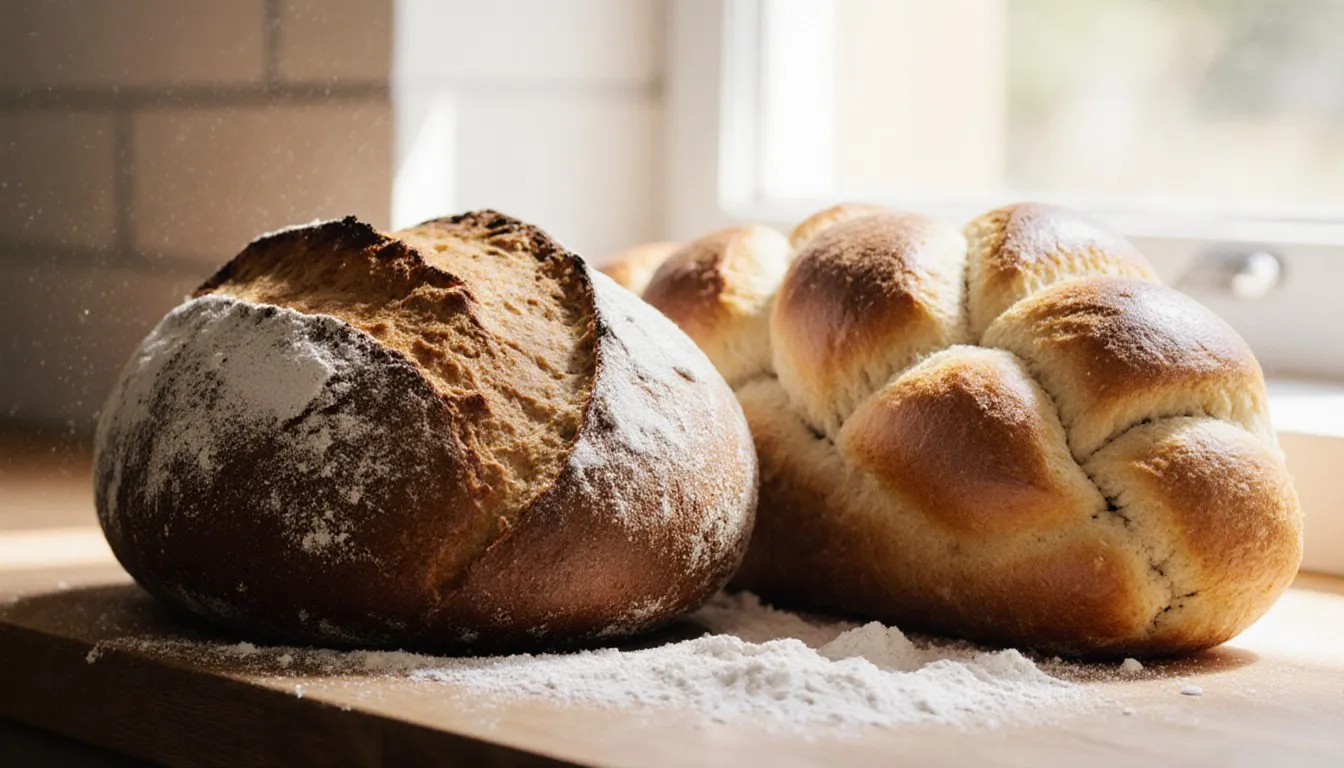
Artisan crusty breads are lean doughs, meaning flour, water, salt, and leavening with little or no fat or sugar, usually run at high hydration and baked hot, 450 to 500°F (230 to 260°C). Baguettes, ciabatta, rustic Italian loaves, country boules, pain de campagne. With no fat to soften anything, the crust can go thin, glassy, and loud.
In the first several minutes of the bake, a professional oven injects steam. That moisture keeps the surface of the loaf flexible so it can keep expanding, which is the dramatic push bakers call oven spring, and it gelatinizes the starches on the outside. When the steam clears and the crust finally sets, those gelatinized starches dry into a thin shell that shines and crackles as it cools. Bake the same dough in a dry oven and the crust sets in the first two minutes, the loaf stops growing, and you get something dense with a leathery skin.
At home the fix is a Dutch oven, preheated empty at 475°F (245°C) for a full 30 minutes before the dough ever goes near it. Lid on for the first 20 minutes and the loaf steams itself in its own moisture. Then pull the lid, drop the oven to 450°F (230°C), and give it another 20 to 25 minutes, until the crust is several shades darker than looks reasonable. It works embarrassingly well for something that costs nothing. Listen to the loaf as it cools on the rack. A properly baked crusty bread ticks and pops for several minutes, and that sound is the crust contracting and cracking.
Ciabatta is a good study in hydration. The dough is so wet it is closer to a batter, handled with wet hands and folded rather than kneaded, which is what produces those big irregular holes and the flat slipper shape the name describes. It is also a fairly modern loaf. The story usually told is that Italian bakers worked it out in the 1980s as an answer to the baguette. Focaccia, grissini, and the rest of that family have their own habits, and italian bread digs into those specifics.
One honest warning: crusty bread is the most perishable bread there is. That gorgeous crust starts softening within hours. Bakery bread bought Saturday morning is a Saturday project.
What are whole grain, sprouted, and alternative-flour breads?
Change the flour and you change everything about how a dough behaves, because you are changing the amount and quality of the gluten it can build.
Whole wheat and other whole grains
Whole wheat flour includes the bran and the germ. Bran is sharp-edged at a microscopic level and it cuts through developing gluten strands, so 100 percent whole wheat loaves rise less and come out denser and more crumbly than white ones. Bran also drinks a lot of water, so whole wheat doughs want more liquid and a rest before kneading. A 100 percent whole wheat dough that feels merely firm under your hands is already too dry. It should be tacky and a little heavy, closer to wet sand that holds a fingerprint than to the smooth springy ball a white dough gives you, and if it feels tight after ten minutes of kneading, add water a tablespoon at a time until it stops fighting you. Half whole wheat, half bread flour is how a lot of good bread gets made, and it gives you the flavor of the grain with a crumb that still climbs. That is the mix in my own canister, and I stopped apologizing for it a long time ago.
If you are buying rather than baking, read the ingredient list. A loaf can be brown from molasses or caramel color and still be mostly refined flour, and a label saying multigrain only promises more than one grain, not whole ones. Whole wheat flour also carries oil from the germ, which goes rancid faster than white flour does, so keep it in the freezer if you bake occasionally.
Rye
Rye is its own animal. It has little of the protein that forms strong gluten and a lot of gums that hold water, so rye doughs are sticky, slack, and bake into a dense, moist, close crumb. That is the point of a good pumpernickel, and it is why the stuff gets cut thin as a playing card and sent out under butter, smoked fish, or a slab of something sharp. Rye also carries enzymes that will turn the crumb gummy if left unchecked, which is why traditional rye breads are soured. The acid keeps those enzymes in line. Deli rye is usually mostly wheat flour with enough rye for flavor and caraway doing a fair amount of the work.
Sprouted and alternative flours
Sprouted grain breads start with whole grains soaked until they germinate, then ground into a wet mash rather than milled into dry flour. Cut into one and you can see what that does: a tight, damp, close crumb flecked with visible bits of grain, and a slice that feels heavier in your hand than its size promises. It disappoints people in predictable ways. It makes a dense sandwich, it goes gummy under anything wet, and straight from the bag it tastes a little flat and a little wet. Toasted is a different loaf entirely, because the sugars the sprouting created caramelize and the edges crisp. Mine lives in the freezer and goes straight from freezer to toaster, which is the only arrangement under which it earns its shelf space in my kitchen. Sprouting activates enzymes that begin converting starch into sugar, which is why these loaves taste faintly sweet without any sugar added and why they tend to be dense and moist. Ezekiel-style breads, made from sprouted grains and legumes, are the best-known version, and sprouted grain bread goes further into what to expect from the crumb.
Gluten-free flours are a separate craft. Rice flour has no gluten-forming protein at all, so a rice flour bread dough is really a batter, and it needs a binder such as psyllium husk or xanthan gum to trap gas and hold the loaf together. Expect a tighter crumb, a shorter shelf life, and better results toasted. Set your expectations in the right place: a good gluten-free loaf makes fine toast, decent croutons, and a sandwich that wants eating within the hour. Buy it sliced, keep it in the freezer, and toast every slice, including the ones you would not normally bother toasting.
How do you match the bread to the meal?
Match the bread to the job it has to do, and the job is almost always structural.
- Sopping up stew, chili, or a good pan sauce: a crusty lean loaf with an open crumb. Ciabatta, a country boule, a rustic Italian loaf. Those holes are storage.
- Under a roast, or alongside soup: the same family, torn rather than sliced, or a soft dinner roll if there are children who object to crust.
- Sandwiches that travel: a tight, even crumb that will not shred. Sandwich loaf, milk bread, a soft roll. A wet filling wants a sturdy toasted slice or it will be a puddle by lunch.
- Grilled cheese: sliced sandwich bread or a mild sourdough, cut a hair thicker than usual. Big holes let butter and cheese escape onto the pan.
- Toast with butter and jam: anything with a bit of chew. Sourdough and whole wheat both improve in the toaster, which is more than white sandwich bread can claim.
- Bruschetta and crostini: a firm lean loaf, sliced and toasted so it can carry toppings without going limp.
- Stuffing and bread pudding: stale, sturdy, and torn by hand. This is the second life of that crusty loaf you did not finish.
- Scooping and wrapping: flatbreads, obviously. Warm them, always. Thirty seconds in a dry skillet beats anything a microwave does to a tortilla.
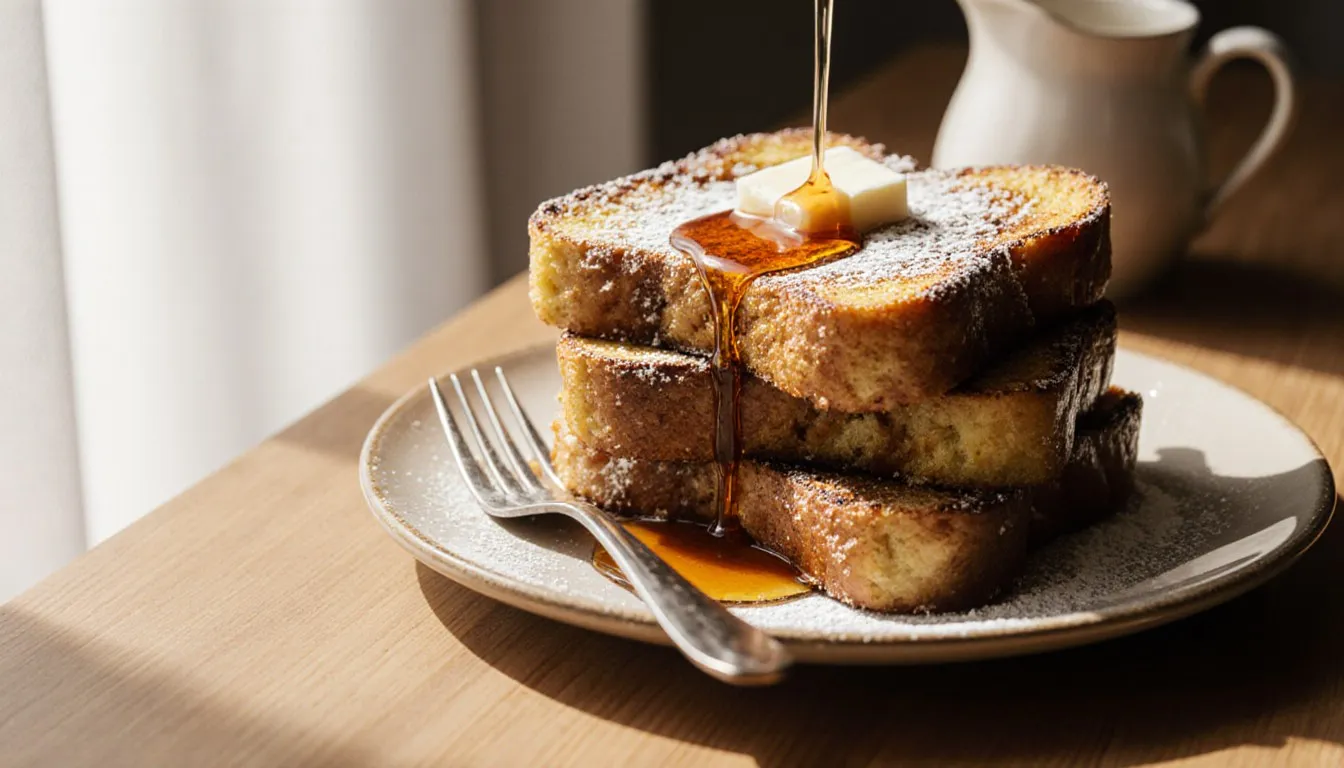
French toast deserves its own line because people get it wrong constantly. You want an enriched loaf with an open enough crumb to drink custard, cut thick, and ideally a day or two old so it is thirsty. Challah and brioche are the classics for exactly that reason. Fresh soft sandwich bread turns to mush somewhere between the bowl and the pan. The best bread for french toast is worth reading up on if this is a weekend fixture in your house.
The rule I would actually hand someone: soft bread for soft fillings, sturdy bread for wet ones, and never let anybody tell you a bread is universally the best. Best at what, with what, on what night.
How should you store each type so it doesn’t go stale (or moldy) too fast?
The single most useful thing to know is that the refrigerator is usually the wrong call. Bread goes stale through starch retrogradation, the starch molecules recrystallizing and squeezing out water, and that process runs fastest at cold-but-not-frozen temperatures. Refrigerated bread goes stale faster than bread left on the counter. The freezer skips past that zone entirely, which is why it works.
- Crusty artisan loaves: cut side down on the board or in a paper bag, at room temperature, and eat them within a day or two. Plastic traps moisture and turns that crackling crust soft and chewy within hours. If you will not finish it, slice and freeze the remainder the day you buy it, not on day three when it is already going.
- Sandwich loaves and enriched breads: sealed plastic or a bread box at room temperature. The fat in enriched bread slows staling, so challah and milk bread stay pleasant a bit longer than a lean loaf.
- Sourdough: the acidity holds off mold longer than most breads. Cut side down, room temperature, a linen bag or a paper bag.
- Flatbreads: tortillas and pita keep in the fridge without much penalty, since they have almost no crumb to go stale, and they reheat well. This is the one exception to the fridge rule.
- Quick breads: let them cool completely before wrapping, or condensation turns the top gummy. Then wrap well at room temperature.
- Anything you will not eat in two days: slice it first, wrap it well, freeze it. Sliced bread goes straight from the freezer into the toaster. A whole frozen loaf reheats beautifully unwrapped at 350°F (175°C) for twenty to thirty minutes, straight from the freezer, no thawing, and comes out close to fresh, but you only get to do that once. Quality holds for roughly three months before freezer taste creeps in.
Stale is not spoiled. Stale bread becomes croutons, breadcrumbs, panzanella, stuffing, French toast, or bread pudding, and some of those are better with old bread than new.
Mold is a different matter, and here there is no judgment call to make. If you see mold on bread, throw out the loaf. Bread is soft and porous, so the mold you can see is sitting on top of a network of threads running through the crumb where you cannot see them, and cutting off the fuzzy corner does not get rid of them. That advice is specific to soft porous foods; it is not the same as trimming a spot off a block of hard cheese. Do not sniff the bag to decide, either. Just toss it, and give the bread box or bin a wipe with vinegar while you are at it, because spores hang around. A loaf costs a few dollars. That is the entire cost-benefit analysis.
If you want the short version stuck to the inside of a cabinet door, there is a printable one-page cheat sheet with every category here, its leavening method, its texture, and what it is best used for.
My mother’s line was that bread does not keep, it gets used, and she was right in the way mothers usually are. Buy the crusty loaf on the day you plan to tear it apart. Keep a sandwich loaf sliced in the freezer for the mornings you have no time. And the next time you are standing in front of a bakery case with no idea what to pick, ask yourself what is going on the plate next to it. The bread will pick itself.
Tessa Calloway
Staff Writer
Tessa Calloway has spent twenty years cooking dinner on a weeknight clock and testing the shortcuts that survive contact with a real kitchen. She believes the best recipe is the one you can make with what's already in the house, and she has strong opinions about what actually needs to be homemade (less than you think) and what always does (dressing).