Nuts and Seeds Spoil Before You Notice, and Four Other Things Worth Knowing
Cooking with nuts and seeds, minus the guesswork: why they go rancid fast, the one toasting rule, and how to swap one for another without wrecking dinner.
The bag of walnuts in your cupboard has probably turned, and you have probably been eating them anyway. Nuts and seeds are mostly oil, and oil goes off, so a pantry that keeps flour and rice happy for a year will quietly ruin a bag of pecans in a few months. That single fact governs almost everything worth knowing about cooking with nuts and seeds: how you store them, why you toast them right before you use them, and why the tired ones in the back of the shelf make a sauce taste like paint thinner no matter how good the rest of your ingredients are.
Buy them the way you buy fish: fresh, in the amount you will get through, and cold from there on. Below: how to tell a good nut from a spent one, the storage that buys you months instead of weeks, the toasting principle that works across the whole category, how ground nuts and seeds carry a sauce without a lick of flour, and how to swap one for another without guessing.
Why do nuts and seeds go stale so much faster than the rest of the pantry?
Because they are largely unsaturated fat, and unsaturated fat reacts with oxygen. That reaction is rancidity, and it does not need heat, moisture, or bugs to get going. Light and warm air are plenty. The oils in walnuts, pecans, pine nuts, and flaxseed are especially prone to it, which is why those four are the usual suspects when something in a dish tastes vaguely of crayons.
Nothing dramatic happens visually, and that is the problem. A rancid pecan looks exactly like a fresh pecan. Rancidity is generally treated as a quality problem rather than a food-safety one, so what it wrecks is the flavor: old cardboard and bitter oil, and once that is folded into a batter or blitzed into a sauce there is no rescuing the dish. My mother used to say you can’t unring a bell, and a rancid nut in a batch of brownies is that bell.
The test takes four seconds. Open the bag and put your nose right down in it. Fresh nuts and seeds smell faintly sweet, faintly green, mostly of themselves. Off ones smell sharp and oily, like the inside of a paint can or an old crayon box. If your nose says maybe, eat one. A tired nut tastes bitter at the back of the tongue and leaves a film. There is no salvaging it: toasting will not fix rancidity, it will make it louder, because heat drives the volatile compounds straight up into your face. Toss the bag and buy fresh. A cup of walnuts costs a few dollars; the cake costs an afternoon.
The ground versions turn fastest of all. Almond flour, ground flaxseed, and anything pre-chopped has had its surface area multiplied by a hundred, which means a hundred times more contact with oxygen. If you bake with almond flour regularly, that bag belongs in the freezer from the day you open it, no exceptions. (There is a lot more to say about how that flour behaves in a batter, and cooking with almond flour gets into it properly.)
What’s the best way to store nuts and seeds so they last?
Cold and airtight, in that order of importance. The three things that speed up rancidity are heat, oxygen, and light, so the fix is a sealed container in a cold dark place. That is the whole strategy. Everything else is detail.
- Room temperature is fine for nuts you will finish inside a few weeks. Keep them in a sealed jar or a zip-top bag with the air pressed out, in a cupboard away from the stove. The cabinet directly above your range is the single worst spot in the kitchen for them, and it is where most of us keep them.
- The fridge buys you several months and is the right default for anything you use occasionally. Seal it properly; nuts pick up smells with enthusiasm, and almonds that have been living next to an onion will taste like it.
- The freezer is where the real gains are. Frozen, nuts and seeds keep for many months to a year with very little loss, and they thaw in the time it takes to preheat the oven. There is no texture penalty and no need to thaw before toasting.
Buy whole rather than pre-chopped whenever you have the choice. A whole almond is a sealed package; a chopped one is a pile of exposed oil. Chopping takes ninety seconds and you get a fresher, better-tasting nut for the trouble. Same logic for seeds: whole flaxseed keeps far longer than pre-ground, and a coffee grinder reserved for the job (never the one you use for coffee, unless you want flax-scented espresso) will grind what you need in seconds.
One habit worth stealing: write the month you opened it on the bag in marker. The clock on a nut starts the day air gets in, so that is the date worth having. Future you will be standing in front of the freezer at 6pm holding a bag of pepitas with no memory of when they got there, and a Sharpie scrawl settles it.
What’s the one toasting rule that works for almost any nut or seed?
Low and slow, and trust your nose over the timer. Every nut and seed follows the same curve: nothing, nothing, nothing, fragrant, burnt. The window between “fragrant” and “burnt” is about a minute, sometimes less, and it does not announce itself with color. It announces itself with smell.
Two methods cover everything.
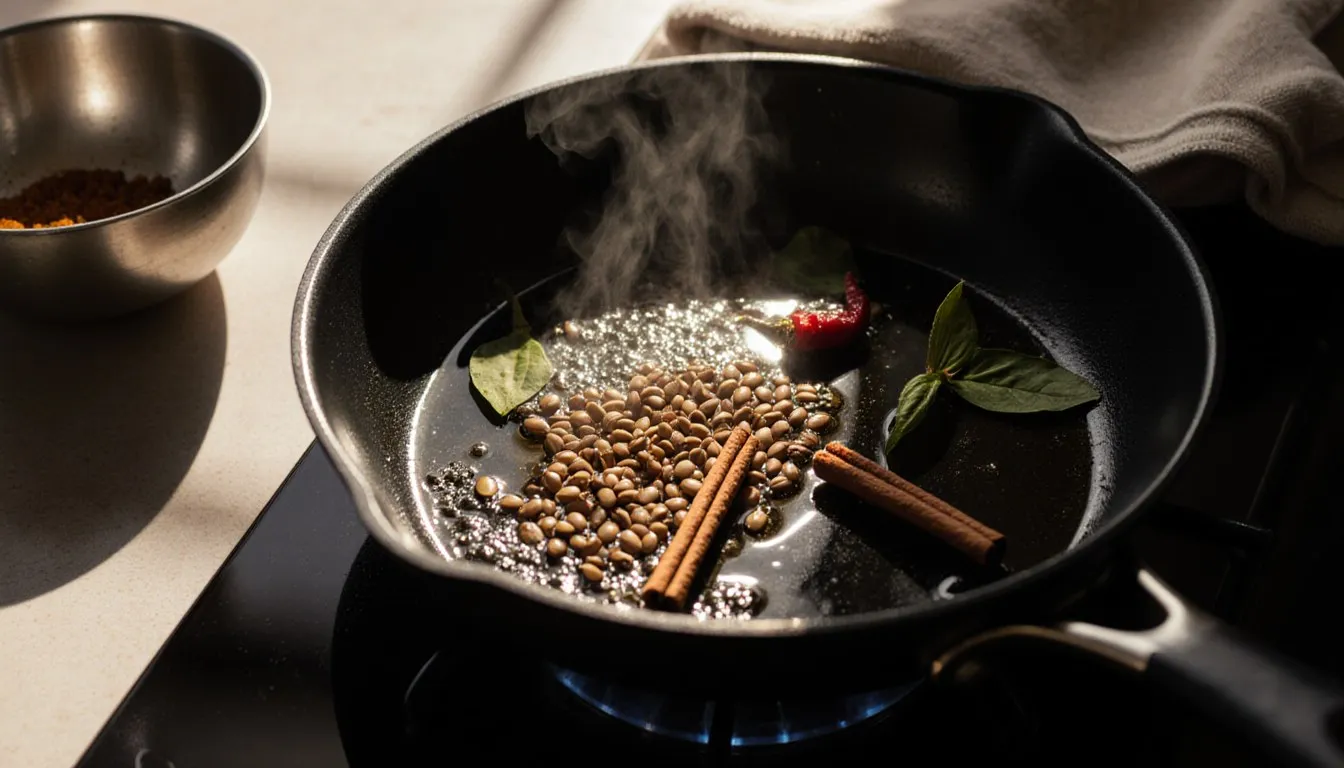
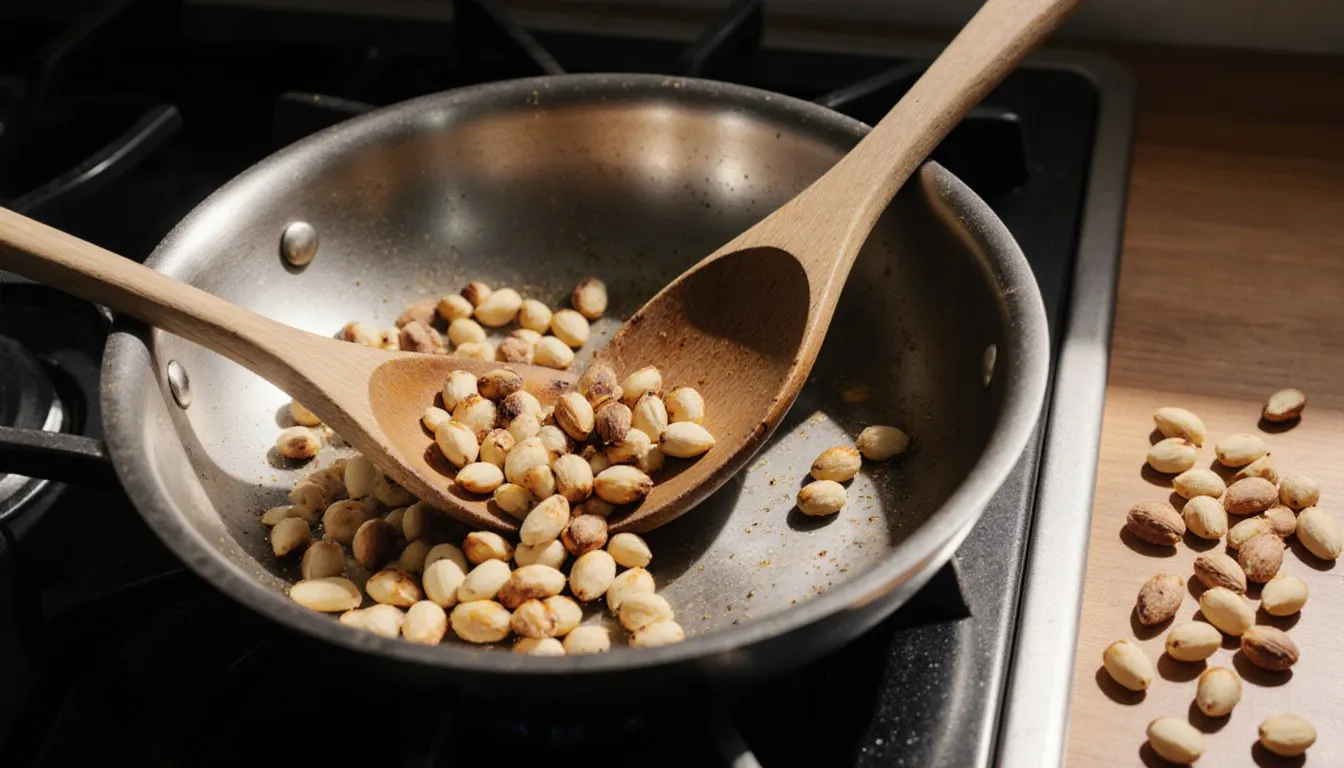
The dry skillet is for small amounts and small items: sesame, pine nuts, pepitas, sliced almonds, anything you need in the next five minutes. Medium-low heat, no oil, single layer, and keep them moving. Toss or stir every twenty seconds or so. You are looking for a shade or two of color and a smell that turns nutty and warm. Pull them out of the pan the second they are there, because a hot skillet keeps cooking them, and pine nuts in particular will go from perfect to bitter in the residual heat while you are chopping parsley.
The oven is for volume and for anything whole and thick: pecan halves, walnuts, whole almonds, hazelnuts, sunflower seeds. Somewhere around 325°F to 350°F (165°C to 175°C), single layer on a rimmed sheet, and start checking at eight minutes. Give the pan a shake halfway. Whole nuts brown from the inside out, so pull them when they smell right and look barely tanned, not when they look done. They darken as they cool.
The doneness cues, in order of reliability:
- Smell first. When the kitchen smells like the nut, it is ready. This is the only cue that works for every single item in the category.
- Color second. A shade darker than raw, and for anything with a skin, the skin loosens and starts to crack.
- Sound third. Sesame seeds and pepitas pop and skitter when they are close. Sunflower seeds crackle faintly.
Get them onto a cool plate or sheet pan the moment they come off the heat, spread out, not piled. A heap of hot pecans keeps toasting itself in the middle. And salt after toasting, never before: salt draws moisture to the surface and you end up steaming instead of toasting.
A few items have quirks the general rule does not cover. Pine nuts are the touchiest thing in the category, expensive and quick to scorch, so how to toast pine nuts is worth two minutes before you sacrifice a bag. Cashews carry enough sugar to color long before the inside is done, which is the whole argument in how to roast cashews. Pecans turn acrid a good half-step sooner than walnuts do, and how to toast pecans has the timings I go by. Sesame is a skillet job with its own popping and skittering tells, covered in how to toast sesame seeds. And when you want a big tray done at once for the week, how to roast sunflower seeds handles the volume version.
How do nuts and seeds work as a sauce thickener?
Ground fine, they do the job flour and cornstarch do, but with flavor and body instead of paste. This is one of the oldest tricks in Mediterranean and Mexican cooking and it deserves to be far better known in American home kitchens.
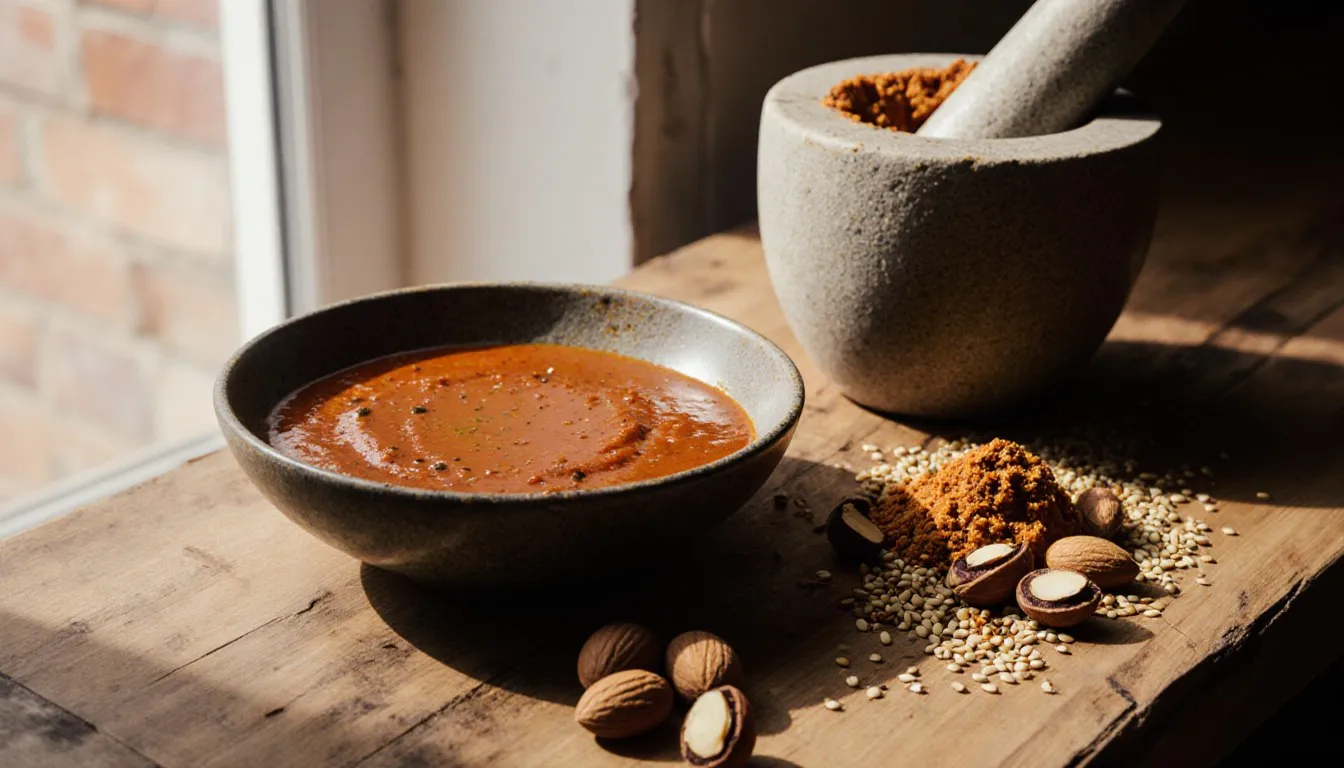
Romesco, from Catalonia, is roasted red peppers and tomato blitzed with toasted almonds, sometimes hazelnuts, plus bread, garlic, vinegar, and olive oil. The almonds carry the body of that sauce. Pull them out and you have a thin pepper puree. Leave them in and you get a sauce thick enough to sit on a piece of grilled fish without sliding off. Mexican moles run on the same principle, with sesame seeds, pepitas, peanuts, or almonds ground into the paste alongside chiles and spices; a green pumpkin-seed mole is essentially seeds doing all the structural work. Tahini, which is nothing but ground sesame, thickens a dressing the moment you add water to it, seizing up first and then loosening into something creamy.
Why it works, plainly: you are making an emulsion. The ground solids give the liquid something to suspend, and the nut’s own oil, released by grinding, does what oil does in a vinaigrette. No starch, no roux, no cooking out a raw-flour taste.
The ratio logic is simpler than it sounds. Start at roughly a quarter cup of ground nuts or seeds per cup of liquid for a sauce with light body, and go up toward a half cup per cup for something genuinely thick and spoonable. Then adjust with liquid, because you can always thin a sauce and you cannot easily un-thicken one. Three things worth knowing before you start:
- Toast first, almost always. Raw nuts thicken just as well but taste flat and slightly green. Toasted ones bring the roasted depth that makes romesco taste like romesco.
- Grind them dry before adding liquid. Nuts pulverize much finer in a dry blender or food processor. Dumping everything in at once gets you a gritty sauce.
- Nut-thickened sauces break with hard boiling. Warm them gently. If a mole or a romesco splits, a splash of cold liquid and hard whisking usually brings it back.
Tahini has one behavior that trips up everyone the first time. Add water and it seizes into a stiff, chalky paste that looks ruined. Keep going. Another splash of water, keep whisking, and it slackens into a smooth cream. I have watched more than one person throw out a perfectly good bowl of tahini at exactly the wrong moment.
Can you substitute one nut or seed for another in a recipe?
Usually, if you match on fat content and texture rather than on flavor. Match the fat and the texture and the swap holds. A flavor difference you can taste around, and half the time you will like the second version better.
Three groups, roughly:
- High-fat and soft: walnuts, pecans, macadamias, pine nuts, hazelnuts. Rich, they grind into a paste readily, and they go rancid fastest. These swap for each other freely in bakes and in sauces.
- High-fat and firm: almonds, cashews, pistachios. They hold their shape when chopped and give a cleaner snap. Cashews are the softest of the three and blend the smoothest, which is why they carry cream sauces so well.
- Leaner and smaller: sunflower seeds, pepitas, sesame. Less oil, so they contribute less richness and more crunch. In a sauce they thicken but do not enrich; you may want a little extra olive oil to compensate.
Swap freely within a group by weight, not volume, especially in baking. Swapping across groups needs a thought first. Every real substitution comes with a trade-off worth naming:
- Pecans for walnuts (and back): a straight one-for-one, same fat, same softness. Pecans are sweeter and less tannic, so a walnut brownie made with pecans tastes rounder and less bitter. No adjustment needed.
- Sunflower seeds for pine nuts in pesto: works well, roughly one-for-one, and saves a fortune. Toast them first. The result is nuttier and less buttery, and it will not have that soft, almost resinous quality pine nuts give. Pepitas do the same job and turn the pesto a brighter green.
- Cashews for almonds in a sauce: excellent, blends smoother, but the sauce comes out sweeter and paler. Fine for a creamy curry, wrong for a romesco where you want almond’s slight bitterness against the peppers.
- Seeds for nuts in a bake: use the same weight and expect a drier crumb, since you have removed fat. A teaspoon or two of extra butter or oil per cup evens it out.
- Any nut for almond flour: this one fails. Almond flour is ground to a specific fineness and a specific fat level, and hand-ground nuts release oil and turn to butter before they get there. Buy the flour.
The other places a swap breaks: marzipan and frangipane, which are almond-specific by definition, and anything where the nut is the whole point of the dish. Nobody wants pecan-crusted baklava. And walnuts versus almonds is a comparison that gets asked often enough to deserve its own answer, since the two behave less interchangeably than their similar fat numbers suggest.
How do you use nuts and seeds for crunch, coating, or garnish?
Texture is the job they do that nothing else does. A grain bowl with toasted pepitas on top and the same bowl without them are two different dinners, and the difference costs you thirty seconds.
For crusting proteins, chop the nuts to a coarse rubble, not a powder, and press them onto a surface that has something sticky on it: mustard, mayonnaise, a beaten egg, honey. Pecan-crusted salmon and pistachio-crusted lamb both work this way. Bake rather than pan-fry when you can, because nuts in a hot pan burn before the protein is done. If you must pan-fry, coat one side only and give it the shorter cooking time. Roughly a half cup of chopped nuts covers two good-sized fillets.
For finishing, the rule is add at the very end, off the heat. Toasted nuts on a salad go soft within about fifteen minutes of hitting the dressing, so scatter them as the bowl goes to the table. On a warm grain bowl or a soup, the same: last thing.
The blends are where the same pantry starts doing new work. Dukkah, from Egypt, is a coarse mix of toasted nuts (hazelnuts or almonds usually), sesame, coriander, and cumin, pounded to a rubble and traditionally eaten by dipping bread first in olive oil, then in the dukkah. Gomashio, the Japanese sesame salt, is the one blend I would never buy in a jar: eight parts toasted sesame to one part flaky salt, ground in a mortar just until about half the seeds have cracked open and the whole thing smells like sesame oil. Grind them all and you have paste. It takes two minutes and it goes on rice, on steamed greens, on a fried egg, on plain sliced cucumbers when there is nothing else in the house. Both are essentially spice blends built on a nut or seed base, which is exactly the territory cooking with herbs and spices covers more broadly.
Make dukkah in a mortar or with a few short pulses in a food processor and stop while it is still uneven. Ground to a paste it becomes nut butter, and the whole appeal is the grit. Keep it in a jar in the fridge and use it within a couple of weeks, since a blend is a lot of exposed oil sitting together. Fold sesame or nut blends into a rub and you have another lever entirely, which the dry rub for ribs piece gets into.
Raw, toasted, or soaked: which prep state fits which dish?
Toast almost everything. The nuts that skip it are the ones headed into a batter or a long bake, where the oven does the toasting for you.
Raw is correct when the nut goes into something that will cook anyway. Walnuts in a banana bread toast themselves in the oven; toasting them first pushes them past pleasant into slightly burnt over a forty-minute bake. Raw is also right when you want a delicate, milky flavor rather than a roasted one: pistachios scattered on a rose-scented dessert, raw cashews blended into a pale cream sauce, sliced almonds on a fruit tart where a toasty note would fight the fruit. And raw nuts blend paler, which matters in anything you want to stay white.
Toasted is worth the step anywhere the nut is a finishing element or a flavor backbone: salads, grain bowls, pesto, romesco, granola, anything where you would notice its absence. The step takes under ten minutes and it is the single highest-return thing you can do to a nut. Toast a whole sheet pan while the oven is on for something else and keep the extras in the freezer.
Soaking is for blending. Cashews soaked in cool water for a few hours (or covered with boiling water for twenty to thirty minutes if you are in a hurry, which works nearly as well) go soft enough to blend completely smooth in a standard blender, no high-powered machine required. That is the trick behind cashew cream and most nut milks: the softened nut breaks down into an emulsion instead of a grainy slurry. Drain and rinse before blending, and use fresh water for the sauce itself, since the soaking water tastes muddy. Almonds want longer, overnight, and the skins slip off after a soak if you want a whiter result.
Soaked nuts are wet nuts, which means they are perishable. Keep them refrigerated during a long soak and use them the same day or the next, and treat any homemade nut milk as a fresh dairy item: fridge, sealed, and out within a few days.
What should a home cook know about nut and seed allergies before cooking for others?
Ask before you plan the menu, not while you are plating. Nut and seed allergies are among the most serious in the food-allergy world, reactions can be severe, and a guest who has one has almost certainly spent years being made to feel like an inconvenience for mentioning it. A quick text a few days out (“anything I should steer clear of?”) costs you nothing and settles it.
If the answer is yes, cook around it entirely rather than trying to cook carefully. Cross-contact is easier to create than most people expect: a cutting board that held almonds, the food processor bowl you rinsed but did not wash, a wooden spoon, the pan you toasted pine nuts in an hour ago. For a genuinely allergic guest, use clean equipment, wash with soap and hot water rather than a rinse, and prep their food first if you can.
Two practical notes on labels. Sesame is now one of the major food allergens the FDA requires to be declared on packaged food in the United States, added to the list in 2023, so a sesame allergy is easier to shop around than it used to be. And nuts and seeds hide in more products than you would guess: pesto is usually pine nuts or cashews, many curry sauces are thickened with ground almonds or cashews, tahini turns up in dressings and dips, and plenty of granolas and breads carry both. Read the ingredient panel and the “may contain” line on anything packaged.
Also worth knowing, and easy to get wrong: peanuts are legumes, not tree nuts, and a peanut allergy and a tree-nut allergy are separate things, though some people have both. Coconut sits in its own strange category. When in doubt, ask your guest what they can and cannot have rather than reasoning it out from botany. They know their own allergy better than you do. (The peanut-is-not-a-nut question has a longer answer, and where do peanuts come from tells it.)
Take all of this as kitchen practice, the part of the job that belongs to whoever is holding the pan: ask early, cook around the allergen entirely, use clean gear, and defer to whatever your guest’s own doctor has told them about what they can eat. Give them the opening and they will tell you exactly what they need.
Where to start tomorrow
Go check the walnuts. Smell the bag, and if it reads sharp and oily, out they go. Then move whatever is left into the freezer and write the month on the bag. That one afternoon of housekeeping does more for your cooking than any technique on this page, because every nut you toast from here on will start from something worth toasting.
Tessa Calloway
Staff Writer
Tessa Calloway has spent twenty years cooking dinner on a weeknight clock and testing the shortcuts that survive contact with a real kitchen. She believes the best recipe is the one you can make with what's already in the house, and she has strong opinions about what actually needs to be homemade (less than you think) and what always does (dressing).