Types of Wine: A Home Cook’s Map of the Wine Aisle
The main types of wine, red, white, rose, sparkling, dessert and fortified, sorted by what actually changes in the glass and what to serve it with.
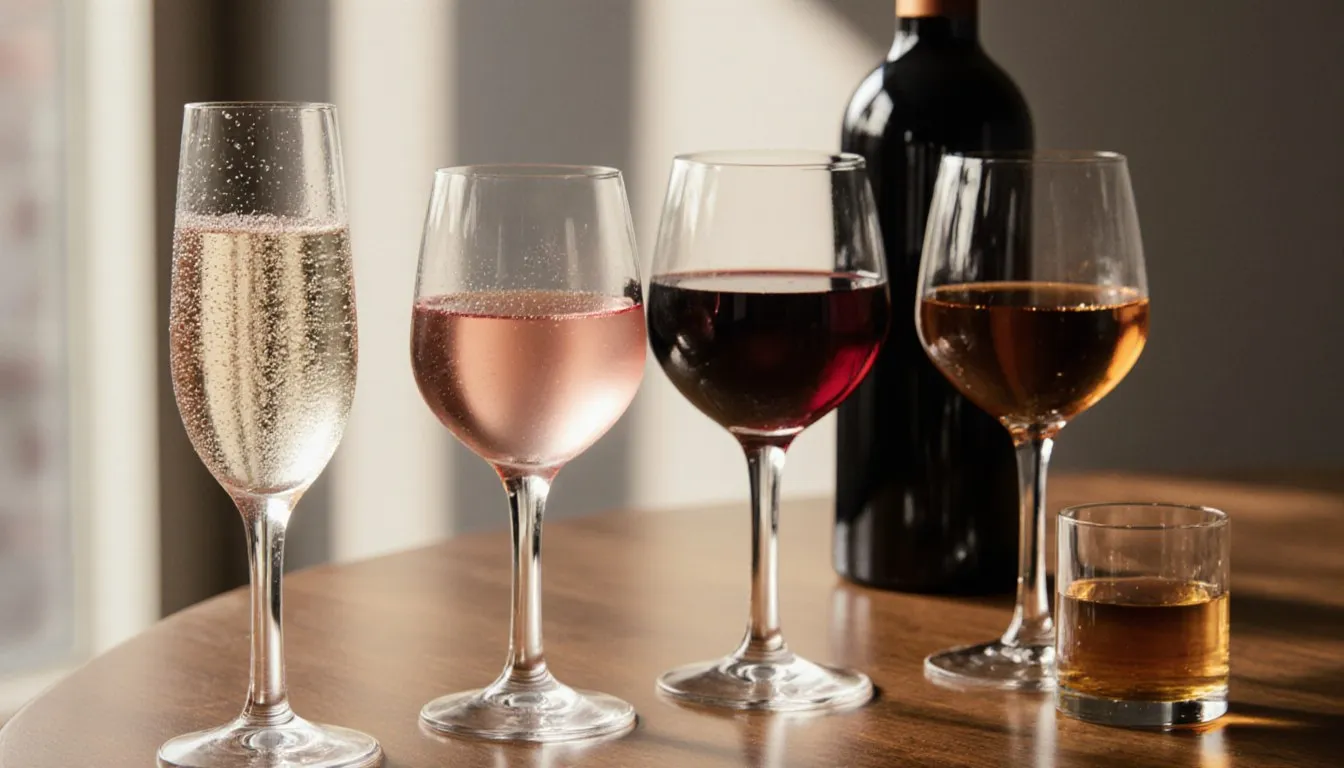
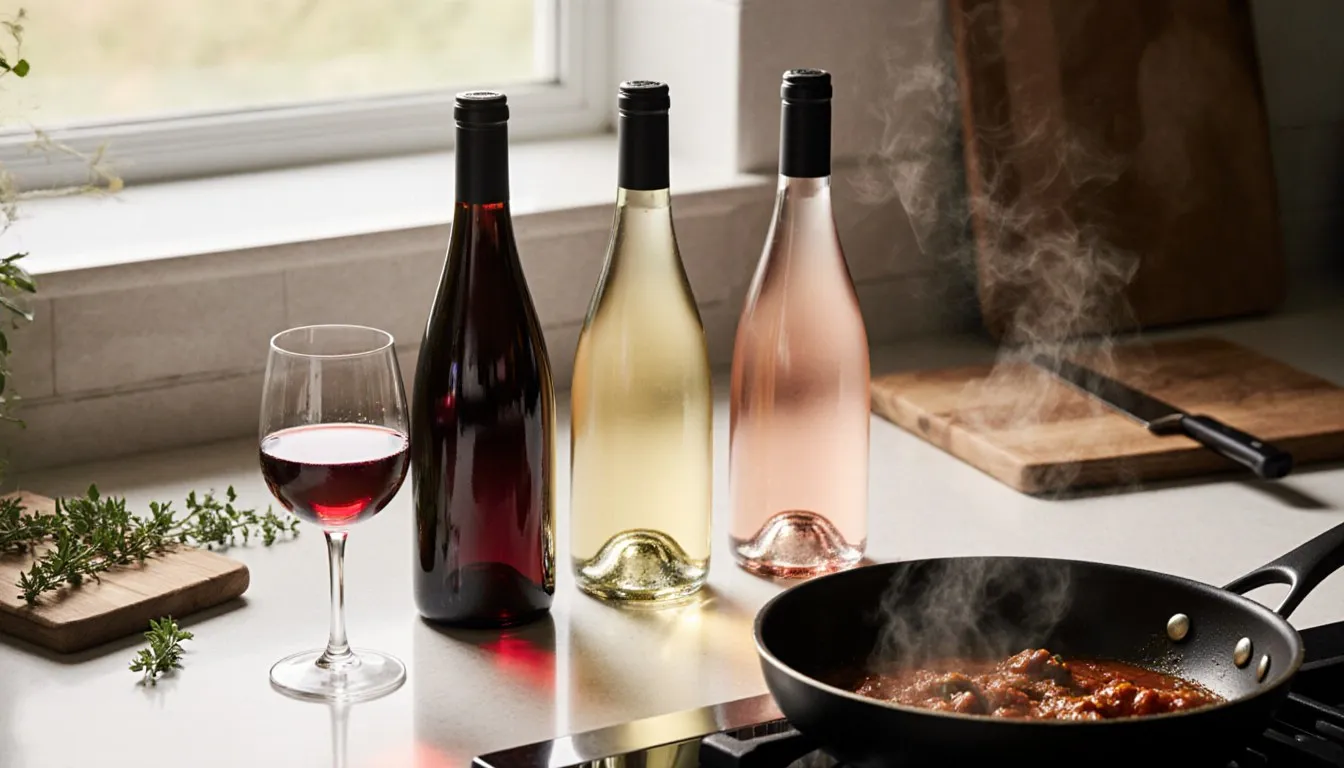
There are four types of wine that matter once you are standing in the aisle with dinner in an hour: still, sparkling, fortified, and dessert. Still wine (the flat kind, no bubbles) splits into red, white, and rose, and that one branch accounts for the overwhelming majority of what is on the shelf and almost everything you will ever pour at a weeknight table. Everything else on a wine label, the region, the vintage, the grape, the chateau with the drawing of a building on it, is detail layered on top of those categories.
That is the whole map. The rest of this is what each category actually tastes like, what it does next to food, and how to walk out with a bottle that suits the night instead of the one with the prettiest label. I have bought the pretty label. It was fine. But knowing four categories does more for your dinner than knowing forty producers.
What are the main types of wine?
Wine gets sorted first by how it is made, and that gives you four buckets. Three of them will be sitting in the same twenty feet of aisle, and the fourth, fortified, is usually stranded on an end cap near the liquor, which is how a lot of people go a decade without buying a bottle of sherry.
- Still wine: fermented grape juice, no bubbles, usually somewhere in the neighborhood of 11 to 15 percent alcohol. This is the big one. Red, white, and rose all live here.
- Sparkling wine: still wine that has gone through a second fermentation in a sealed container, which traps carbon dioxide in the liquid. Champagne, prosecco, cava, and every bottle labeled brut or sec belong to this group.
- Fortified wine: wine with a neutral grape spirit added, which pushes the alcohol up into the high teens or low twenties. Port, sherry, madeira, and marsala.
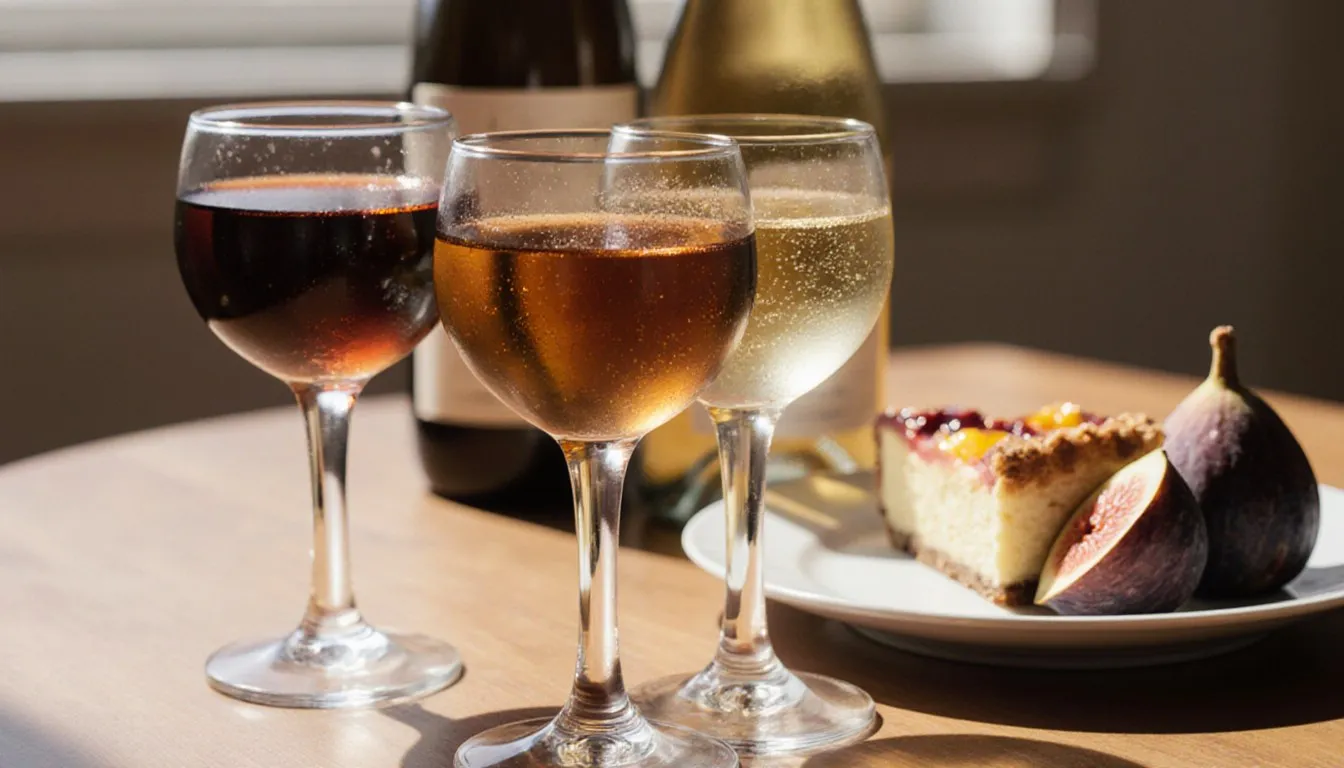
- Dessert wine: wine that finishes with noticeable sweetness, whether it is fortified or not. Sauternes, ice wine, late-harvest riesling, moscato.
Those last two overlap and that trips people up constantly. Port is fortified and sweet. Dry sherry is fortified and not sweet at all. A late-harvest riesling is sweet and not fortified. Sweetness and fortification are two separate dials, and a bottle can turn either one without touching the other. If you want the fuller picture on both, dessert and fortified wine goes through them properly.
Within still wine, the split into red, white, and rose is a matter of grape skins and how long the juice sits with them. That is genuinely it. The rest of this piece works through each category in the order you are most likely to buy them.
Red wine: what makes it red
Red wine is red because the grape skins stay in the fermenting juice. Crush a red grape and the juice that runs out is pale, nearly clear in most varieties. The color, and a good deal of the flavor and structure, comes out of the skins during fermentation, which is why winemakers talk about skin contact the way bakers talk about proofing time. Long contact, deep color, more grip. Short contact, lighter everything.
The skins also bring tannin, which is the word for that drying, slightly puckery feeling across your tongue and gums after a sip of cabernet. You get the same grip from oversteeped black tea. Tannin is a texture rather than a flavor, and it is the single most useful thing to understand about red wine at the table. Tannin binds with fat and protein, which is why a big tannic red next to a ribeye tastes softer and rounder than the same wine on its own. That is also why a heavily tannic red next to a delicate piece of fish tastes like licking a penny.
The reds you will meet most often, roughly light to heavy:
- Pinot noir: light-bodied, low tannin, red-fruited. The red that behaves like a white at the table.
- Merlot: medium-bodied, softer tannin, plummy. The one people describe as easy, and they mean it as a compliment.
- Sangiovese: the grape behind chianti. Tart red cherry, bright acid, made for tomato sauce.
- Syrah (or shiraz, same grape, different accent): dark, peppery, full.
- Cabernet sauvignon: full-bodied, firmly tannic, the classic steak wine.
Temperature is where most home cooks lose the plot on red, myself included for about a decade. The room-temperature guideline, the story goes, was set in drafty European houses that ran a good deal cooler than a modern kitchen in August. A red served at 75°F tastes flabby and hot with alcohol. Twenty minutes in the fridge before pouring, particularly with lighter reds, and the fruit sharpens right up. Nobody has to know you did it. Red wine covers the varieties and their styles in depth.
White wine: the range from crisp to rich
White wine is made by pressing the juice off the skins before or very early in fermentation, which is why it stays pale and carries essentially no tannin. That leaves acid to do the structural work, and acid is what makes a white taste refreshing rather than heavy.
The useful way to think about whites is a line running from crisp to rich, because that spectrum tells you more about what is in the glass than the grape name does.
At the crisp end: pinot grigio, sauvignon blanc, albarino, dry riesling. High acid, citrus and green apple and sometimes something grassy or mineral, no oak, nothing creamy. These are the whites for anything fried, anything with lemon on it, anything with goat cheese, and any oyster you can get your hands on. They are also the whites you want in your cooking pot, though cooking with wine has its own rules worth knowing.
At the rich end: oaked chardonnay, viognier, white burgundy, some white rhone blends. Rounder, weightier, sometimes tasting distinctly of butter or vanilla or toast.
That butter note has a name, and it is worth knowing because it explains half of what people mean when they say they hate chardonnay. Malolactic fermentation trades the wine’s sharp green-apple acid for the soft, milky kind, and it throws off a compound your nose reads as butter. Nearly all red wine goes through it. With whites the winemaker decides, and with chardonnay the decision defines the style. Oak barrels add the vanilla and toast on top. A chardonnay made in stainless steel with no malolactic fermentation, like most chablis, tastes like a different grape entirely: lean, stony, sharp.
So if someone tells you they do not like chardonnay, they usually mean they do not like the buttery, oaky version, and a bottle of chablis will change their mind before the second glass. I have run this experiment at my own table more than once and the success rate is embarrassing. White wine has the full range, and how to choose white wine gets into picking for a specific occasion.
Rose wine: more than a summer fad
Rose is made from red grapes with the skins left in for a short stretch, usually hours rather than days, then pressed off before the wine takes on full red color. The winemaker is watching the color, not the clock, and pulls the juice off when it hits the shade they want. (Blending red and white together is legal for some sparkling rose and effectively nowhere else in serious winemaking.)
Because the skins came out early, rose lands in a genuinely useful middle: it has some of red’s fruit and body, but it keeps white’s acid and chill and carries almost no tannin. That combination makes it the most flexible bottle on a table where five people ordered five different things, or where you have made one of those dinners with a bit of everything on it. Charcuterie, a salad with something salty in it, grilled vegetables, salmon, a plate of leftovers.
Styles vary more than the uniform pale-pink shelf suggests. Provencal rose is bone dry, very pale, and delicate. Spanish rosado is darker and fuller. Italian rosato sits between them. And American white zinfandel, which is what a whole generation thinks of when they hear pink wine, is sweet, and there is nothing wrong with that if it is what you like. It just is not what a French rose is doing. Types of rose wine sorts out which is which, and how to serve rose wine covers the temperature question, which matters more here than people expect.
Rose is best drunk young, generally within a year or two of its vintage. It is not built to age, and a four-year-old bottle of pale Provencal rose has usually gone dull and slightly orange. Buy the current vintage and drink it.
What makes a wine sparkling?
Bubbles come from a second fermentation happening in a sealed container. The winemaker takes a finished still wine, adds a measured dose of sugar and yeast, seals it, and the yeast produces carbon dioxide that has nowhere to escape and dissolves into the wine. Open the seal and it comes out of solution as bubbles.
Where that second fermentation happens is what separates the styles and most of the price.
- The champagne method (methode traditionnelle): the second fermentation happens inside the individual bottle you eventually buy, and the wine then rests on the spent yeast cells for months or years. That contact is where the bready, biscuity, toasty character comes from. Champagne, cava, and traditional-method sparklers from anywhere in the world use this. It is slow and involves handling every bottle individually, which is a decent chunk of why it costs what it does.
- The tank method: the second fermentation happens in a large pressurized tank, and the wine is bottled under pressure at the end. Faster, cheaper, and it preserves fresh floral and fruity aromas rather than developing bready ones. Prosecco is made this way, and it is the right method for that grape.
- Carbonation: gas injected into still wine, the way soda is made. Rare in wine, mostly in the cheapest fizz, and the bubbles are coarse and disappear fast in the glass.
Champagne only comes from the Champagne region of France. Everything else is sparkling wine, regardless of quality, and some of it is superb. Cava is made by the same method in Spain for a fraction of the money, and for a batch of mimosas or a pitcher of spritzes, buying champagne is throwing money at a glass of orange juice.
The sweetness scale on sparkling labels is the one genuinely counterintuitive thing here, so commit it to memory: brut nature is the driest, then extra brut, then brut, then extra dry, then dry (sec), then demi-sec, then doux. Extra dry is sweeter than brut. Yes, it makes no sense. It is a leftover from an era when everyone drank their fizz sweet, and the labels never caught up. Brut is your safe default. Champagne and sparkling wine goes deeper, and champagne vs prosecco settles the everyday question of which to buy.
Sparkling wine is also badly underused with food. The acid and the bubbles both cut through fat, which makes a cold glass of brut and a plate of fried chicken one of the great pairings, and I will not be arguing about it.
Dessert and fortified wine: the sweet and the strong
These two get shelved together and they are not the same thing, so here is the split.
Dessert wine is sweet because sugar was left in it. There are several ways to get there. You can pick the grapes very late, when they have shriveled and concentrated on the vine (late-harvest riesling). You can let a particular beneficial mold, botrytis, dehydrate the grapes and concentrate everything in them (sauternes, tokaji). You can freeze the grapes on the vine and press out concentrated juice while the water stays behind as ice (ice wine, or eiswein). Or you can stop the fermentation early, before the yeast has eaten all the sugar (moscato d’Asti).
Fortified wine is wine with a neutral grape spirit added, and the timing of that addition decides everything. Add it partway through fermentation and it kills the yeast while sugar is still in the wine, so you get something sweet and strong. That is port. Add it after fermentation has finished and the wine is already dry, so you get something dry and strong. That is fino sherry.
Fortified wine typically runs somewhere in the high teens to low twenties in alcohol, roughly half again as strong as a table wine, so a pour is a small glass rather than a full one. That extra alcohol also acts as a preservative, which is the practical part: an opened bottle of table wine is a two or three day proposition, while an opened bottle of port or madeira keeps in the fridge for weeks. Madeira in particular is nearly indestructible, since it is deliberately heated during production and cannot be hurt much by anything your kitchen will do to it.
These are the bottles I keep, honestly, for cooking as much as for drinking. Marsala for chicken and mushrooms, dry sherry for a pan sauce, a little port in a reduction for pork. Dessert and fortified wine covers the full family, types of port wine breaks down ruby versus tawny versus vintage, and sherry wine for cooking gets specific about which sherry to reach for.
Serving temperature is where fortified wine gets mishandled most. Dry sherry belongs cold, properly cold, straight from the fridge like a white. Serving fino at room temperature is the reason people think they dislike sherry. Tawny port is lovely lightly chilled. Vintage port and the sweet styles are fine at cool room temperature.
How is wine classified beyond color?
Once you have the four categories, three more ideas cover almost everything a label is trying to tell you.
Dry versus sweet
Dry means the yeast ate essentially all the sugar during fermentation. Sweet means sugar remained, either because the winemaker stopped fermentation or because there was more sugar than the yeast could handle. Most table wine sold is dry.
The catch is that people constantly mistake fruitiness for sweetness. A big jammy zinfandel can smell like blackberry jam and be technically bone dry, with the fruit intensity fooling your brain into reading sugar. Meanwhile a German riesling with real sugar in it can taste crisp rather than sweet because the acid is so high it balances the sugar out. Sweetness and fruitiness are separate things, and the fastest way to feel the difference is to taste them side by side. It clicks in about thirty seconds.
Labels help unevenly. Sparkling wine has that formal scale (brut, extra dry, and so on). Still wine mostly does not, though riesling from Germany often carries terms like trocken (dry) or halbtrocken (off-dry), and plenty of American bottles now just print “dry” or “off-dry” on the back, bless them.
Body
Body is how heavy the wine feels in your mouth, and the classic shorthand is skim milk to whole milk to cream. Light-bodied wine feels like water with flavor in it. Full-bodied wine coats your mouth. Alcohol level, tannin, and oak all push toward fuller body, which is why higher-alcohol wines usually feel heavier.
Body matters more than grape variety for matching wine to food, because the goal is not having one overwhelm the other. Light-bodied wine with light food, full-bodied with rich food. Pinot grigio with a delicate white fish, cabernet with braised short ribs. This one rule handles more real dinners than any pairing chart I have ever taped inside a cabinet door.
Grape variety versus blend
A varietal wine is named for its grape: chardonnay, merlot, riesling. This is the American, Australian, and generally New World way of labeling, and it is the friendlier one, since the label tells you what is in the bottle. Most countries require some minimum percentage of the named grape, and the exact threshold varies by country, so a bottle labeled merlot usually has a little something else in it, which is normal and not a trick.
A blend is made from several grapes together, and the classic ones exist because the grapes cover for each other. Cabernet brings structure and tannin, merlot brings flesh and softness, and the Bordeaux blend of the two has been the reference point for centuries.
Old World bottles (France, Italy, Spain, Portugal) usually name the place rather than the grape. Chablis is chardonnay. Sancerre is sauvignon blanc. Chianti is mostly sangiovese. Rioja is mostly tempranillo. Nobody is being coy; the logic is that the place shapes the wine more than the grape does, which is arguable but deeply held. You do not have to memorize the map. Learn the six or eight place names that keep showing up in your own shopping and you have covered it. Wine basics fills in the rest of the label vocabulary.
How do I pick a type of wine for the table?
Three questions, in this order, and you will be right most of the time.
What are you eating? Match weight first. Rich food wants a fuller wine, delicate food wants a lighter one. Then think about acid: acidic food (tomato sauce, anything with a lot of lemon, a sharp vinaigrette) needs a wine with acid to match, or the wine tastes flat and dull next to it. That is why chianti works so well with red sauce and why an oaky chardonnay next to a lemony salad falls apart. Fat wants either tannin or acid to cut it, which is your permission slip for both a cabernet with steak and a brut with fried chicken.
The old rule about white with fish and red with meat is a rough approximation of the weight rule, and it holds most of the time. It falls down at the edges, which is where dinner usually lives. Salmon is rich enough for pinot noir. Chicken in a cream sauce wants a fuller white than chicken on a grill. Wine pairing gets into the specifics, and there is a good deal written on wines that go well with steak and best wines to pair with chicken if you want the particular cases.
What do the people drinking it actually like? This is the question everyone skips and it matters most. If your guests drink sweet wine, pour sweet wine. A moscato at a table of people who like moscato is a better bottle than a bone-dry sancerre nobody finishes. My own mother has taken exactly one sip of every dry red I have ever poured her in thirty years, and I finally stopped and started buying her the semi-sweet red she has liked all along. Everyone is happier.
What are you spending? Wine quality climbs quickly at the bottom of the price range and then slows down hard. Moving up a few dollars from the very cheapest tier gets you a noticeably better bottle. Moving up several tiers from the middle gets you a wine with more complexity and more age-worthiness, qualities you may or may not notice on a Wednesday with a plate of pasta. The steepest part of that curve is the low-to-mid range, and it is where nearly all the sensible buying happens.
Where the money goes further, if you want a rule to shop by: less famous regions, less famous grapes, and countries whose currency is doing you a favor. Portuguese reds, Spanish wine, southern Italian bottles, and unfashionable French appellations all deliver more per dollar than the name-brand equivalents, because you are not paying for the name on the label. Cheap red wine and best spanish wines both work this territory.
Do I need to know all this to buy wine?
No. Genuinely, no. You need three or four categories and one honest sentence about what you like, and that will get you through nearly every bottle purchase you will ever make.
Here is what nobody tells you at the wine shop counter: the person working there wants to help and is bored. “I’m making lasagna for six people, I’ve got about twenty dollars, and I don’t like anything too heavy” is a fantastic question. You will get a better bottle than you would have found on your own, and you will learn something. I have gotten some of my favorite recommendations of the last decade this way, from people whose names I never caught.
A few myths worth putting down:
- A screw cap is not a red flag. Screw caps seal more reliably than cork and eliminate cork taint entirely. Serious producers in New Zealand and Australia have used them for years on excellent wine. For anything you plan to drink within a few years, which is essentially everything you buy, the screw cap is the better closure.
- Boxed wine is fine and sometimes smart. The bag inside collapses as you pour, so the wine barely meets air, and it keeps for weeks after opening rather than days. For a house pour or for cooking, that is a real advantage over watching half a bottle go sour on the counter.
- Most wine is not for aging. The overwhelming majority of wine sold is made to be drunk within a couple of years, and holding it does nothing but make it duller. Aging benefits a small slice of structured reds and a few sweet wines. That bottle in the back of your pantry from a wedding in 2014 is not an investment.
- Expensive does not mean better for your dinner. An expensive wine is often built for aging, or for sipping slowly on its own, and can be entirely wrong next to a bowl of pasta.
- Wine legs tell you almost nothing. Those streams running down the inside of the glass are a function of alcohol content and evaporation, which is why a jammy 15 percent zinfandel weeps down the sides of a glass and a 10 percent riesling barely does. Swirling and inspecting them is theater. Fun theater, but theater.
Wine talk was built, at least partly, to make people feel like they were on the outside of something. Ignore all of that. It is fermented grape juice and it is meant to make dinner better.
What’s a good starting bottle in each type?
Styles rather than brands, since what is on your shelf depends on where you live, and prices move. Each of these is widely available and rarely expensive, and each is a fair representative of its category.
- Light red: a Beaujolais, made from the gamay grape. Bright, juicy, low tannin, happy slightly chilled. The gateway red for people who think they dislike red wine. Chill it for twenty minutes and serve it with a roast chicken.
- Full red: a Spanish rioja crianza (tempranillo, aged briefly in oak). It gives you savory, structured red wine with some age already on it for well under what a comparable Bordeaux costs.
- Crisp white: a Spanish albarino or a Portuguese vinho verde. Both are sharp, citrusy, and cheap, and vinho verde has a faint prickle of carbonation that makes it wonderful on a hot afternoon.
- Rich white: a chardonnay from a cooler region, which will have some roundness without tipping into a butter bomb. If you want the lean version instead, ask for chablis by name.
- Rose: anything dry from Provence or a Spanish rosado, current vintage. Pale is not automatically better, whatever the shelf suggests.
- Sparkling: a Spanish cava brut. Made by the champagne method, priced like a weeknight. Prosecco if you want it fruitier and softer.
- Dessert: a moscato d’Asti. Lightly sweet, gently fizzy, and light enough in alcohol that it sits well at the end of a heavy meal instead of piling on. Excellent with fruit desserts and with a plain shortbread.
- Fortified: a ten-year tawny port. Nutty, caramelly, keeps for weeks in the fridge after opening, and a small glass with a piece of hard cheese is one of the cheapest pleasures in the house.
Buy two or three of these over the next month and pay a little attention while you drink them. You will figure out your own preferences faster than any chart can tell you, and you will start recognizing what you are reaching for. That is the whole education, really. And if the education ever turns into a hobby, home winemaking is a whole world of its own.
One last practical note, since it is the question I get most: an opened bottle of still wine keeps two to three days in the fridge with the cork pushed back in, reds included. The cold slows the oxidation that turns wine flat and vinegary. Past that it is cooking wine, and there are plenty of recipes using red wine happy to take it off your hands. Waste not, want not, as my mother said about approximately everything.
Tessa Calloway
Staff Writer
Tessa Calloway has spent twenty years cooking dinner on a weeknight clock and testing the shortcuts that survive contact with a real kitchen. She believes the best recipe is the one you can make with what's already in the house, and she has strong opinions about what actually needs to be homemade (less than you think) and what always does (dressing).