Types of Liquor: What Each Bottle Is Made From and What It’s For
The types of liquor that matter, sorted by base ingredient and the job each does in a glass, plus what to buy first and how to store it.
Six bottles will cover almost everything you actually pour at home: a whiskey, one clear grain spirit (vodka or gin, whichever you like), a rum, a blanco tequila, a brandy if you’re a nightcap person, and a bottle of vermouth so the martinis and manhattans aren’t sad. Every major type of liquor starts as something fermented, grain or sugarcane or agave or grapes, and then gets run through a still. Once you know what the base ingredient was and how long it sat in oak, you can predict most of what’s going to happen in the glass.
So here’s the whole family, sorted the way I sort a spice rack: by what it’s made from, and by what job it does. Walk into the store with that in your head and you’ll buy on purpose instead of buying whatever has the prettiest label.
What actually makes a liquor a liquor?
Distillation. Beer and wine stop at fermentation, where yeast eats sugar and makes alcohol; liquor takes that fermented liquid and concentrates it in a still. The trick is a difference in boiling points. Ethanol boils at about 173°F (78°C) and water doesn’t until 212°F (100°C), so heating the wash sends alcohol-rich vapor up first, where it gets cooled back into liquid at a much higher strength. That’s the entire secret, and it’s the same physics whether you’re in a Kentucky rickhouse or a shed in Oaxaca.
Two still designs do most of the world’s work, and the difference shows up in your glass. A pot still runs in batches, like cooking a single pot of stock. It’s inefficient in the best way: it drags flavor compounds along with the alcohol, which is why pot-still Cognac, Irish pot still whiskey, and mezcal all taste emphatically of what they were made from. A column still runs continuously, stripping the spirit cleaner and higher-proof with every plate it passes. That’s what gives you vodka, most light rum, and the grain whiskey that goes into blended Scotch.
Then there’s proof, which confuses people for no good reason. In the United States, proof is exactly double the alcohol by volume, so 80 proof is 40% ABV. Most standard bottles of whiskey, gin, vodka, rum, tequila, and brandy sit right at that 80-proof line, because 40% ABV is the legal floor for those spirit classes in the US and because it’s a comfortable place to drink. Above that you get into cask-strength whiskey, navy-strength gin, and overproof rum, all of which want a smaller pour and usually a splash of water to open them up.
One more distinction worth having: a spirit, straight, has no added sugar. Add sugar and flavoring and you’ve made a liqueur, which is a different animal with a different job. More on those below.
Whiskey: the one with the most rules
Whiskey is grain, cooked into a mash, fermented, distilled, and aged in oak, and the differences between styles come down to which grain, which barrel, and which country’s rulebook. It’s the category with the most paperwork, and the paperwork is genuinely useful, because a word on a whiskey label is a legal promise about what’s inside.
The four you’ll meet most often:
- Bourbon: American, at least 51% corn, aged in new charred oak. The new barrel is why bourbon runs sweet and round, with vanilla and caramel notes that come straight out of the toasted wood. “Straight bourbon” means it spent at least two years in that barrel.
- Rye: at least 51% rye in the mash, and you can taste the swap immediately. Rye is drier, peppery, a little herbal. It’s the reason an old-fashioned made with rye tastes like it has a spine and the same drink made with a soft wheated bourbon tastes like dessert.
- Scotch: made and matured in Scotland, at least three years in oak. Single malt means malted barley from one distillery; blended Scotch marries malt with lighter grain whisky. The smoke people either love or refuse comes from drying the barley over peat fires, and plenty of Scotch has none of it at all. Which scotch brands earn a first bottle is its own study.
- Irish whiskey: made and matured in Ireland, also a three-year minimum, and often triple distilled, which is a fair part of why it lands so smooth and easy. Single pot still Irish whiskey, made from both malted and unmalted barley, is the one to try if you think you already know this category.
The whole grain-by-grain, country-by-country picture is more than one section can hold, and if you want it, the full breakdown of the types of whiskey is where it lives. Same goes for the scotch vs bourbon question, which comes up every single time someone new looks at my shelf.
Buying note from twenty years of pouring: for cocktails, a mid-shelf bourbon or rye at 90 to 100 proof beats a delicate expensive bottle every time. The extra proof carries flavor through ice, citrus, and sugar instead of getting flattened by it. Save the special bottle for a glass with nothing in it.
Vodka: what you’re actually tasting in a “neutral” spirit
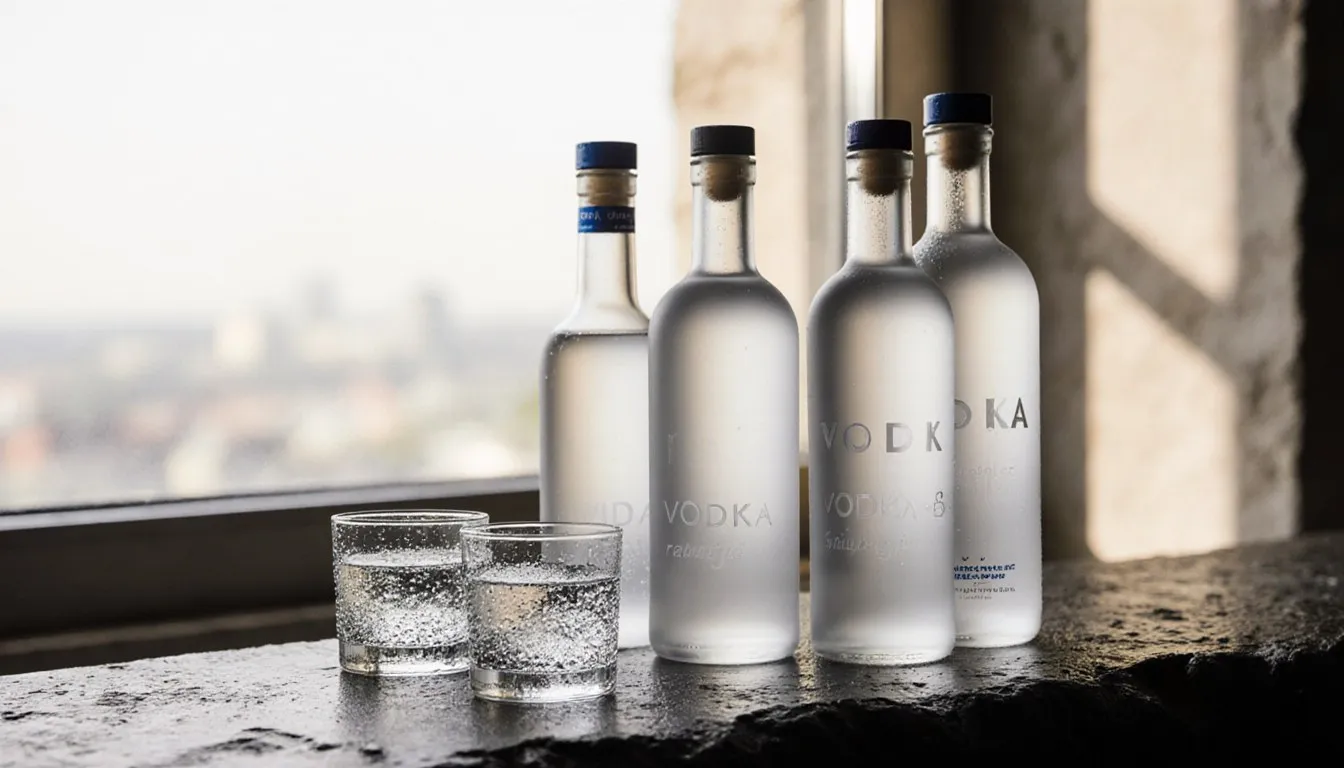
Vodka is a neutral spirit distilled to a very high strength and then cut back with water, which makes it the one category built on subtraction: the still’s whole job here is stripping out the flavor compounds every other spirit works to keep. In US terms, the base spirit comes off the still at 190 proof or above, at which point most of the character of the original ingredient has been stripped out, and then it gets diluted to bottling strength, usually 80 proof.
The base can be almost anything fermentable. Wheat and rye are traditional in the Polish and Russian houses, corn is common in American vodka, potato vodka has a rounder, slightly earthy weight to it, and there’s grape-based vodka out there too. A lot of the world’s vodka starts life as bulk grain neutral spirit that a brand buys, filters, proofs down, and bottles under a fancy-schmancy name. Worth knowing before you pay a premium for the frosted glass, and worth pouring a forty-dollar bottle blind against a twenty-dollar one before you commit to the expensive habit.
Good vodka is judged on texture and finish: how viscous it feels on the tongue, whether the burn sits in the middle of your mouth or crawls up the back of your throat, whether the last note is a faint sweetness or a chemical bite. Those are small differences, and they matter most in a martini or a vodka soda, where the spirit has nowhere to hide. Here’s how to find out where a bottle lands. Pour two vodkas at room temperature, taste them side by side, and the differences that vanish in the freezer become obvious. Cold mutes everything, flaws included. Serve vodka from the freezer if you like it that way, but don’t judge a bottle there.
Charcoal filtration is the other lever brands pull, and more filtering makes a softer, blanker spirit. Whether that’s an improvement depends entirely on whether you want your vodka to taste like anything. For the flavored bottles and how the big brands actually stack up against each other, spend ten minutes with our guide to the types of vodka before you spend forty dollars at the register.
Gin: what turns a neutral spirit into gin
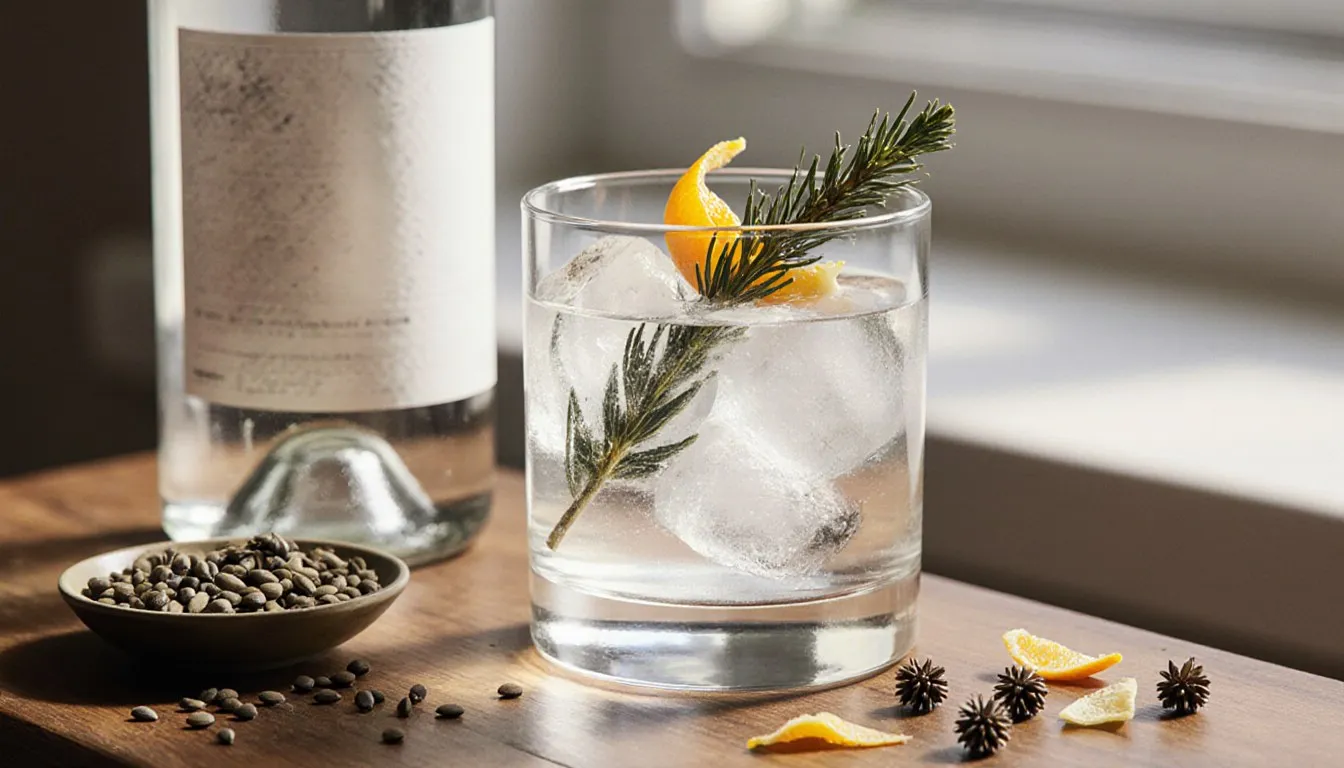
Juniper. That’s the whole rule. Gin starts from the same kind of neutral spirit as vodka, and then it’s redistilled with or steeped in botanicals, with juniper berries required to be the dominant flavor. Everything else on the botanical list, coriander seed, angelica root, orris, citrus peel, cardamom, cassia, is the distiller’s own arrangement around that piney backbone.
The style names on the label tell you roughly what to expect:
- London Dry is a production method rather than a place. All the flavor has to come in during distillation, with nothing added afterward but water, which is why these gins are crisp and unsweetened. Most of the classic cocktail gins live here.
- Plymouth is a protected designation tied to Plymouth, England, and runs a touch softer and earthier than a typical London Dry.
- Old Tom is the sweeter, rounder historical style, and it’s what a Tom Collins was originally built on.
- Genever is the Dutch ancestor, made with malt wine in the base, so it drinks halfway between gin and a light whiskey. Don’t put it in a gin and tonic expecting a gin and tonic.
- Contemporary or New Western gins dial the juniper back and push citrus, floral, or cucumber notes forward. Lovely in a highball, sometimes too shy for a proper martini.
If the phrase “I don’t like gin” is in your mouth, you probably met one aggressive London Dry in college and never went back. Try a contemporary style in a tall glass with good tonic and a grapefruit peel before you write off an entire category. Take our rundown of gin brands with you next time you’re out; it names the specific bottles I’d start a shelf on, at three different price tiers.
One practical thing about gin: it’s the most cocktail-flexible clear spirit on the shelf. A single bottle covers a martini, a negroni, a gimlet, a French 75, a Tom Collins, and a gin and tonic, and all six taste distinctly of gin rather than of whatever you mixed into them. That is a lot of range for one purchase, and it’s the reason gin earns its spot on a small shelf faster than almost anything else.
Rum: sugarcane’s spirit, in more styles than you’d guess
Rum comes from sugarcane, and the first fork in the road is which part of the cane. Most rum in the world is distilled from molasses, the thick byproduct left after sugar is crystallized out, which gives you those familiar brown-sugar and baking-spice notes. A smaller and very distinct group, the rhum agricole tradition of Martinique and the French Caribbean, ferments fresh-pressed cane juice instead, and it tastes grassy, vegetal, and alive in a way molasses rum simply doesn’t.
After that it’s mostly about aging and what happened after aging:
- White or light rum is usually young, often column-distilled, and frequently filtered to strip color back out. This is your daiquiri and mojito bottle.
- Gold rum has picked up color and some oak character from barrel time, though caramel coloring is legal and common, so color alone tells you less than you’d like.
- Dark rum is the heavier, longer-aged, richer-tasting end of the shelf, big on molasses and dried fruit. This is what you want in a rum punch, a dark ’n stormy, or a glass by itself.
- Spiced rum is rum plus flavoring, typically vanilla, cinnamon, clove, and often added sugar. Treat it as a flavored spirit rather than as a rum you’d sip and compare.
- Overproof rum runs well above the usual 40% ABV, up to 75.5% in the classic 151 bottlings. Use it in quarter-ounce doses to lift a tiki drink or float across the top, and treat it as genuinely flammable, so keep the bottle away from an open flame and never pour it near a lit burner.
Here’s the honest caveat with rum: labeling is far looser than it is for whiskey or tequila. Age statements can mean the youngest rum in the blend or the oldest depending on where it was made, and some producers add sugar after distillation without saying so. So shop by producer reputation rather than by the adjectives on the front label, and give your money to the distilleries that publish their age statements and say whether they sweeten. If you want the names, our guide to rum brands is the one I’d hand you on the way out the door.
Tequila and mezcal: agave, two ways
Both come from agave, and the difference is which agave, where, and how it’s cooked. Tequila is the narrow, tightly regulated one: it must be made from blue Weber agave, and it must be produced within a legally defined zone under Mexico’s Denominación de Origen, centered on the state of Jalisco with authorized municipalities in a handful of neighboring states. Mezcal draws on a much wider agave family, dozens of species, espadín being the most common, and comes mostly from Oaxaca and several other designated states.
The flavor split traces back to how the agave hearts, the piñas, are cooked before fermentation. Tequila producers typically steam them in ovens or autoclaves, which keeps the spirit clean and bright and peppery. Traditional mezcal roasts the piñas in earthen pits lined with hot rocks and wood, and that’s where the smoke comes from. It’s the same difference as roasting a pepper in the oven versus charring it directly over the flame, and it changes the whole dish.
Read the tequila label for two things. First, “100% de agave” means every fermentable sugar came from agave; without that phrase you have a mixto, which only needs to be 51% agave sugars, with the rest made up from other sugars. Second, the aging class:
- Blanco (silver): unaged or barely rested. The most agave-forward, and my default for margaritas.
- Reposado: “rested” in oak from two months up to a year. Softer, a little vanilla, still recognizably agave.
- Añejo: aged one to three years, darker and rounder, closer to whiskey territory.
- Extra añejo: three years and up, a sipping proposition.
Be careful with “gold” tequila. Sometimes it’s genuinely a blend of aged and unaged spirit; often it’s a mixto with caramel color added, dressed up to look aged. The full side-by-side on mezcal vs tequila covers where the two traditions actually diverge, and it’s worth reading before you spend real money on either.
Brandy and Cognac: what happens when you distill wine
Brandy is fruit’s second act. Ferment fruit into wine, distill the wine, and you have brandy; do it with grapes and you have the mainstream of the category, do it with apples, pears, cherries, or plums and you have the wide world of fruit brandies and eaux-de-vie. Age it in oak and it picks up color and softness, which is why most brandy is amber and why unaged fruit brandy like kirsch is water-clear.
Cognac is brandy’s most heavily regulated dialect. It has to come from the delimited Cognac region of western France, it’s made overwhelmingly from Ugni Blanc grapes, it’s double distilled in copper pot stills, and it’s aged in French oak for a legal minimum before it can be sold. The age classifications on the bottle are worth memorizing, because they’re specific:
- VS: the youngest eau-de-vie in the blend has spent at least two years in wood.
- VSOP: at least four years.
- XO: at least ten years, following a rule change that raised the old six-year minimum. If you learned “XO means six,” that’s out of date.
Elsewhere in the world: Armagnac, from further south in France, is often single distilled in a continuous still and tends to drink rustier and more rustic. Brandy de Jerez comes out of Spain’s sherry country and is aged in a solera, so it carries a nutty, sweet-wine echo. Calvados is Normandy’s apple brandy. Grappa and marc are pomace brandies, distilled from the skins and stems left after winemaking, which is thrift turned into a tradition. And American brandy is having a genuinely good decade.
Brandy is traditionally served at room temperature in a snifter, and the standard advice has long been to warm it in your hand rather than over a flame, since heat drives off the aromatics you paid for. Also, and I say this as someone who kept a dusty bottle for “special occasions” for an embarrassing number of years: brandy is excellent in cocktails. A sidecar is a superb drink. So is brandy in hot cider on a cold night. The deeper look at brandy and cognac gets into regions and grading properly.
The bottles that don’t sort neatly: absinthe, vermouth, and liqueurs
Three things live on the liquor shelf that don’t follow the base-ingredient logic, and each one behaves differently enough to trip people up.
Absinthe
Pour about an ounce, lay the slotted spoon and sugar cube across the glass, and drip cold water over the cube slowly, somewhere between three and five parts water to one part absinthe. The spirit goes cloudy as the anise oils drop out of solution. That clouding is the louche, and watching it arrive is half of why anyone bothers with the spoon.
Absinthe is a high-proof spirit flavored with grande wormwood, green anise, and fennel, commonly bottled between 120 and 140 proof. Treat it accordingly: one glass, built slowly, which takes roughly as long as the sugar needs to dissolve anyway.
The hallucination stories have been picked over for a century by writers and chemists, and the drink carried a US ban for most of the twentieth century over the thujone in wormwood. That ban came off in 2007, and absinthe has been legally sold here since, under a federal thujone limit. What’s in the glass is very strong booze with a heavy load of anise, which is plenty to respect on its own terms.
For the ritual done right, water ratio and slotted spoon and all, our walkthrough of how to drink absinthe has the steps in order.
Vermouth
Vermouth is wine, not liquor: a fortified, aromatized wine flavored with botanicals, traditionally including wormwood, which is where the name comes from. Sweet (red) vermouth goes into manhattans and negronis, dry (white) goes into martinis, and blanc sits in between. Because it’s wine at heart, it goes bad the way wine does. An open bottle left on the back bar for six months is why so many people think they hate martinis. Store it cold, buy small bottles, and read what is vermouth if you want the styles and producers.
Liqueurs
Liqueurs are spirits with sugar and flavoring added, and US labeling rules require a meaningful amount of that sugar, at least 2.5% by weight. This is the category with the most range: orange liqueurs like triple sec and curaçao, coffee and nut liqueurs, herbal blends built on old monastic recipes, cream liqueurs, fruit liqueurs, and the whole bitter Italian amaro family. Bitters, the dasher-bottle kind, are their own thing again, intensely concentrated and used in drops rather than ounces.
One orange liqueur is the single highest-leverage bottle a new bar can add. It turns tequila and lime into a margarita, whiskey and lemon into a sidecar’s cousin, and gin into a white lady. Buy one decent bottle and it will outperform three novelty ones.
How do you choose what to buy first?
Work backward from the drinks you already order. Write down the last five cocktails you enjoyed somewhere else, list their base spirits, and buy those. That method beats every generic starter list, because a bar full of bottles you don’t drink is just expensive shelf decoration.
Past that, three questions decide almost everything:
- How do you drink it? If you sip neat, put your money into one good bottle and drink it slowly. If you mix, buy more bottles at moderate quality, because the citrus and sugar in a cocktail will flatten out subtlety you paid extra for.
- How fast will you go through it? A bottle you’ll finish in two months justifies a splurge. A niche liqueur you’ll use twice a year does not, and it will fade in the meantime.
- What does the price actually buy? Age is the big one: barrel time costs money in warehouse space and evaporation loss, so older spirits cost more, always. Raw material matters too, since agave takes years to mature before harvest, which is why 100% agave tequila costs more than mixto. After that you’re often paying for packaging, marketing, and your state’s tax structure, which is why the same bottle can carry very different prices depending on which side of a state line you’re standing on. Compare within a category and within an age class, never across.
If you want a shape to build toward, this is the six-bottle bar I’d stock for someone starting from zero: a 90-proof-ish bourbon or rye, one clear grain spirit (gin if you like botanicals, vodka if you want it invisible), a light rum, a blanco tequila, an orange liqueur, and a small bottle of vermouth in whichever style matches your drinks. Add a bottle of aromatic bitters and you can make a startling number of classics. Everything after that is preference: an amaro because you liked one after dinner somewhere, a second whiskey because you want to taste the two side by side. Our printable liquor cabinet cheat sheet maps each family to its signature cocktail if you want something to take to the store.
And don’t let anyone make you feel small about the price tier you’re buying at. The most fun I’ve had with a cocktail shaker involved a mid-shelf bottle, a bag of limes, and no snobbery in the room.
Do you need to refrigerate or store liquor a special way?
No refrigeration required for most of it. Distilled spirits are shelf-stable at room temperature, and an unopened bottle stored properly will hold for years. Three exceptions matter: cream liqueurs, which need the fridge once opened and should be used within the window printed on the bottle; vermouth and other wine-based aperitifs, which belong in the refrigerator after opening and are best inside a month or so; and low-proof fruit liqueurs, which fade faster than a full-strength spirit.
What actually damages liquor is light, heat, and air, in that order of how often I see it happen. Sunlight will strip the color and dull the aromatics of an aged spirit sitting on a windowsill. The cabinet directly above the stove is the worst storage spot in the average kitchen, and it’s where half of us keep the bottles anyway. Pick a cupboard away from the range.
A few habits that keep bottles right:
- Store upright, always. High-proof spirit sitting against a natural cork will break it down, and a crumbled cork in a bottle of good whiskey is a genuinely bad afternoon.
- Close the cap tight. Oxygen is what slowly flattens an opened bottle. Bartenders have long worked on the assumption that an opened spirit holds its character for months rather than weeks, and that the emptier the bottle, the faster it fades.
- Decant the last third. When a bottle you care about gets down to a quarter or so, pour it into a smaller clean bottle filled close to the top. Less air, more time.
- Rinse the neck. Any bottle with sugar in it, liqueurs especially, will glue its own cap shut if you don’t wipe the threads now and then.
- Freezer is fine for vodka, and fine for aquavit, but skip it for anything you want to actually taste. Cold shuts down aroma.
An old bottle of gin at the back of the cabinet stays safe to drink for years. What it loses is flavor: after years of sitting half full, the juniper and citrus oils go dull and the whole thing flattens toward warm nothing. A bottle that smells like very little and tastes like less has lost its aromatics, and it will do more for a pan sauce or a pot of steamed clams than for a martini. Cook with it or pour it out.
Buy one bottle from each family that suits how you drink, keep them dark, upright, and capped, and you’ll have a bar that works on a Tuesday and holds up on a Saturday. My mother used to say a well-run kitchen is one where nothing sits around getting old, and she was talking about the vegetable drawer, but the same logic holds three feet to the left. (Everything above assumes you’re of legal drinking age and pouring for people who are too.)
Tessa Calloway
Staff Writer
Tessa Calloway has spent twenty years cooking dinner on a weeknight clock and testing the shortcuts that survive contact with a real kitchen. She believes the best recipe is the one you can make with what's already in the house, and she has strong opinions about what actually needs to be homemade (less than you think) and what always does (dressing).